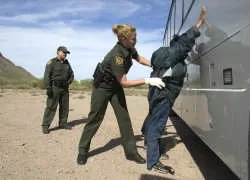
The victory reports of American border guards and security services are based on statistical data from the US Department of Justice for February 2008, collected and analyzed by the independent research organization Transactional Records Access Clearinghouse, which works at Syracuse University. According to its report, the Department of Homeland Security, which in addition to combating terrorism controls the US state border, has become the most effective law enforcement agency in the United States. It accounted for 60% of all arrests and detentions on American territory.
According to ministry representatives, this was made possible largely due to the experimental program Operation Streamline, introduced in December 2005, which began operating in Texas on a 338 km border section. There the border runs along the Rio Grande River. The essence of the innovation is that now illegal immigrants from Mexico caught at the border are not simply sent back home after having their fingerprints taken, but are introduced to the American legal system more closely. That is, illegal immigration is here considered not an administrative offense, as it always was in America, but a criminally punishable crime. Illegal immigrants are detained, officially charged – most often with repeated violation of the US border – and then sent to prison to await court hearings, which almost always decide on deportation. According to US law enforcement, the prospect of ending up in prison and getting a criminal record should make many Mexicans intending to swim to the American shore think twice.
After employees of the ministry's border agencies became convinced of the effectiveness of 'River Border', they extended the program to two more sections: in Arizona it was introduced in December 2006 on a 200 km stretch of the state border, and on another section in Texas (275 km long) from October 2007. According to the ministry, the results of its application are impressive: in Arizona, by the beginning of 2008, the number of detentions in the experimental area had decreased by 70%, and the same result is observed on one of the sections in Texas. On the second Texas section of 'River Border', where it began operating relatively recently, the number of detentions has already decreased by 22%.
The head of the Department of Homeland Security, Michael Chertoff, during his recent appearance before Congress, gave 'River Border' an excellent recommendation. 'This is a wonderful program, and we are working to extend it to other sections of the border,' he said. 'It has a significant deterrent effect.' US Attorney General Michael Mukasey also called the program 'very successful'. According to him, with the help of Operation Streamline, US authorities were able to demonstrate determination in the fight against border violators, who for the most part are not hardened criminals, but ordinary people trying to find work in the United States.
Despite the fact that the program currently operates only on sections that total no more than a quarter of the total length of the US-Mexico border (over 3,200 km), its application has not only turned illegal immigration into the most common criminal offense in America, but has also put the correctional system in a very difficult position. This is especially noticeable in border towns. For example, in the Del Rio prison in Texas, eight years ago there were only 180 beds. Now, after several renovations, it can accommodate about 1,500 inmates, but there are still not enough places. Southern states are experiencing a construction boom even amid the mortgage crisis – state governments are trying to reduce the shortage of places for inmates by building more and more correctional facilities. In addition, the costs of detaining and deporting illegal immigrants have increased by 148% since 2004 (from $959 million in 2004 to $2.3 billion in 2008).
If we consider that America is already the 'most incarcerated' country in the world and that with a population making up only 5% of the world's total, US prisons contain a quarter of the planet's inmates, it can be assumed that the successful application of Operation Streamline will further lead to the American justice system becoming overwhelmed in this fight for the inviolability of the country's southern borders. However, all the dreams of a Mexican illegal immigrant will come true by themselves. He will live in America, and at the government's expense.
Anton LYSENKOV.