
Whisky for ladies!
For me, it is too strong a drink with a very specific smell and taste, but I remembered the most important rule: never, if you don't want to offend all the Scottish people at once, dilute single malt whisky with Coca-Cola or something similar. Blended whisky – you can, but single malt – in no case, as it is considered the highest quality and most expensive.
But even whisky experts themselves add a drop of water to a glass of whisky: it opens up its flavor.
This is the north wind, we are in its palms
I deliberately did not discuss the weather first, as is customary in conversations about England. I knew what awaited me when I traveled to Glasgow, so I prepared for the worst and didn't dwell on it too much. Of course, the British climate is a special thing. As they say, we have two misfortunes – fools and roads. In Foggy Albion, the roads are fine, the number of fools is the same as everywhere else, but the weather is truly the most troublesome of all troubles.
Compared to England, Glasgow is much windier and more humid. The proximity of the sea to the west and the relative openness of the landscape take their toll. The humidity is always very high, which affects hair curliness and the laundry that never dries: in Glasgow it's hard to do without a drying cabinet. Every second or third day it rains (here it's called a shower). Heavy downpours with thunderstorms almost never happen; it just drizzles and drizzles.
The weather in Glasgow likes to change scenery several times a day: sun gives way to rain, rain turns into hail (or sleet in December-January), and then the sun appears again. Hooded raincoats are the best protection. Umbrellas here are disposable, as they break on first use from gusts of wind in all directions. But you even get used to such weather and quickly stop being surprised.
Some winters occasionally treat us with a thin layer of snow, but in the Glasgow area this causes bewilderment and traffic jams. There is no Christmas from Santa Claus fairy tales with sparkling snowflakes, snowdrifts, and colorful lights here. The lights are lit, but instead of snow, it will most likely rain.
Heifers sober, girls drunk
Nevertheless, even in such capricious weather, people manage to enjoy life, have fun, and not lose heart. Glasgow is a city very rich in entertainment and other manifestations of life. It is believed that Edinburgh, located about an hour away by train, is the historical and cultural capital of Scotland, while Glasgow is the youth, nightlife, and fun capital. There are many musical gigs here, featuring both unknown and well-known bands; absolutely anyone can make it onto the stage. There is always a pub or club where you can gather an audience ready to support and listen.
Nightlife in Glasgow from Friday to Sunday is something special, even wild at first (and second and third) glance. Office workers, managers, clerks, students, whoever, let loose in clubs and pubs so much that their own mothers wouldn't recognize them. If you find yourself in the city center on a Friday or Saturday night, be prepared for crowds of drunk screaming girls with doll-like makeup and dresses barely covering the lower part of their bodies (in any, even the coldest weather). Some men like to joke about this: once a taxi driver, driving past long-haired cows grazing on a hill, said that "these are the most beautiful women in Glasgow."
By the way, about cows. Red, and sometimes brown, black, and white cows with a double coat and wide large horns (Highland cattle) were specially bred for harsh Scottish conditions. They even have a "fringe" that protects from wind and rain, and in summer from flies. These cows have long become a symbol of Scotland; they are very undemanding both in terms of food and climate.
Countryside: castles, sheep, and heather
Besides cows, in Glasgow and its surroundings there are many foxes, partridges, and squirrels – unfortunately, gray ones. On the coast you can find seals, and in the North Sea there is Atlantic salmon; Glasgow is generally a fish city, as it is close to water.
As for vegetation, for me the most pleasant symbol of Scotland is heather. It grows everywhere: in tubs on the main streets of the city and on hills descending to the lakes. When heather blooms, everything around is covered with lilac-pink small flowers. And the combination of these colors with the blue water of the lakes, dark green slopes, half-ruined stone castles, and gray clouds evokes thoughts of the harsh Middle Ages with knights and battles. And everything was absolutely the same: the same castles, the same weather, the same heather... and the same sheep.
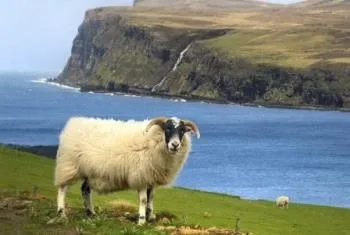
Sheep are an integral part of Scottish landscapes. There are many of them, and they are so self-confident that they are not afraid of cars or people; they graze anywhere and in any number. As soon as you leave the densely populated part of Glasgow and lush green hills open before your eyes, there will certainly be white moving dots on them.
Sheep are very much loved here, but also used from A to Z. Haggis, as I said, is made from sheep offal. The famous Scottish tartan scarves with clan check pattern are made from sheep's wool, and if the scarf is of good quality, such wool is hard to distinguish from cashmere. And, of course, the Scottish kilt is also a wool product.
In general, the kilt is an extremely beloved item even among modern Glaswegians, very reliable and comfortable. No national holiday in Glasgow or wedding is complete without kilts: rest assured, all Scottish men will wear a kilt, and each tartan will correspond to the historical Scottish clan to which they belong. Wearing a kilt with someone else's tartan is a violation; no one attempts it, to avoid being ridiculed and humiliated.
That, perhaps, is all I would like to tell you about Glasgow. I am grateful to this city for teaching me independence, teaching me to understand the initially inaccessible accent, and revealing to me Scottish culture, which differs strikingly from English culture and to which I have become strongly attached.