
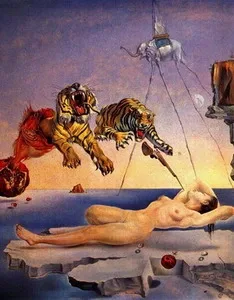
But there are geniuses of another kind - unpredictable, wild, by the very fact of their existence shifting the unshakable canons of evaluating the activities of their more prudent brethren. They are geniuses of madness, the very madness to which we later sing glory. Their creations are seasoned with a pinch of recklessness, their lives exude a chill of the beyond. It seems that all of us, educated and balanced citizens, have long known what is good and what is bad. And suddenly - hey presto! - one movement of a brilliant juggler, and the world turned upside down, once again swapping the sky and the earth of our perception.
What am I talking about? Simply that a hundred years ago, on May 11, 1904, in Figueres, a boy was born into the family of Don Salvador Dalí i Cusí and Doña Felipa Domènech. The big-eyed, chubby-cheeked cherub was named Salvador Felipe Jacinto Dalí Domènech. A hundred years later, the world bows its head before the genius of madness - the great Salvador Dalí.
Napoleonic Dreams
He was an ordinary child - but born to quench the pain of losing the previous one. What is it like to live under the shadow of the memory of a deceased elder brother? Perhaps that is why, even as a child, he strove to stand out with all his might? Dalí began to draw at the age of four. At six he wished to become Napoleon, at 10 he created his first real painting, at 15 he decided "to become Dalí".
In Figueres, Dalí took drawing lessons from the painting professor Joan Núñez, and by the age of 14 there could be no doubt about his drawing ability. When Salvador was almost 15, he was expelled from the monastic school for indecent behavior. But he managed to pass all examinations successfully, enroll in the institute (the name used in Spain for a school providing completed secondary education), and graduate with brilliant marks. Next was the Madrid Academy of Fine Arts. Salvador was expelled five years later "for freethinking" - as the faculty claimed, or "because they could not teach me anything" - as the young and cheeky Dalí claimed.
From then on, he went his own way. In 1925, his first solo exhibition took place at the Dalmau Gallery: 27 paintings and five drawings of an unknown style and direction. In 1926, the artist left for Paris, where the first paintings of the real Dalí - "Honey Is Sweeter than Blood" and "The Bright Joys" - would see the light of day.
He did not wish to bend to the world. And the world, in turn, did not pay too much attention to Salvador Dalí's appearance among the people. There was only one way out - the creation of a world of his own. And the genius created it - the world of surrealism, the world of super-reality. And he gave it to us.
Creation of the World
It is difficult to write about Dalí's paintings - it is better to look at them. In the world he created, the artist easily mixed space and time. Time freezes like viscous tar, and objects flow and change before our eyes. He invited into his world Christ and Columbus, refined Raphael and angular Picasso, American sex symbol Mae West and an ordinary atomic bomb.
But he felt cramped within the confines of traditional painting. And with his closest friend Luis Buñuel, Salvador worked on creating the film "Un Chien Andalou". Among the most shocking shots is a scene, still famous today, that Dalí, as is known, came up with - a human eye cut in half with a razor blade. Decomposing donkeys flickering in other scenes - that is also Dalí's contribution to the creation of the film. It was he who created the famous surrealist dream sequence in Alfred Hitchcock's film "Spellbound".
He dabbled in interior design, created costumes and sets for the Monte Carlo Ballet. And Dalí personally decorated the luxurious apartment of the cosmetics queen Helena Rubinstein. He created such striking and outrageous things as the lip sofa, the shoe hat, a floor lamp in the shape of a champagne glass, and many others that appeared on the pages of the most famous magazines. Images from his world slowly began to penetrate our world.
What kind of artist was he? Some consider Salvador Dalí's painterly achievements to be surrealist kitsch, others consider them the pinnacle of technical and conceptual sophistication, a treasure trove of images and discoveries. Dalí himself called his work the paranoid-critical method. As the artist claimed, he freed himself from subconscious images like a madman. But "the difference between me and a madman is that a madman lives in a peculiar world of fantasies - he lives in a room located next to reality. When I enter that room, I know where I am now; but I leave the door open. A truly mad person cannot get out of there - for him that door is forever locked."
What kind of man was he? Dalí's nickname was Avida Dollars (Money Lover) - yet he gave his paintings to museums for free. He made a royal gift to his own backwater Figueres - the famous "house with eggs", a place of eternal pilgrimage for crowds of curious tourists. In that place everything is bizarre - the paintings, the halls, the sculptures, and the building itself. Dalí did not want tours to be held there - everyone should see what they can.
He was painfully shy - and stunned the imagination of those around him with the outrageousness of his antics. Everyone knows how once the artist showed up at a ball held in his honor, having decorated his hat with a rotten herring; how he got off a ship carrying on his head a loaf of bread baked for the occasion; how he personally dipped a starfish in paint and publicly let it crawl across a canvas, assuring those present that they were witnessing the birth of a masterpiece. At 70, Salvador gave a "royal audience" to Khachaturian - performing in front of him a dance with sabers in his birthday suit.
Once he demanded from our world simply recognition. Now the world he created demanded much more from him - a brilliant tragic farce lasting a lifetime.
Muse for a Vampire
The Spanish artist was married to a Russian muse - once and for all. In Russian he knew only one little rhyme - as crazy as he himself was: “A ladybug flew across the sky. It flew - and fell. It fell - and crawled. There is no evil in people.” Only Dalí could imagine a ladybug flying across the sky. And only him can we believe that it is possible. Well then, shall we fly after?
“I love Gala more than my father, more than my mother, more than Picasso. And even more than money,” wrote Dalí. An ordinary woman with a Central Russian appearance, a piercing gaze and a hermetically sealed soul, thanks to this love became the image of a woman torn by the contradictions of the 20th century. Having met a poor, insecure young artist, Elena Dyakonova crossed out her entire established and prosperous life with one phrase: “We will never part again, baby.” She was 35, he was 25. A poet husband, a little daughter, a bohemian salon in Paris - all this was beaten by a trump card: the opportunity to be next to a genius, to feel with one's own skin the chill of a transcendent world.
In Dalí's life she was the only woman. He became a Galomaniac, or rather, a megalomaniac. In return, Gala became a mirror in which Dalí contemplated himself. She never gave interviews, letting her great husband enjoy absolutely all the fame alone. And he spent his whole life forcing her to be by his side. And demanded her hand. He said that it was her hand that restored strength and gave new ideas... “Give me your hand!” he shouted angrily at her, sick and weakened. And she obediently gave it. And could you become the muse of a vampire? Even if a great one?
They spent 53 years together. Dalí survived his wife by seven years. After her death, the artist stopped painting forever.
A month after Gala's death, Juan Carlos, King of Spain, awarded Dalí the Grand Cross of Charles III and the title of Marquis. Salvador asked everyone to call him Marquis Dalí de Púbol - in memory of the place where Gala rests. Eleven days after the royal decree was published, the Kingdom of Spain bought from Dalí for 100 million pesetas “Ashes Particles” and “Harlequin with a Little Bottle of Rum”. Salvador Dalí, Marquis de Púbol, died on January 23, 1989.
As he had instructed, the artist lies unburied in the crypt of the Dalí Theatre-Museum in Figueres. Salvador Dalí left all his fortune and works to Spain. A final joke, which he would have appreciated, is connected with the resting place of the great genius: they say his grave is located exactly above the women's toilet.
And both worlds - ours and his - continue to exist. Sometimes intersecting...