
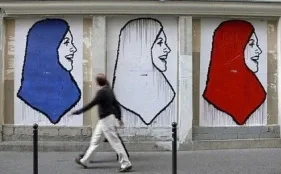
Politicians commit actions that work for the public, and it is much easier than solving real problems such as unemployment or racism
– Should this resolution be seen as the next step in affirming the secular nature of the French state?
– Certainly, as early as 1989 the first attempt was made to ban the hijab in public schools, but it was only possible in 2004. One must understand the difference between the arguments put forward in favor of this law and the reasons driving the government. The arguments used to justify the need for this law are almost always somehow connected to secularism, that is, to the idea that the French state is exclusively secular in its character. But in essence this is a very vague explanation, because no one has fully understood what the secular character of the state is and where its boundaries lie.
The second reason that was actively used to justify why the burqa and similar female Muslim garments should be banned is tied to the protection of women's rights. From this perspective, the very existence of the burqa is a sign of women's oppression, a violation of their rights by men, because there are women who are forced or persuaded to cover their faces from the world by male members of their families. Supporters of this law believe that by banning the burqa, they will solve the problem of women's oppression. The same argument was used in 2004. This is a long-standing story, and the attempt to ban the burqa is just a new phase in its development.
– Recently, a similar law was passed in Belgium. However, while in Belgium this idea was promoted mainly by the right and far-right forces, in France there is almost a national consensus regarding the burqa: both left and right want to ban it. Should we again look to secularism for an explanation?
– Yes, exactly that. Political traditions in Belgium and France are very different, despite the fact that half of Belgium speaks French. However, Belgium is more like the Netherlands or Germany than France. Belgian religious organizations have always played an important role in society, and secularism is not the foundation of the Belgian state.
In France, however, it is different. The French left has always staunchly defended secularism, and therefore supported the idea of banning the burqa. The French right supported it for other reasons, and to understand them, one must look at their political calculations. Thus, the main task of the right-centrists in France is to take votes away from far-right forces, and for this they are ready to toughen their positions on immigration and related issues.
– Does this resolution mean that France has found an answer to the question of what is more important to it: secularism or freedom of religion? Can it be said that the republicans have won over the liberals?
– This is a very good question. A few days ago, an editorial in Le Monde contained flattering words for Great Britain, where the Liberal Party, which formed a government together with the Conservatives, is returning the country to the primacy of individual freedom, so traditional for the Foggy Albion. The liberals insist on repealing a number of restrictions introduced by the Labour Party. And Le Monde said that France should do the same, follow the English example and return individual freedom to the place it once occupied. Of course, this should not be taken seriously, because France does not like to follow Great Britain, but nevertheless, this editorial confirms that the steps taken by the government raise a number of questions.
Liberalism, which protects individual freedom, is alive and well in France. The point is that the burqa issue brought together two currents: secularists and defenders of women's rights. This whole topic is presented as an attempt to protect individual freedom, namely, women's freedom. And that is precisely why the resolution was so successful, because supporters of the secular state would have supported it anyway, and those who disagreed because they respect individual freedom supported it because they were presented with arguments that this resolution protects women's freedom.
However, overall, I do not think that France will adopt a law similar to the Belgian one, which bans the wearing of the burqa in any public place, including on the streets. I think that in France it will concern specific institutions where the ability to see the face is a necessity. This is linked to the concept of proportionality: the remedy must be proportional to the problem. Thus, many French lawyers, including members of the Council of State, have stated that an outright ban on the burqa would be a disproportionate response to the problem and would be declared unconstitutional.
And this is precisely because liberalism in France has not lost its positions. Liberalism will limit the effect and scope of this law, and even if the majority of French people support it, there are a number of prominent intellectuals who criticize such initiatives.
– Research shows that many Muslim women wear the hijab or burqa out of a desire to appear respectable or to emphasize their Islamic identity as a reaction to the racism that exists in French society. These motives seem quite decent, so why has the image of these women become so negative? Can it be said that the French state is trying to avoid a discussion on morality and racism?
– Why a woman in a headscarf has become such a negative image and whether the French state is trying to divert attention from racism through these laws – these are two different topics, and both of them are very important.
Let's start with the woman in the headscarf. This problem emerged in the 1980s. It was during this period that a generation of young people born in France began demanding the right to openly express their religious affiliation. This group demanded recognition of their rights from society, and their persistence was linked to the fact that they were thus seeking their Islamic identity in France. And to some extent this was related to racism, because the native French population, raised in a secular state, could not recognize these people demanding the right to be Muslims not only in the private sphere, as their fellow citizens.
As a result, Islam became the main part of these people's identity, rather than French citizenship. To this should be added the war between France and Algeria, which did not increase understanding between these communities. In the same period, the phenomenon of 'political Islam' appeared around the world, and Algeria was no exception, where armed Islamist groups emerged. Women in headscarves began to be perceived as a kind of 'fifth column', potential agents of Khomeini's Iran or Algerian Islamists. Gradually other factors were added. For instance, parallels began to be drawn between the treatment of women in Islam and how women were treated by the Catholic Church, which feminists actively fought against in the 1970s. These same feminists later began to fight against Islam.
Regarding the second question... I agree that the politicization of this issue is to some extent an attempt to divert attention. I closely followed the discussion in 2002-2004, when the government kept repeating: we have a problem, French society is losing its identity, we must do something. At some point it no longer mattered what exactly was done, the main thing was that at least something was done. This attitude has led to the fact that today not only the burqa has been banned, but all schoolchildren are required to sing the 'Marseillaise' once a week.
These are cheap efforts to return everything to how it was before. Politicians make moves that appeal to the public, and this is much easier than solving real problems such as unemployment or racism. Thus, women in France suffer much more from domestic violence than from the imposed burqa, and fighting violence of any form would significantly ease women's lives more than this law. However, politicians prefer more symbolic solutions.
Interviewed by Yulia NETESOVA.
IA Rosbalt