
In February, Europe will see both shadows, surrealism, and avant-garde
More details about these and other events of cultural life in February are provided by Gazeta.Ru in the next issue of the review “Exhibitions of Europe”.
AUSTRIA
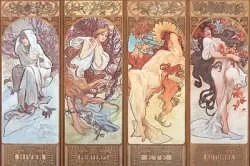
Exhibition of works by Alphonse Mucha, February 12 – June 1, Vienna. The Belvedere Museum in Vienna has prepared an exhibition of the famous Czech artist Alphonse Mucha (1860–1939), who worked in Paris, Chicago, and Prague. In the history of painting, Mucha is known primarily as a decorator and designer who published his books “Decorative Documents” and “Decorative Images” at the beginning of the 20th century. At the start of his career, Mucha worked as a theater artist, made drawings for Parisian newspapers, created posters for Sarah Bernhardt, advertising posters for Nestlé, decorative panels, calendars, programs, and even jewelry for fashionable Parisian salons. Real fame came to Alphonse Mucha after he designed the pavilion of Bosnia and Herzegovina for the 1900 World’s Fair. At the exhibition in Belvedere, visitors will see a reconstruction of this pavilion, as well as about 250 paintings, drawings, pastel portraits, photographs, decorative panels – including from the cycle “Slav Epic”, a large series of paintings where traditional folk style is supplemented with shades of symbolism. //www.belvedere.at
Retrospective exhibition of Gerhard Richter, January 30 – May 3, Vienna. An exhibition of one of the most popular and influential contemporary artists, Gerhard Richter (born 1939), opens at the Albertina Gallery in Vienna. In the early 1960s, Richter became famous for participating in high-profile actions within the new shocking art movement called “capitalist realism”. At the same time, he created a series of monochrome paintings in the style of pop art, resembling amateur photographs or images on negatives. In 1979–1983, Gerhard Richter created a color series of “abstract paintings”, in which, according to the artist’s concept, the very “process of the birth of painting” is expressively recreated. Later, the artist created a multi-style figurative painting on the theme of the transience of life with recurring images and motifs (skulls and candles). In the early 2000s, Richter was called “the most expensive living artist”, with large canvases now costing about $10 million. The exhibition at the Albertina will feature 80 paintings, about 80 watercolors, and selected drawings from museums and three large private collections, created between 1963 and 2007. Works from recent years are provided by the artist himself. //www.albertina.at
BELGIUM
Boat Show, February 7–15, Exhibition of Vintage Cars, February 21–22, Ghent. Over 200 exhibitors will present new models of motor yachts and sailboats, as well as accessories for them at the traditional February boat show in Belgian Ghent. At the Flanders Expo exhibition center, visitors can see models in operation, as well as visit halls showcasing the latest equipment and clothing for water sports that are now popular worldwide. Ticket to the exhibition costs €10.
The exhibition of vintage collector cars will take place at the same Ghent exhibition center a week after the boat show. This year’s theme is “Exotica”, so visitors will be able to see and purchase rare collector cars, as well as special literature, computer games, and models of vintage cars. Ticket to the exhibition costs €11. //www.belgianboatshow.be, www.collectioncar.be
UNITED KINGDOM
Exhibition “The Life and Legacy of Andrea Palladio”, January 31 – April 13, London. For 500 years, the word “architecture” has been associated with the name of Andrea Palladio (1508–1580), who designed and built public buildings, a theater, many private palazzos in Vicenza, several churches in Venice, and numerous villas in the adjacent regions, especially on the hills around Vicenza. In February, an exhibition dedicated to the life and work of the Italian architect opens at the Royal Academy in London, featuring large models of his buildings, original drawings, books, blueprints, as well as computer animation. Within the framework of the exhibition, special tours of London will be organized (theme – “Palladio’s Influence on London Architecture”), as well as lectures, symposia, and an architectural forum. //www.royalacademy.org.uk
Exhibition “Rodchenko and Popova: Defining Constructivism”, February 12 – May 17, London. The evolution of the aesthetics of Russian Constructivism in the works of Alexander Rodchenko and Lyubov Popova from the period 1917–1929 can be traced at the exhibition at Tate Modern in London. The exhibition will feature about 350 objects that reflect this evolution: from abstract painting to typography, utilitarian art. In 1921, Rodchenko became one of the leaders of “production art” – a radical wing of Constructivism, whose representatives sought to incorporate factors of time and space into art to achieve a “synthesis of plastic arts”. The exhibition will include paintings, posters, photographs, sketches of stage designs, book illustrations, costumes. Visitors will see works by Lyubov Popova from the series “Painterly Architectonics” and “Space-Force Constructions”, as well as monochrome canvases by Rodchenko from the 1921 exhibition “5x5=25”, his photographs and posters for films. The exhibition will then move to Thessaloniki in the summer and to Madrid in the fall. //www.tate.org.uk
GERMANY
Exhibition of sculptures by Edgar Degas, February 6 – May 3, Hamburg. French artist Edgar Degas (1834–1917) is known to the general public primarily for his pastels and oil paintings, although he began creating wax sculptures as early as the late 1860s. During the artist's lifetime, only one sculpture, "Little Dancer of Fourteen Years," was exhibited at the Sixth Impressionist Exhibition in 1881. At the end of his life, when Degas was almost blind, he turned to the genre of wax sculpture. Only after Degas's death in 1919 were some of his sculptures cast in bronze, and then over the 20th century, 20-25 casts were made from each surviving wax sculpture. The exhibition at the Hamburg Kunsthalle will present 73 sculptures and paintings by Edgar Degas, thematically and stylistically close. Dancers, bathers, and racing jockeys are the main themes of the artist's works. Unexpected angles, strange poses, the intimacy of the situation, work and rest without an outside observer – these are the plastic and stylistic subtleties that interested Degas, the artist and sculptor, and which will become the semantic center of the Hamburg exhibition. //www.hamburger-kunsthalle.de
BioFach exhibitions, February 19–22, Nuremberg. The exhibition of natural, organic food, natural cosmetics, textiles, and toys BioFach is very popular worldwide – it takes place not only in Europe but also in China, Brazil, Japan, and the USA. As last year, the exhibition will feature a "Wine Hall" where visitors can taste and evaluate the best natural wines presented by 350 exhibitors from 23 countries. Since the exhibition will be held for the 20th time this year, the organizers have prepared many surprises – live concerts, lotteries, special thematic mini-exhibitions. //www.nuernbergmesse.de
DENMARK
Retrospective exhibition of Max Ernst, February 6 – June 1, Copenhagen. At the famous European museum of contemporary art Louisiana (Humlebæk, near Copenhagen), a large retrospective exhibition dedicated to the work of Max Ernst (1891–1976) will open in early February. More than 200 paintings, watercolors, linocuts, collages, frottages, and sculptures by Max Ernst will be arranged in chronological order according to periods of his creative work. The exhibition opens with works from the 1910s, a time when Ernst was one of the founders and an active participant in Cologne Dadaism. This period is represented by watercolors and collages, which, according to the artist, were created in a technique "based on the chance encounter of two different realities on an inappropriate plane." The following halls feature surrealist works from the Parisian period of the 1920s–1930s, created using collage, frottage (sheets of paper rubbed with lead pencil over an engraving plate), as well as sculptural and painting compositions. Then come American works in the technique of "dripping," which he invented together with Masson. The exhibition concludes with French compositions created by Ernst in the 1950s–1970s. //www.louisiana.dk
SPAIN
Exhibition "Shadows," February 10 – May 17, Madrid. The thematic exhibition opening in early February at the Thyssen-Bornemisza Museum (Museo Thyssen-Bornemisza) in Madrid explores in detail the issue of chiaroscuro in painting from the Renaissance to the present day. The first section of the exhibition brings together paintings of the Renaissance that reveal chiaroscuro, which gives figures and objects depicted on a flat surface the illusion of volume and relief; paintings of Classicism, Baroque, Romanticism; and works of the Impressionists. The second section explores the work with chiaroscuro in 20th–21st century art. It includes paintings by German Expressionists and Surrealists, photographs by Man Ray and André Kertész, an installation by Christian Boltanski, as well as excerpts from films by Friedrich Wilhelm Murnau, George Orson Welles, and Peter Greenaway. //www.museothyssen.org
Exhibition of Francis Bacon, February 3 – April 19, Madrid. For the 100th anniversary of Francis Bacon's birth (1909-1992), three of the world's largest museums – Tate Britain in London, the Metropolitan Museum in New York, and the Prado in Madrid – have prepared a large retrospective exhibition of the English artist. It has already been shown in London in the fall, and will open at the Metropolitan in May. "Nothing is more terrible than life itself," Bacon asserted, so existential despair, universal loneliness become the main themes of his painting. The exhibition will feature about 150 works by the artist, including his famous triptychs and interpretations of classics – a series of works based on Diego Velázquez's painting "Portrait of Pope Innocent X." The influence of Spanish artists Goya and Velázquez on Bacon's work will be one of the main themes at the Madrid exhibition. //www.museodelprado.es
ITALY
Futurist exhibitions in Milan, February 6 – June 7, Milan. This spring, Milan will turn into the "capital of futurism," as it was exactly a hundred years ago. The movement loudly announced itself after the publication of the "Manifesto of Futurism" in the Parisian Figaro in February 1909, composed by the head of the first, Milanese group of futurist artists, Filippo Tommaso Marinetti. It is to him and his work that the exhibition "Marinetti = Futurism" is dedicated, which will open on February 12 at the Fondazione Stelline exhibition center in Milan.
The programmatic ideology of the futurists consisted in exalting the future and the new myths of modern society – machine, speed, dynamism. Following Marinetti's stated thesis ("we must fulfill our task until a new generation comes and throws us into the trash bin"), the provocative and vibrant futurist movement spread throughout Italy and then to other countries.
"Futurism: 1909–2009" – that is the name of another exhibition that will open on February 6 at Palazzo Reale in Milan. Visitors will be able to see works of the first wave of Futurists from 1909–1914, including Boccioni, Balla, Severini, Carrà, Russolo. The second Futurism, developing from 1918 to 1930 and gradually turning from "rebellious art" into official art, is represented by works by Crali, Dottori, Tato, Prampolini. In addition to these two major exhibitions, Milan will host fashion shows, theater festivals and film screenings dedicated to the centenary of futurism. //www.stelline.it, www.artpalazzoreale.it, www.informarte.org
Exhibition "Charles Darwin: 1809–2009", February 3 – May 3, Rome. At the Palazzo delle Esposizioni in Rome, an exhibition will open in early February dedicated to the 200th anniversary of Charles Darwin's birth and the 150th anniversary of the publication of his main work "On the Origin of Species by Means of Natural Selection" (1859). It was prepared jointly with specialists and staff from natural history museums in New York, Boston, Chicago, Toronto and London. Visitors will be able to learn about Charles Darwin's life and the scientific debates around his theory in sections "Worldviews Before Darwin's Theory", "The Young Naturalist", "The Voyage of the Beagle, 1831–1836", "The London Period", "Evolutionary Theory Today", "Charles Darwin and Italy", "Human Evolution". //www.darwin2009.it
FRANCE
Retro car exhibition, February 6–15, Paris. At the Paris Expo exhibition center, one of the brightest and most visited exhibitions – the exhibition of vintage cars – will be held for the 34th time. Retro cars have long been associated with works of art for many visitors. This year, the main theme is "New Life for Hundred-Year-Old Cars". In addition to unique vintage car models, bicycles and motorcycles from museums and private collections, the exhibition will feature old collectible photographs. Several exhibition stands will be dedicated to the topical issue of alternative energy sources. Exhibition ticket costs €13. //www.retromobile.fr
Asger Jorn exhibition, February 11 – May 11, Paris. A solo exhibition of Danish artist Asger Jorn (1914–1973) will open at the Centre Pompidou in Paris. Jorn began painting in the 1930s, working in Paris with Léger and Le Corbusier. Upon returning to Denmark, he became a member of the artistic group "CoBrA", and his work, becoming freer, developed towards dynamic, improvisational, vibrant art. Jorn played a leading role in several avant-garde movements such as "CoBrA" (1948–1951), "International Movement for an Imaginist Bauhaus" (1953–1957), "Situationist International" (1957–1960). For Jorn, who worked in a variety of techniques (watercolor, oil painting, printmaking, ceramics, tapestry), stylistic variability is characteristic. He moved from figurative painting to fantastic symbolism and then to expressionism. Between 1957 and 1972, Asger Jorn donated more than 400 of his works to the Danish museum Silkeborg Kunstmuseum, which will form the basis of the composition of the Paris exhibition. //www.centrepompidou.fr
SWITZERLAND
Exhibition "Hotspots" in Contemporary Art, February 13 – May 3, Zurich. It is generally believed that the world centers of contemporary art are cities such as Paris, New York and London. But, as the organizers of the exhibition at the Kunsthaus Zurich claim, since the mid-20th century, another trend has emerged: new art developed rapidly and fruitfully precisely on the "peripheries" - in Rio de Janeiro, Los Angeles, Milan and Turin. The exhibition is dedicated to art created in these cities from the mid-1950s to the end of the 1960s. Visitors will be presented with architectural projects by Brazilian Oscar Niemeyer, paintings and installations by Italian artists Lucio Fontana, Piero Manzoni, as well as Mario Merz and Michelangelo Pistoletto, who were part of the "Arte Povera" movement, and works by Los Angeles artists James Turrell, Robert Irwin, David Hockney, Dennis Hopper and many others. //www.kunsthaus.ch