
Trying to attract residents of the British capital to this exhibition at the «Millennium Dome», which does not even feature his famous golden mask, its organizers released supposedly sensational material shedding light on the circumstances of the young ruler's death 3,300 years ago. Combining modern technology with deductive methods (and where would they be without them in London!), researchers concluded that the pharaoh died of blood poisoning due to an infected wound sustained while hunting.
The conspiracy theory surrounding the young pharaoh and his murder, which had prevailed for many decades, literally since the discovery of Tutankhamun's sarcophagus by archaeologist Howard Carter in 1922, seemed far more romantic and fully corresponded to the mores that reigned in the cradle of civilization over three thousand years ago. However, the evidence base of supporters of this version turned out to be weak. Their key piece of evidence was X-rays of the mummy taken in 1968. One of them revealed a dark spot at the base of the skull, which was considered a bone fragment. However, recent computed tomography studies involving specialists from several countries found no traces of a blow to the head or other violence.
But two years ago it was revealed that before his death the pharaoh had broken his left leg just above the knee. And even the head of the Supreme Council of Antiquities of Egypt, Zahi Hawass, who very zealously monitors both the safety of the relics from the Valley of the Kings and the correct interpretation of old and new legends about the rulers from the banks of the Nile, was forced to admit that the new version has a right to exist. And the option of gangrene or sepsis developing after an open leg fracture gradually became one of the main ones.
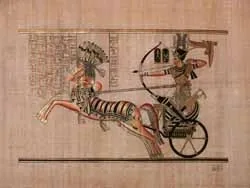
However, simultaneously Egyptologists needed to refute another persistent prejudice that reigned in historical circles. The pharaoh of the 19th dynasty was considered a frail and very sickly youth, who for this reason could hardly enjoy the pleasures of chariot hunting, during which, as is now believed, the leg injury was sustained. To this end, with the meticulousness of Sherlock Holmes, the researchers studied the list of objects found in the tomb next to Tutankhamun's mummy and looked at them in a new light. It turned out that the pharaoh's chariot was not a battle chariot but a hunting chariot, and moreover, a well-used one. The arrows also turned out to be far from ceremonial. The apotheosis of the deductive method was the comparison of the flowering dates of cornflowers and daisies in Egypt, the garland of which adorned the mummy, with the duration of the mummification process and the traditional hunting season of those times.
According to the British newspaper The Independent, everything matched: cornflowers on the banks of the Nile bloom in March to early April, they were used to decorate the mummy, whose embalming according to ancient Egyptian methods required more than two months. So the pharaoh died in January or late December, at the height of the hunting season. Consequently, researchers believe, the cause of death could indeed be an injury sustained in pursuit of a hunting trophy.