
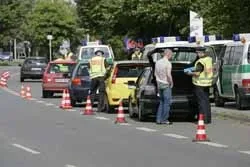
All this concerns foreigners, and not least our compatriots, about whose driving behavior the German police, for example, are increasingly sounding the alarm. Drunk drivers are also being seriously targeted in China, which will soon host the 2008 Olympics.
Speeds, traffic flows, and the number of drivers are increasing, and as a result, compulsory prevention is needed. It is precisely for prevention that the Deputy Minister of Mobility and Transport of Belgium, Etienne Schoup, wants to introduce a 0.2‰ alcohol limit for drivers with less than two years of experience, instead of the currently permitted 0.5‰. He has solid arguments for parliamentarians. In 2006, during roadside checks, 16% of drivers under 25 had alcohol levels exceeding the norm. And 21% of administrative and criminal cases for drunk driving were initiated against drivers aged 18–25.
The director of the well-known public organization 'Responsible Young Drivers,' Johan Schiers, accused the ministry of 'age discrimination.' He said that drivers in their 30s and 40s are more guilty of drunk driving. Members of the organization led by Schiers conduct educational work at discos and offer free rides home to tipsy drivers on New Year's Eve. To avoid escalating the debate, Deputy Minister Schoup clarified that his proposal concerns not 'young' but 'inexperienced' drivers. Professor Dr. Jan Pauwels of the Catholic University of Leuven, considered an expert on this issue, also asserts that it is not so much a matter of age as of driving experience. 'The effects of alcohol are especially detrimental for drivers who have less than 20,000 kilometers on their personal odometer,' he stated.
In 2001, the European Commission recommended that EU governments reduce the permissible blood alcohol content to 0.2‰ for novice drivers. But each country decides for itself, guided by the thermometer of public sentiment and traditions. Only eight EU countries, including Germany, have implemented this recommendation from Brussels.
Germany is a special case here. The medical-psychological independent examination (to which almost every driver whose license was revoked for drunk driving in this country is referred) is called the 'idiocy test' or 'test for idiots.' The translation can be twofold. To each their own, depending on what suits them better.
This term first appeared in the 1950s, when people who failed to pass the driving test after three attempts were sent for examination. Since then, almost everyone in Germany has come under suspicion of 'idiocy' – from artists to football players, including the famous Bayern striker Claudio Pizarro. This name for the examination applied to offenders of sobriety was not given as a joke, but with absolutely iron motivation. In the minds of most Germans, only an idiot would knowingly risk their job, career, reputation, health, their own life and that of others.
However, as Hauptkommissar of the Bavarian police Manfred Gottschalk stated, 'In Germany, 0.3‰ is generally considered the norm. If everything is in order and the driver has not violated the speed limit or anything else, they may not be punished even for 0.5‰. But if an accident occurs, the same officially permitted 0.3‰ is already classified as driving under the influence of alcohol.'
To the question, 'Is there a difference between a drunk German driver and a drunk Russian driver?' the commissioner replied: 'The law forbids us from making any distinctions. The only thing I can say is that among Russian drivers who got behind the wheel intoxicated, you can find very heavily drunk individuals. Which is, of course, not as typical for German motorists.'
Another German police officer, who wished to remain anonymous, told a correspondent about a driver from Russia who, having gotten lost on the autobahns, drove up to a traffic patrol himself and asked for directions. 'Looks like you've been drinking?' the police asked. 'Yesterday, but not today,' our compatriot replied. The breathalyzer showed 1.6‰, which almost automatically led to the so-called 'Idiotentest.' And passing that test is very difficult.
For example, a person is given a sheet with three identical white butterflies drawn in a row, and they are asked how they differ from each other. If you answer 'they are all the same,' you fall into a trap. 'One is on the left, another on the right, the third in the middle' – that is what you need to say. And it gets worse. The candidate for 'idiot' is asked how many trees are along the road from Munich to Nuremberg. 'Who counted them?' the examinee reasonably thinks and answers 'many.' Wrong answer. There are as many as along the road from Nuremberg to Munich. Or there is, for example, a question about how many turns there are in Germany. The correct answer: two – left and right.
It is believed that apart from Germany, the strictest "anti-alcohol" control in Western Europe is in Slovenia, Austria, Belgium, Portugal and France. But recently, China, which is preparing to host the Olympic Games, is increasingly competing with Europe in this regard. For a blood alcohol level reaching 0.2 per mille, a fine of 200 to 500 yuan or a one to three month suspension of driving license is imposed. For 0.8, up to 15 days of arrest, suspension of license for three to six months or fines of 500-2 thousand yuan are imposed. Moreover, the authorities continue to tighten penalties. A few days ago it became known that for the same 0.8 per mille one can lose the right to drive for a full five years. And it's not just about the Olympics. In 1996, according to official statistics, 89,455 people died on China's roads. The authorities admit that most accidents occur for three reasons: driver fatigue, speeding and drunk driving. Moreover, as in small Belgium, in huge China the number of young drivers who abuse alcohol is growing.
A similar situation is across the ocean. As Mаiа Zalavitiz, a senior researcher at the National Statistical Organization, which serves, in particular, US transport organizations, told a correspondent of Novye Izvestia, "almost 80% of high school students regularly drink alcoholic beverages to some extent, but no one has yet properly counted how many of them get behind the wheel while intoxicated." According to statistics, the reckless behavior of drunk youth behind the wheel kills about 3,500 people a year.
Since the middle of the last century, mountains of legislative acts aimed at combating drunk driving have begun to grow in the administrations of almost all US states. The basic principle according to which new laws are written is that drunk driving should be considered a criminal offense with all the ensuing consequences. The permitted level of alcohol content in the human body has been sharply reduced over the past two years – from 0.10% to 0.08% (i.e., from 0.1 to 0.8 per mille). Violators are punished with fines, imprisonment, house arrest, temporary or permanent suspension of driving licenses, as well as a ban on "starting the engine" of one's own car for a period set by the court (the latter is a specific American invention).
According to police statistics, the harshness of the legislation has borne fruit. Over the past two years, the number of drunk drivers detained in the US has decreased from 1.2 million to 995,000. The number of fatal accidents on the country's highways caused by them has fallen from 26,000 in 1982 to 17,000 in 2007. But Americans believe it is too early to relax. Recently, a very telling story occurred in Chicago. Schoolchildren aged 16-18 threw a party in the home of one of their classmates. In the evening, while driving his friends home in his car, an intoxicated 18-year-old youth lost control and crashed into a tree at high speed. He and his three passengers died. The father and mother of this young man, in whose house the youth had been partying, were put on trial and each sentenced to one year of probation. Professor Eric Goplerud of George Washington University, who specializes in working with adolescents, commenting on this sad story, emphasized: "Parents, and no one else, should be responsible for their children's behavior. Especially if they do not prevent their children from getting behind the wheel while intoxicated."
Mаiа Zalavitiz believes that there are other culprits for the inappropriate behavior of young drivers. In her opinion, commercial advertising in the media that promotes price discounts on alcohol needs to be controlled: "This advertising is one of the resources for the death of innocent people at the hands of drunk young drivers. Such advertising is simply harmful," asserts the traffic expert.
Alexander MINEEV, Adel KALINICHENKO,
Boris VINOKUR, Alexander KRUGLOV.