
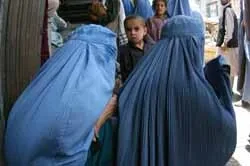
The reason is the rapidly growing number of European Muslims against the backdrop of their increasingly strong adherence to religious norms at the expense of state laws. According to forecasts, the share of these "new Europeans" in the European Union by 2050 could be a third or even half the population.
Strasbourg - a city of contrasts
The place to discuss the painful issue was the most fitting. Taking as a guide a young Strasbourg Muslim woman named Fatima, and calling on the help of the Internet, the correspondent for Itogi quickly got her bearings in the city's Islamic routes. It's simple. From the station on Rue du Maire Kuss, turn left, and in front of you is the station mosque next to an Arab café. Or - by tram to the stop "Lycée" - the "Turkey Mosque". Or like this: take the tram to the university, turn into an alley - the "Galia Mosque".
However, these establishments are called mosques only unofficially. In reality, they are prayer houses - unremarkable rooms behind a door painted green. There are not many parishioners - mostly residents of surrounding areas, predominantly young people. Strasbourg Muslims settle compactly, observing not only religious but also national clan loyalty. The station area, for example, is almost completely occupied by Turks - the numerous "Döner Kebab" eateries make your eyes water. Although there are exceptions: on the neighboring street, every now and then a Lebanese restaurant appears, and between two Turkish "Döners" there might be one Kurdish one.
The fact is that Strasbourg is a city where the French law on the separation of church and state does not apply. There are three such departments in France, by the way: Bas-Rhin, Haut-Rhin, and Moselle. Because these territories alternated between Germany and France, the management of religious organizations here is based on the concordat (treaty) concluded in 1801 by Napoleon Bonaparte and the Pope. According to it, only three religions are considered official: Catholicism, Protestantism, and Judaism. Their clergy are considered civil servants, and local authorities have a free hand in resolving all issues of the life of religious organizations.
So it is not surprising that the Russian Orthodox Church has still not received permission to build an Orthodox church in Strasbourg: for the parish of All Saints, whose rector is Father Filaret, premises are rented. Even the visit of Patriarch Alexy II last autumn did not help in advancing the issue of building an Orthodox church. That's European tolerance for you!
Muslims are in a similar situation, trying to get permission to build a mosque. Back in 2003, then-mayor Fabienne Keller proposed a deal to the leaders of the Muslim community: the right to build a mosque and a subsidy from the city budget of €600,000 (a tenth of the total cost of the project) in exchange for reading sermons in French rather than Arabic, helping in the fight against juvenile crime, and approving a ban on wearing headscarves in schools. The secretary general of the Muslim association, Abderahim al-Heloui, refused, saying, "the language of the sermon is a theological matter, and politicians should not be involved in it, and wearing the headscarf is political, and it is not for us to decide." The city hall took offense. There is still no official mosque in Strasbourg. But the local Muslims do not seem very bothered by this.
Here you especially clearly understand the main problem associated with the Islamic factor in Europe. It is that European Muslims, especially the youth, place sharia law above state law. Moreover, they understand it very literally. For example, explaining why they settle in closed communities, a young Strasbourg Arab quoted from the Quran: "Do not take Jews and Christians as friends: they are friends of one another. And whoever among you takes them as friends, then he is one of them. Indeed, Allah does not guide the unjust people!"
However, many are of the opinion that Europe itself is to blame for this state of affairs. According to the rector of the Russian Orthodox Church parish in Strasbourg, hegumen Filaret, Europeans are so shocked by Muslims' adherence to the norms of their religion because they themselves have long been less meticulous in observing Christian ones: "Not only Islam, but also Christianity affirms the necessity of following certain rules in all spheres of life." This gives rise to the illusion that Islam is a warlike religion. According to Father Filaret, the desire to observe rituals and live according to the canons is precisely what leads to the creation of communities - because "secular life does not allow observing everything fully."
But the main thing, the representative of the Russian Orthodox Church is sure, is that the conversation on this topic did take place: "Finally, Europe has taken the realities of the religious side of life seriously."
Scandal in the European family
The realities, it must be said, are not very pleasant. The terrorist attacks of recent years have forced Europeans to open their eyes - their security is threatened not by foreigners, but by fellow citizens born and raised in Europe. Responsibility for this state of affairs, according to PACE rapporteurs, lies both with European governments, "creating the ground for extremism," and with Islamic fundamentalist organizations, which have proliferated on the continent in great numbers.
The authorities are guilty of not doing enough to integrate Muslims into the "European family" and not fighting poverty in Islamic communities. The PACE Committee on Political Affairs' report was devoted precisely to how to rectify this situation. It proposes several ways to solve the problem: combating Islamophobia (primarily through the media), tracking foreign financing of Islamist associations, organizing "local training of imams," involving Muslims in public life, and forming an Islamic secular intelligentsia.
However, many experts believe that it is already too late to rectify the situation - Europe is rapidly becoming Islamized. Today, France has approximately 5 million adherents of Islam, Italy about a million, Germany over 3 million, the United Kingdom one and a half million, Switzerland at least 700 thousand, and Sweden and Spain almost half a million each. And this does not include illegal immigrants. Most notably, the number of European Muslims is growing not only due to migration influx or high birth rates, but also due to converts - ethnic Germans, French, British, and other Europeans who have adopted Islam. The latter already number in the hundreds of thousands. Incidentally, it is mainly European women who change faith - they outnumber men by a ratio of four to one.
For now, there is not even talk of full integration, let alone simple mutual understanding between the two cultures. The discussion within the walls of the Palace of Europe confirmed this. The main opponents of the PACE report were Turkish parliamentarians. And the most eloquent among them were the ladies. Özlem Türken denounced the European media for the cartoon scandals. Her delegation colleague Birgen Keleş recalled that Islamophobia in Europe began long before September 11, 'Europeans are completely unaware that Islam is a religion that contains no extremism.' According to her, Europe does not understand that Muslims can build a secular state, although among the members of the Council of Europe there are already three such countries - Turkey, Albania, and Azerbaijan.
European parliamentarians tried their best to be politically correct, though they did not always succeed. Some frightened the audience by saying that Europe is surrendering its traditional values today. Briton Michael Hancock warned that the main danger lies in the 'communal system' - the compact living of migrants and their descendants: 'In such a situation, any imam imported from abroad can influence the residents as he wishes.'
The Roman Empire in Decline
Everyone notes that Islam has already become the second religion in Europe after all Christian denominations. According to Hegumen Filaret, there is nothing surprising about this: 'States did not help the Christian church preach basic values - family, childbearing - hence the demographic crisis, the solution of which has long been linked to the migration component.' This policy has 'justified' itself: in recent years, there has been an increase in birth rates in the countries of the Old World - due to Muslim communities.
Attempts to build bridges between them and state power rarely succeed. Suffice it to recall the organization in 2003, on the initiative of then French Interior Minister Nicolas Sarkozy, of the French Council of the Muslim Faith. 'There is no place for fundamentalism at the republican table,' Sarkozy proudly declared then. And he lost: in the council elections, radicals got 40 out of 50 seats, and the loyal-to-the-authorities rector of the Paris mosque, Dalil Boubakeur, who was tipped to become the head of the council, barely scraped together the necessary number of votes. And no wonder: in France, followers of the Prophet increasingly declare that they are first and foremost Muslims, and only then French. Especially the youth, who have chosen active resistance to the authorities as a form of protest. In Strasbourg itself, every New Year's Eve, migrants from the suburbs burn cars on the city streets - this is already a tradition.
However, not all leaders of European Muslims approve of such behavior. The informal head of the continent's Muslims, Tariq Ramadan, also calls for integration into European society. Through his mother, he is the grandson of the well-known Muslim activist Hassan al-Banna, who founded the organization 'Muslim Brotherhood' in 1928 in then-British Egypt and was killed 21 years later. Tariq Ramadan himself was born in Geneva, his native language is French. His call: 'Fear not to cease being Arabs, fear to cease being Muslims.' Ramadan urges integration into European society, learning the language, getting an education. This is what they would like to hear in all government residences of EU countries. But as Lithuanian MP Egidijus Vareikis noted, 'the majority of Muslims are not ready to accept our rules.'
In attempts to find a way out of the current situation, Paris and Berlin proposed the idea of forming a Mediterranean Union. According to one of the project's authors, Nicolas Sarkozy, the union is a panacea, including against the influx of Muslim migrants. They would supposedly be able to remain in their countries, which the EU would provide with financial aid, and in the future, perhaps even invite them to join the European Union. It is no wonder that German Chancellor Angela Merkel and French Foreign Minister Bernard Kouchner spoke so enthusiastically about the Mediterranean Union from the rostrum of the Palace of Europe.
However, many participants of the PACE session stated: if they manage to revive the Roman Empire, it will be an empire in decline. An interesting impression from the discussion in PACE was left by a representative of the Russian delegation, State Duma deputy Dmitry Vyatkin: 'Europeans feel that something is wrong, but cannot do anything about it.' In his opinion, the facts cited by the report's authors indicate that for 20 million Europeans, the norms of Islam are closer and more understandable than the norms of law.
Twenty million is too many. The point of no return for the Old World seems to have already been passed. A different Europe will replace the current one, where the 'Islamic factor' will be one of the key dominants in domestic and foreign policy. 'Native' Europeans no longer hope to stop the process. And they set themselves a much more modest task - to survive the era of the 'Euro-Caliphate' at least without bloodshed.