
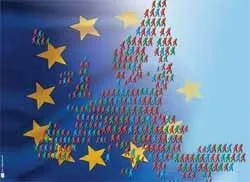
The European Union has decided to liberalize its labor market for migrants from non-EU countries. According to Gazeta.Ru, this was stated by European Commissioner for Justice, Freedom and Security Franco Frattini in an interview with EUobserver. According to him, a 'blue card' will be introduced in the EU, the holder of which will be able to work in any EU country. The European Commission will send the relevant law for approval by EU interior ministers in the fall.
The holder of the 'blue card' will be able to move from one EU country to another if there are vacancies. However, he will be able to do this only by observing a certain periodicity: in the first country he must work for at least two years, and in each subsequent one – at least one year. If the labor migrant returns to his homeland, the card will remain valid for another 4-5 years.
Brussels hopes that in this way the EU will be able to attract labor migrants from disadvantaged regions who go to work in the USA, Canada and Australia, and solve the problem of labor shortage in Europe. However, the 'blue card' will not be an absolute analogue of the 'green card' in the USA – it will not grant the right to permanent residence and an unlimited-term employment contract.
It would seem that Frattini's proposal contradicts EU policy, as its member states have been imposing restrictions on labor migration even for 'their own' in recent years. After the EU expanded by ten new members from Eastern Europe in 2004, only Ireland, Great Britain and Sweden fully opened their borders to labor migrants from these countries. Other countries either introduced quotas or completely banned the entry of labor migrants. However, over time, some countries liberalized their legislation: Greece, Italy, Portugal, Spain, and Finland also opened their borders to workers from Eastern Europe, while Belgium, Denmark, France, Luxembourg, and the Netherlands declared their readiness to do so. Austria and Germany, on the contrary, announced that they would maintain temporary restrictions for migrants from new EU member states. For Romania and Bulgaria, which joined the EU in 2007, the conditions turned out to be even stricter: even the UK, which was liberal toward their predecessors, introduced quotas for workers from these countries, stating that it would allow them to work only in the food industry and agriculture. Only Poland, Slovenia, Sweden, and Finland did not impose any restrictions on them.
However, experts see nothing paradoxical in Frattini's proposal: the EU is balancing between fighting labor shortages and curbing unwanted migration. "All European policy of recent decades in the field of labor migration is contradictory," comments Elena Tyuryukanova, a leading researcher at the Institute of Socio-Economic Problems of Population, on the European Commission's proposal. "Own labor resources are unable to meet the economic needs of European countries, but on the other hand, there is fear of an influx of migrants who may not fit into the cultural environment and provoke an aggravation of social conflicts. So the door is opened just enough as necessary."
"European countries only restrict so-called undesirable migrants – unskilled arrivals, for example from Africa," says Sergei Karaganov, Deputy Director of the Institute of Europe of the Russian Academy of Sciences and Chairman of the Presidium of the Council on Foreign and Defense Policy. "But they are very actively competing for labor migrants, creating competition in this market, including with Russia: they have already attracted millions of Ukrainians and Moldovans." Obviously, Frattini's initiative will not affect all migrants, but only highly qualified specialists – it is assumed that doctors, engineers and scientists will work under the 'blue card', the commissioner said in an interview with EUobserver.
But according to experts, such selectivity is the wrong approach: Europe needs not only highly skilled specialists. "The idea that only highly qualified personnel are needed is a myth. Exactly the same picture is observed with low-skilled labor," says Elena Tyuryukanova. "The situation on the European labor market can be depicted as an hourglass, where the upper half, expanding upward, is conditionally 'filled' with professionals, and the lower half with ordinary workers, and only the middle between them is narrowed: this is entirely the European middle class."
• Are you far from home and miss your loved ones? Set a picture on your computer desktop that will remind you of your homeland. Today you can download any screensavers from the Internet that will please your eyes and evoke only pleasant memories.