
***
- The olive tree is considered in Spain the main tree, - the guide said. - You can't say it's beautiful. That's because at a certain age the olive tree is specially pruned. The crown is shaped so that pickers can reach every branch. This is very important. The olive tree is prickly, you'll tear all your hands before you harvest. You can, of course, do it differently - 'shake it', as we say. But then the olives get bruised and they are accepted as a lower grade. The earnings, of course, are not the same.
That was already interesting. I began to glance sideways at the guide. Russian, about thirty, tall, thin. He stands in the front of the aisle, his right hand resting on the railing above the driver's cab, in his left hand a microphone, which he brings to his lips with a rock star gesture. And indeed, he sings - his speech flows freely, with jokes and lyrical digressions, almost inspired. In pauses he exchanges short phrases with the driver, showing off his Spanish. You can see that he enjoys standing like that before us, looking up at him, enjoys explaining to us, directing, edifying:
- Usually Russians consider Spaniards stingy. That's because you come here to relax and spend money. And the Spaniards here also work. Try to imagine yourself, say, installing formwork for foundations while digging pits in 35-degree heat...
At one of the stops I approached him:
- And how are you here - do you live or only work?
- I both live and work.
- Long time?
- Six years.
- And by education - a historian?
- By education - an Odessite. I worked as a steward on international lines. Once in Barcelona they let me go ashore for a walk. I walked along Las Ramblas, drank some coffee, took a sip of cognac, looked around and realized that Spain is just right for me. And six months later I moved here. At first, of course, I struggled, but now, as you see, everything is okay. The job - God grant it to everyone. I already got a residence permit, all that remains is to wait for citizenship.
A couple of days later I continued the conversation with Jordan, a Bulgarian from the travel agency that was looking after me:
- Yes, there are many Russians here. Russians, Ukrainians, Bulgarians. Spanish youth now choose the tourism business - they study languages, management, hotel management. Accordingly, problems have arisen with labor in agriculture and construction. Now that is work for illegal immigrants. Well, those of the newcomers who cannot or do not want to work in these areas work for Tangier.
- And what is that?
- A black hole. The Moroccan channel. Drugs, prostitution, car theft and smuggling across Gibraltar, and so on. Last year I went home for a month, on vacation, left my car near the house. I returned - and it was gone.
- And what?
- Nothing. The police didn't even pretend they would search. Hopeless - 90% that the car has already been ferried to Tangier. The police drew up a report for the insurance company, I got the money and bought a new car.
The conversation took place in the evening in the lobby of my hotel in Belanmaden, a resort suburb of Malaga. Listening to Jordan, I recalled my trip to Malaga.
That day I walked around the city, returned home by electric train, and while waiting for the train I smoked on the upper platform, looking at two Russians. A guy and a girl. I looked, of course, at the girl - she was very pretty. Thin, slender, with dark curly hair, in her pose, in her gestures - the grace of a spoiled teenager. But something else was fascinating - the combination with all the above of heaviness in her gaze and a slight hoarseness in her voice. It was clear that she was not a tourist, that the Spain around was not an object of admiration or even curiosity, but a living environment. A rather specific life. She stood three steps away from me, so I not only looked but also listened.
- I promised nothing to those freaks. Honestly. But this asshole decided that we agree... You tell yours that I'm not to blame. Tell them they themselves latched on.
- Alright, don't worry, - her companion said. - We'll get you off the hook. And as for your jerk... I'll call Stas. He'll take care of it.
The guy's profession was easy to guess: by the scars on his face and the marks on his shoulder left from an unsuccessful attempt to remove prison tattoos.
What turned out to be unexpected for me in Spain was the density and thickness of our, quite Russian, life. To find Russians in the same Malaga, you don't need to strain.
- Dima, how many times have I told you, don't buy sour cream from Gypsy women, only from Spanish grandmothers. Haven't you learned to tell them apart yet? - along the embankment among the strollers on a Saturday pre-evening hour walks a classic young family with a child in a stroller.
- Could you tell me how to get to the bus station from here?
- We'll tell you, why not, - they reply. - And have you been here long? How are things back home?
And within a couple of minutes a quite lively conversation started. I immediately make a summary in my head for notes. Dima. Russian. 26 years old. From Krasnodar. Works in construction - carpenter, tiler, and if needed, plumber. $1,000 per month.
- Seems like a lot of money, but here the expenses are serious too. Just for the apartment - 280. At home you get less, but you also spend accordingly.
- But while we're young, we need to see the world, - his wife Tanya joins the conversation. She is 21, and it's clear that she intends to see the world for a long time. The child will soon be a year old. A boy. Tanya, of course, does not work.
- In general, it's fine here, we don't complain, - the father of the family continues. - The police don't look our way. Russians here are law-abiding people. Mostly. If you don't break the law and just work, then you're welcome. Some illegal immigrants have children who even go to Spanish schools. The parents don't have documents, but the children study. Recently the Spaniards passed a law according to which all illegal immigrants who had work at that time received residence permits. We didn't make it to that law. We'll wait for the next one.
- And how do people become illegal immigrants anyway?
- Elementary. You can go through an employment agency. Or through acquaintances who have already settled in here. Or at your own risk: buy a one-week tour, laze around in a hotel for three or four days, then pack your things and go to the square. They'll fix you up there. Do you know where the square is?
- No.
- In the center, not far from the cathedral. You must know it. Tourists always hang around there.
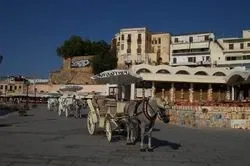
I found the square a few days later. It turned out to be that old square near the port, in the center of Malaga, with the smell of horse manure (there are tourist carriages standing there), which I had walked through a couple of times before without noticing anything special. I was looking in the wrong place. At a small area near the entrance, a bustling Russian-Ukrainian gathering was quietly buzzing, reminding me of homegrown street meetings of burned depositors. Especially when you look at the people sitting tightly on a bench filling out some forms. Others stand in small groups of three or four, seemingly apart, but you can feel they are together. I slowly walked through the crowd, chose a half-empty bench at the edge. On it sat a woman of about fifty and two younger ones.
- Can you tell me how to get to the train station from here? - I addressed the senior woman with a phrase I had already tested.
- Russian?
- Yes.
- Are you on vacation or what?
- Just vacationing. And you?
- I work.
- And how did you get set up?
- Fine.
A neatly dressed, calm Ukrainian woman of fifty-two. In Spain for a year and a half. From Lviv. She stood at a conveyor belt at the Elektron plant for thirty years. ("The plant ended. Everything was destroyed. There is work in Lviv, but you have to pay a lot for it.") She doesn't know any languages, is picking up Spanish and English on the spot. A housekeeper. The Spanish prefer middle-aged Slavic women for such work. Tidy the house, cook food, water the flowers in the garden, pick up the kids from school and kindergarten. €500 a month plus accommodation, food, and a commuter train pass. She works "interno," that is, around the clock, and there is also "externo" - these are visiting workers, "hourly workers." Once a week she comes to the square to see friends and for business:
- I want to bring my husband here. But he has no trade, he's a driver. The only work for such a one is with our gangsters. But I want him to go into construction. There's a man here, Volodya from Dubna, who promised to help, he works in construction. I've been coming here for the third time now, and he's still not here...
A man approaches our bench.
- Good afternoon, - he addresses me cautiously.
- Good afternoon.
- Are you looking for work?
- No. Just curious, - I say just as cautiously.
- There is work. We need a welder, we need bulldozer operators for work in the mountains. If you don't have a trade, we can arrange work on plantations. Housing and food provided. Take a look. If you decide, come over.
Indeed, everything is simple.
To the last question I asked the woman from Lviv then, how she would get back home afterward, she waved her hand:
- I know who to give what to get my documents fixed. It's easy.
What that "easy" actually meant, I observed a few days later at Malaga airport while going through passport control. An elderly, good-natured Spaniard sat in a glass booth. He lazily took passports, leafed through them slowly, looked thoughtful, and the queue was getting annoyed because time was passing and it would be better to go through duty-free than to linger here.
- It's impossible! Why are they all dawdling?! We wasted two hours at check-in, and now here... Sovok, honestly. One hundred percent Sovok!
A young woman standing in front of me did not take part in this seething. She seemed not to be a part of anything at all. Her five-year-old daughter tugged at her hand, and the woman, with effort, as if from somewhere far away, bent down to the girl, listened, and then froze again. The first thought that came to mind was that she had rushed off on a journey "by telegram." But that didn't fit. You could see, for example, that they had packed without haste, carefully and deliberately. And in their luggage there was none of the souvenir-tourist junk. No, this tension was not from grief-stricken shock; it was fear. It was hard to be mistaken.
And when at last her turn came, she took a convulsive, almost sobbing breath and moved forward. The customs officer, with the same benignly sleepy expression, took the passport, leafed through it, glanced at the photo, then at her, at the computer monitor, reached for the stamp to place a mark on the appropriate page, and suddenly froze. He stared at the passport as if not believing his eyes. The astonishment seemed to me a little feigned. I realized what he had seen: a more than considerable gap between the date of entry and the validity of the visa. I could only see the back of the woman with her drooping shoulders and heard the quiet whimpering of the child, who was now whining not so much from fatigue as from the unbearable tension transmitted from her mother. The customs officer sighed, glanced at the girl, then at the woman, shook his head ruefully, and sharply clicked his little device, as if waving it away: get out of my sight, let them sort you out at home. And he handed her the passport. The woman nodded her head, and I heard a quiet: "Gracias, señor."
October 2004. Greece. Crete. A small hotel in a village near the city of Chania. I am trying to explain myself in my "little English" to the girl at the front desk. She is polite, tries very hard, but does not understand.
- Moment, - she says, comes out from behind the counter, opens the restaurant door, and calls out: - Vladimir!
In the doorway appears a mighty man in a white apron, with a large head, a potato nose, a bald spot, and remnants of red hair above his ears:
- What's the problem, compatriot?
- Oh, nothing serious, in the bathroom the light bulb above the sink, but there's no switch; I searched the whole room.
- I see, - says Vladimir, walks through the hall and leans out into the garden: - Mykola! Mykola!
From the bushes appears Mykola, slim, dark-haired, in round glasses, resembling John Lennon.
- Nikolai, you can call me Kolya, - he introduces himself to me. - Welcome!
- Where did you hide the switch for the bathroom light fixture in room 27? The man searched everywhere.
- What do I remember? - says the young man. - Let's go to the room. I think we'll find it.
We found it. An elegant little gadget to the right of the mirror, which I had taken for a decorative ornament.
- It's the latest fashion, - says Kolya. - Shall I set up the TV? Before you, a German lived here and set it up for himself, but I can get the first Moscow channel from the antenna.
- No, thanks. I can't bear to look at it.
- You shouldn't, - says Kolya. - You need to love your homeland.
- I do love my homeland, it's television I have a problem with. And what about you, Kolya, do you love your homeland?
- Of course. But it's not mutual. I had to move to my historical homeland. My dad is Greek, my mom is Ukrainian, but I was listed as Jewish.
- Were there problems?
- God had mercy, no serious ones, except for one - work. After university I got a job at a factory, and it went bankrupt right away. Layoffs began, they offered me a position as an electrician. Well, if I had to go into manual labor, it would be better in Greece than in Kharkov.
- Have you already naturalized?
- Not yet. I'm an illegal.
- And Vladimir?
- Also. He's been here three years, I'm nearing two.
- Do you feel homesick?
- No. I like it here. Plenty of our people - from Kiev, Lugansk, and also Poles, Slovaks. A Slavic club, in short.
That same evening, after dinner in the hotel garden, I saw Volodya at a table by the bar.
- Have a seat, - he said to me. - So you've come alone? Keep in mind, it's the end of the season, our girls have already finished their work and gone home, and there's a problem with Greek girls.
- And that's great, I'll keep my money intact.
The conversation, naturally, turned to Russians abroad, and it lasted, with interruptions, for the entire two weeks of my vacation - in the hotel and on the beach, which was exclusively German-speaking, I never met any other Russians in those 14 days.
Being the bore that I am, I wrote down some things about Volodya. 48 years old. An apartment in Gatchina. His mother lives there, and he goes there for the winter. He worked for 15 years as a cook on a floating base in the Pacific Ocean, sailed for two years as a sailor on foreign voyages, worked in a restaurant in Alma-Ata, then returned home to Gatchina, got bored, and began looking for a place in the sun. Literally.
- I had a dream back in the Sea of Okhotsk: a little house in Crimea, to live there all summer. I was earning decent money then, I could afford it. But I didn't make it. And I don't regret it. Crete is better. True, you can't buy a house here - prices are sky-high. But the earnings, especially by our standards, are quite acceptable. For unskilled work, an illegal gets €3 an hour. Kolya is earning that now. But I'm a cook - the rates are naturally higher. And if I had a residence permit, I'd earn one and a half times more. Kolya and I are waiting for the next amnesty for illegals.
- Do you think it will be announced?
- Where else can they go! Take a walk through the local shops - every third one has a Russian-speaking saleswoman. Since our people started coming here on vacation, the Greeks can't get by without us anymore.
Volodya listened to my Spanish impressions attentively. He grunted.
- I've been to Spain, I've seen plenty of our people there. You know what their main problem is? Chicken brains. Just imagine: a person leaves his country, family, friends - and yet he can't be bothered to sit in a library to understand the laws of Spain itself! That's why Russians get ripped off. And by their own people, at that. I've seen those who were firmly convinced - someone told them, you see - that they'd earn two or three thousand bucks a month. Where do they get such numbers?! Spain, by European standards, is a poor country. You can't earn more than €20 a day on a plantation.
Take me, for example. This is what I did: I went to an agency in St. Petersburg, listened to them feed me a line of bullshit, spotted a smarter guy among them, waited until he came out into the courtyard for a smoke, and went up to him again. He explained to me in five minutes how things really were. The maximum you can bring home after a month of work in Spain is $600-700. If you're lucky. The agency can arrange a one-month tourist visa, which gives the right to do seasonal work, book you on a charter flight, and give you the coordinates of a farm where there might be a place. The rest depends only on you. And he also told me: "When you hear Russian speech in Spain, cross to the other side of the street. Don't get involved with anyone who promises you something more profitable. They'll screw you over. Consider that you're not going for earnings, because with the backbreaking work that awaits you there, those $700 you could earn at home too. Consider that you're going on a reconnaissance mission. It's better to look for work abroad yourself."
And so I went. Everything turned out just as he said. Well, almost. We got up before dawn, worked until twelve or one, then slept until five - because of the heat. Then back to the fields. I rested five days. On weekends and holidays, all work stops there. I even did a little traveling and looked around the countryside. A beautiful country. But I realized that Spain wasn't for me. I went to Turkey. Then I targeted Portugal, but at the last moment I switched to Greece, and I wasn't mistaken - work in my specialty, normal relations with my boss, and through him with the local police, so to speak, informally. Here I earn an order of magnitude more than in Spain. And besides, who would have let me into the kitchen of a Spanish hotel?
It was from Volodya that I heard what had been troubling me when I looked at our illegal immigrants. In the faces of the Russians there - almost all of them, perhaps except for Volodya - there was something crushed, tense, like the mark of a serious illness that they were forced to carry on their feet. Over all our conversations hung an unspoken but obvious question: why are we here? And Volodya turned out to be the only one of my interlocutors who tried to explain it:
- What gets me here is the order. No, not in the sense of street cleanliness or law and order. I mean the order of life. Take Crete, for instance. The land here is poor - half stone, and there are problems with fresh water. And the people - I won't say they're exceptionally clever. Ordinary. But they manage. Look at my boss - it's written all over his face that he's a slacker. And his little hotel is a picture. Order like on a battleship. The staff are all local girls - in our terms, 'village girls'. And how well-trained they are, how they rattle off in English and German! Now we Russians are also busting our backs for this order. And we manage too, but - only here. Why not back home, eh?
Looking at today's illegal immigrants, it's hard to shake the feeling that these people are setting up something like a total provocation for themselves. Consciously or unconsciously, they put themselves in extreme conditions where, like it or not, they have to give their all and obtain what they dreamed of: prosperity (by our standards, of course), inner independence, and finally the chance to bask once a year in the Canaries, a name that caresses the Russian ear. And today on those very Canaries, two breeds of "new Russians" come face to face - those who claw at the earth with their teeth, carving out a place for themselves in well-appointed Europe, and those who came here to relax and are already perceived by illegals as part of the coveted "way of life". Because for our illegal, there is no difference between German, Polish, and Russian tourists living in the same hotel and saying "morning" to each other by the elevator. And the Russian-speakers who drive past their compatriots breaking asphalt in rented Volvos and Toyotas are not necessarily bandits or embezzling officials. They are the ones who learned to live and earn money at home. But they practically don't see their compatriot-illegals, because they entered Europe not through the back door and represent a quite organic part of European life. At least for the two weeks of their tour.
I don't presume to judge or pity anyone. That's not my business. I'm interested in today's version of the answer to the old question: "Who are we in Europe?"