
Wanting is not harmful
In the town, most residents are homeowners with experience. In this sense, Irina and Sergei are almost newcomers; they have lived in their own house for only five years. Sergei is a worker at one of the production companies. Salary is around €2,000 gross. The family has two children. The daughter is still small, so the wife works part-time at a store. Her salary is €400.
- Honestly, we didn't even dream of our own house - no way, where would we get such money?! - recalls Sergei. - Of course, when we came here and saw all this beauty, luxurious doll houses, our mouths watered. But wanting, as they say, is not harmful... And then, I think, I was just lucky - I quickly found a job. Maybe also because I wasn't picky - whatever came up became my job. And all my trades are blue-collar.
- My husband was initially strongly against it - 'What are you pushing us into, do you want to put a yoke on us for life? Only over my dead body!' - continues Irina. - Then we started to figure it out together little by little - and calmed down. The main argument: why throw money away - feed a stranger who rents us housing? Say, for a rented apartment for our family we need to pay on average €600-650 per month. Plus the rent increases annually - even if by 2-3%. Over 10 years you will have to pay out more than €80 thousand, and over 20 - more than €160 thousand. No matter how you look at it, the numbers are impressive. There's even a saying: over a lifetime each of us pays the cost of a house, only some pay for their own, and some for someone else's.
Building a house without overexerting yourself
- Of course, it's one thing to calculate everything on paper, and another - practice, - continues Sergei. - So, if on paper we saved on many items, in reality - nothing: everything only turned out more expensive. I think that if you don't have a stable income, it's better not to get into this business. And it's important that two people work in the family; one person alone can't handle such expenses - you can overstrain yourself.
And another thing: you can't do without the help of a serious real estate firm. If you try it yourself, it will turn out more expensive, not to mention the inevitable headache. There are so many 'hassles', pitfalls, unaccounted moments - you'll be exhausted patching holes. Without competent consultants, you'll be paying for nothing and still saying thank you. It's best to take advice from those who already have similar experience. Our acquaintances opened our eyes to many things; they 'built' earlier and suggested a lot of useful things - what and how.
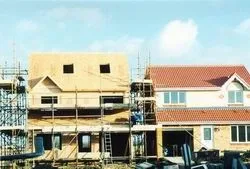
Having weighed all the pros and cons, we chose the option of a ready-made house - turnkey, standard series. This is, of course, not an individual project; there are no special frills and additional conveniences, but the cost, accordingly, is significantly lower. Our house is for two families, that is, designed for two owners, which also has its drawbacks, but it is much cheaper.
Building a house is always more difficult than buying a ready-made one. First of all, because the price stated in the contract is usually not final. Corrections are constantly and imperceptibly made to the work plan - move something there, add something here, remove something somewhere else, and so on endlessly. In any case, you are a hostage of the construction company and depend on it in every sense. It is impossible to keep track of everything, and very often you can 'get caught' on replacement of materials, reduction of volume, and often poor quality of work. The fact is that sometimes construction companies, in order to reduce their costs, hire unskilled cheap labor, and hence the quality. In any case, you need to remember the universal rule: if something is suspiciously cheap, there is surely a hidden catch - there are no miracles. Perhaps the joy of moving into the house will soon be replaced by horror at the expensive but necessary repairs. In short, you cannot do without strict control by specialists.
Five years ago, the total cost of our house with the plot was about 350 thousand marks. Now, by the most modest estimates, it costs no less than €220 thousand. In this sense, nothing has changed: housing is still valuable.
For the purchase, of course, we took a bank loan. But in addition, we took advantage of state assistance. There is a special program for families like ours who are planning to acquire their own housing. Now a family with two children can get assistance in the amount of about €23 thousand over an eight-year period. We were lucky - five years ago this amount was significantly larger. Here the trend is just the opposite - the state helps less and less.
We took a bank loan for 10 years at a relatively low interest rate - 5.3. That was the most optimal option at the time. After this term, we'll see what's left, what our capabilities will be, and then if necessary we'll take a new loan, but surely on different terms. We contributed about 25% of the total cost of the house from our own funds. This, by the way, is a very important point: the higher your own starting capital, the more favorable it is.
The total area of our plot is 250 sq. m. The house is three stories, with an area of 125 sq. m. Downstairs there is a large kitchen and a recreation room. On the second floor there are three bedrooms, a turnkey bathroom, and a toilet. Upstairs, under the sloped roof, there are two more small rooms for guests. Naturally, under the house there is a large basement and a garage.
And here is what the family's monthly expenses for maintaining their own house look like: repayment of the bank loan - €800; payment for electricity, water, street cleaning and other utility services - on average €200, including minimal insurance. Another €180 per quarter the family pays for the plot.
Choosing a house - choose your neighbor
- Five years have passed, and our main fears are behind us. It's like in any undertaking - the main thing is to make up your mind and start. Sooner or later the loan will be paid off, and then it won't be us working for the house, but the house working for us - expenses will in any case become much less than the monthly rent payment. And that gap will grow every year. But that's not all - owning your own home, I am sure, is also reliable protection against poverty. In the worst case, the house can be sold. I'm not even mentioning children - there will be something to pass on as inheritance. And in general, living in your own home, you feel better, calmer. You get more satisfaction from life, feel confidence in the future, and respect yourself more. And for children it's a good life guideline - not to lower the bar, but on the contrary, to try to raise it higher. This, by the way, is an excellent incentive not to feel like poor relatives in Germany, not to consider yourself temporary residents, hangers-on, but to be full-fledged residents.
And yet, perhaps, the main conclusion: you need to buy once and for all. The second time there may not be enough strength, money, or desire. We must remember that with all the pluses there are always minuses, often very serious, so this is an individual matter, and desire alone is not enough. For some, their own house is simply beyond their means, and for others it is not needed at all, not profitable: it is easier and calmer in public housing.
And also, when choosing a house, choose your neighbors. Many of my acquaintances have run into this "detail", turning their lives into a constant nerve-wracking experience. So choose a neighbor as carefully as a wife. With one condition: even if it is "love at first sight" - don't rush, make inquiries, take a closer look. In such cases, it is better to overdo it than to tear your hair out later.
I used to think - why is this needed? After all, no matter how you look at it, your own house is a constant hassle, worry, a bunch of problems. You either have to be able to do everything yourself or pay - in any case, there is little joy. That's how it turned out - not an option for the lazy. But now I've lived and gotten used to it. Including the constant worries. And do you know why? They don't stress me out, because everything I do, I do for myself and my children. After all, this is my house!