
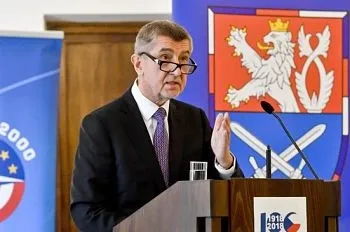
The Czech authorities refused to sign the UN migration agreement
As Radio Prague notes, back in early November, the head of the government of the Czech Republic, Andrej Babiš, stated that he did not intend to sign the UN treaty on regulating migration – following the United States, Hungary and Austria. However, he then added that he would first discuss this decision with the coalition government. Now, the refusal to sign the pact has become a legitimate official decision of the Czech Republic.
Prime Minister Andrej Babiš has repeatedly noted that the document effectively blurs the line between legal and illegal migration, and also noted that migration threatens not only security but also the culture of European countries, including the Czech Republic.
“We must protect everything that our ancestors created over the centuries – our history, our culture. It seems to me that not everyone in Europe understands this. We insist that the European Union stop accepting all these ships with migrants, then they will gradually stop sailing. We will actively fight against illegal migrant carriers. Moreover, these people should apply for political asylum from their homeland, not from EU countries after illegally crossing borders. I want to emphasize once again that we unanimously adhere to the opinion on the need to regulate migration and will not allow the introduction of this ‘false solidarity’,” said the head of the government of the Czech Republic.
Recall that the UN Global Compact for Safe, Orderly and Regular Migration was approved in July of this year – at that time, representatives of 193 countries spoke in support of the pact, with the exception of the US permanent representative. The document was to be signed in December 2018 in Morocco. Among the provisions that should be included in the document are combating discrimination against migrants, providing basic social services, and refusing to place migrants in special camps (such a step is allowed only as a last resort).
However, gradually more and more countries began to refuse to sign the Global Compact for Migration. The first European state to officially declare its disagreement with this document was Hungary. According to Hungarian Foreign Minister Péter Szijjártó, the reason is the difference in approaches between the UN and Budapest. According to him, the UN is trying to present migration as a natural, continuous and positive process that should be promoted, while in Hungary it is considered a negative process that poses a danger both to their country and to all of Europe.
On October 31, 2018, the authorities of Austria announced their refusal to sign the document, thus becoming the first Western European state not to support the UN pact. In early November, the governments of Croatia, Poland and the Czech Republic reported their doubts about signing the document.
The European Commission reacted negatively to the refusal of a number of its members to sign the UN pact. According to EC representatives, migration is a global challenge and only global solutions and global responsibility can produce meaningful results.
It should be noted that those countries that refused to sign the migration pact had previously expressed disagreement with attempts to impose external regulation of migration flows within the EU. The main concerns regarding this document are the reduction of the sovereignty of individual states.
The reasons for the Czech Republic's refusal to sign the pact were explained by the Deputy Prime Minister of the Czech Republic, Richard Brabec: “The government of the Czech Republic has decided that our country will not join the UN Global Compact for Safe, Orderly and Regular Migration. There are several reasons for this, and we have already stated them many times. I would like to note the most important one – the Czech Republic has long insisted on introducing the principle of the need to divide migration into legal and illegal. Our main goal is to ensure that illegal migration is not supported at the official level. It was this point that the Czech government had the most comments on. Since the EU ignored all our amendments and comments regarding these points in the UN pact, the Czech government decided to refuse to sign this document.”
Czech politicians also noted that many points of this pact concern the liberalization of the migration process. For example, the issue of avoiding punishment when crossing the border by illegal immigrants or refusing to place illegal migrants under arrest. Some politicians point to the creation of a privileged position for migrants in society.