
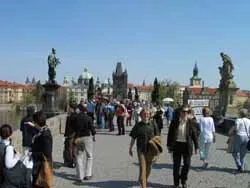
Among nearly 600 participants is 29-year-old researcher Mykhailo from the Institute of Plasma Physics of the Academy of Sciences in Prague, who is originally from Ukraine:
- The circumstances that brought me to the Czech Republic are quite ordinary in the eyes of many young Ukrainian men. I graduated from the Faculty of Physics at Uzhhorod State University and after that I got an opportunity to work in Prague. So I had to choose: either stay home and continue studying or work there, or start something new in the Czech Republic.
I made the decision mainly for two reasons: the first was purely economic. And the second – I wanted to learn something new and visit Europe. Some of my friends were already in Prague at that time, either studying or working, so I wasn't even afraid that I would be completely alone.
I arrived in the Czech Republic in 2000 and after four years here I obtained a doctoral degree at the Faculty of Mathematics and Physics of Charles University. After that I decided to stay in this country and continue working at the Institute of Atmospheric Physics in Prague, although my parents and my older brother still live in Ukraine. My education acquired in the Czech Republic opens up many more options when looking for work here or in other European countries. The Czech Republic offers many more opportunities for learning foreign languages, visiting European countries, establishing new relationships with other scientists. In general, a foreigner with a technical education and knowledge of the Czech language will very likely find a well-paid job that guarantees him and his family a relatively high standard of living in the Czech Republic.
Regarding problems, the biggest obstacle was the local language, which I did not know. However, I was quite satisfied with the rest – the studies, the dormitory. Today I already understand and speak Czech quite well. However, the lack of time for studying and the mandatory administrative procedures related to obtaining the necessary legal documents pose some difficulty.
What I found here in the Czech Republic suited me and still suits me to a large extent. Compared to the situation in Ukraine or Russia, the Czech state adequately supports its students. I won't give you a list of negative things; I don't think I can be objective.
An acquaintance of mine advised me to take part in a project of the Ministry of Labor and Social Affairs; he himself is a participant. I have been participating in the project for two years now. The project provides for obtaining a permanent residence permit for third-country nationals within 2.5 years. Since I plan to stay in the Czech Republic for a longer time – 5, 10, or perhaps more years – I would like to get a permanent residence permit as soon as possible. This makes life easier – for example, the problem of changing address or job disappears. I think that from a foreigner's point of view, many things change – you get rid of the short-term perspective and begin to perceive your life as more settled, you want to create a real home.
Maryna Kravchuk (32 years old) was born in Ukraine, not far from the border with Slovakia. She came to the Czech Republic for the first time more than 8 years ago. Initially, Maryna planned only a short trip, but she stayed forever. Now she works in a small town near Prague:
- I came with a relative who worked here, just to take a look. I had a tourist visa. At that time, many people from Ukraine were coming here, I also wanted to try. I was quite young then, I had no family and nothing kept me at home. Thanks to an agency, I quickly found a job in a company in Dobříš, where I lived for the next 5 years. My employers arranged the work permit. Since other Ukrainians already worked in this company, it was not a big problem for them.
I was a seamstress in a company that produced textiles. Over time, I got a slight promotion, and I only worked on model products that required more care, and also checked the quality of materials, etc. I felt quite happy, I had a good salary and a pleasant work team. I earned much more than in Ukraine – of course, compared to what I could buy with that salary. Six years ago, I was getting 8,000 Czech crowns a month, working 8 hours a day. And my lunch break was the same as that of my Czech colleagues.
At first, of course, there were problems with Czech. Although it is a Slavic language, I understood only the basics. But I watched television, and that helped me a lot. I always tried to speak. Now I have already passed the state exam and received a certificate proving that I am fluent in the language.
After living in the Czech Republic for 5 years, I decided to return home to Ukraine. Why? I thought that I wanted to spend my life here, start a family, raise children. I canceled my visa and work permit. I got a job as an accountant near Kyiv. After working there for three months, I decided to return to the Czech Republic, although it meant that I would have to start all over again – because the previous 5 years were not counted by the Czech government as the necessary time for obtaining a permanent residence permit. And I am very sorry that happened. Friends who stayed here have already obtained it, since it requires a five-year (previously ten-year) stay in the territory of the Czech Republic.
Fortunately, I kept in touch with people in the Czech Republic. My friend helped me get a job at the same company where I worked before, and where I was well known. On my behalf, she obtained all the necessary documents for obtaining a visa. If not for her, I might not have left Ukraine. First, I needed to get a work contract, with which I could apply to the labor office. The position was first offered to Czech applicants – no one was interested, and I was issued a work permit and it was sent to the embassy of the Czech Republic in Ukraine. Thus I got a visa. Here I had to apply to the Foreign Police Department and request a temporary residence permit.
After two years, the employer decided to move production to Bulgaria. The production was closing gradually, so I had three months to find a new job. As a foreigner, I had to find a job immediately - on the second day after being laid off, otherwise I could lose the right to work and the temporary residence permit. I was very worried about this. There were other laid-off workers, so employers from a neighboring district approached us as a group. That is how I ended up in Zdice, where I work assembling parts in cars.
At the beginning of this year, I was included in the state pilot project "Selection of Qualified Workers from Abroad." I heard about this project from my friends from Kazakhstan. I called the ministry and asked if there was interest in Ukrainian citizens, although I knew that at that time Ukrainians were not yet included in the project. After that, I regularly checked the internet to see if Ukrainians had been included in the project, and when it happened, I immediately registered. I filled out the application, and then I received a letter by mail asking me to send the originals of all documents to prove the truthfulness of the data I had included in the registration form.
I have experience of losing a job, and the project gives me protection for one month - until I find a new one, if the dismissal was not my fault. Of course, that is not much, but still, it is protection. Now I am not as afraid that the factory might close again. I think that it is not as difficult to find a job now as it used to be - there are many employment agencies. Such a project makes sense because skilled people are needed here. After all, Czechs leave the Czech Republic to work in the European Union; here it is easier, not much paperwork, you just pack up and go.
Sometimes I feel a distance when someone tells me that I am stealing jobs from local people. But I also have very good friends among Czechs.
Olena Stetsenko (27 years old) was born in Kyiv, currently works as a senior administrator for an international freight forwarding company in the Czech Republic, where she has lived since 1998. She studied economics and management at the University of Economics in Prague. She completed a distance learning course in corporate economics at the economic university in Kyiv. Since 2006, she has been participating in the state pilot project "Selection of Qualified Workers from Abroad."
- I had a student visa, which I had to renew every year. It was quite unpleasant - queues, their attitude... However, I did not have serious problems because I received a government scholarship, so my period of stay was extended without obstacles.
Even during my studies, I decided that I would work in logistics, so I contacted several companies hoping that someone would be interested in my candidacy. One of the companies made me an offer. I was looking for a job while still studying, because otherwise I would have had to leave the country within a month of its end, and I would have had no chance of getting a job. Looking for a job while in Ukraine seemed unrealistic to me.
Of course, my employers had to go through the entire process with the employment service: officially apply there, offer the available vacancy first to Czech candidates, and if none of them met the specified criteria, make an official offer to me. After that, I was able to obtain a work permit, and thanks to that, also a temporary residence permit. Completing all the formalities took almost three months, and every following year this process is repeated, although in a more simplified form. However, there is always a risk that the employer will back out at the end because they do not want such complications. If you change employer, you have to go through the entire procedure again, regardless of how long you have been in the country.
Companies are afraid to hire foreigners, so some of them choose a different strategy than I did. I did not have enough experience when I was looking for a job. Because of that, I offered to find out what was needed for participation in the project myself. But I had no idea where to start. I was very lucky that my employer agreed to arrange all these things. My friends solve this problem in a different way: when they approach an employer, they immediately say that they will take care of the paperwork themselves, and the employer just needs to fill out certain forms for them. That is, they contact the employment service themselves, but on behalf of the employer. To avoid being a burden, they practically handle everything themselves, because this process really takes a lot of time. If a company has the opportunity to hire a Czech employee, they do not want to deal with such things at all.
When I finally received a long-term residence permit, I got rid of the fear that in case of losing my job I would have to pack my things and leave immediately. Now I only have to contact the employment services once a year to extend my work permit, and then go to the police department for foreigners, where they extend my visa. This still means a lot of paperwork for me and my employer, but it is not as terrible as it was the first time.
I have been working for a logistics company for two years now, responsible for freight transport of goods throughout Europe. It is a small family business, but they have large turnovers. I learned about the government project thanks to my friends from Belarus. Citizens of that country were among the first who could register to participate in the project; for Ukrainians, it started in January 2006. I registered precisely because of the chance to obtain a permanent residence permit after 2.5 years instead of five. I will finally be able to have some sense of security in my life. I won't have to fear deportation if I lose my job or something else happens. In addition, I could take a loan for an apartment and start a family, which is currently simply impossible. Despite the fact that I already pay all taxes here, without a permanent residence permit I cannot receive child care benefits, and kindergarten will cost three times more. There are other nuances that I consider quite unfair. A permanent residence permit will give me almost all the rights of a Czech citizen, except for voting rights. Moreover, my employer has many problems because I am a foreigner.
Now the waiting period for a permanent residence permit has been shortened, and perhaps being included in the project means that I really do have a chance to obtain it. This program also provides me with some protection in case I lose my job. Now I will have a period of one month to find a new job. Of course, I need to visit the police department for foreigners.
This project is a very good chance for people who are already here. I cannot imagine someone from Ukraine having a real chance to find a job here without experience of living in the Czech Republic. One of the conditions for admission to participate in the program is having a guaranteed job and legalized stay. You are unlikely to be able to reliably find a job via the Internet. You must be physically present here and attend interviews. This means you need to obtain a visa, but you won't get one if you don't have a job. You cannot get employment with a tourist visa.
It seems to me that, first of all, the project should be aimed at people who are already here. Ukrainians living in the Czech Republic know about it but they do not apply because they do not meet the necessary criteria. They are worthy and hardworking people, but no one cares about them. Of course, they give half of their salary to intermediary companies that hire them and do other things. If these people had a chance for a more dignified life and working conditions, they would be more beneficial to the Czechs. After all, this country needs their services. They offered themselves and arrived here regardless of the presence or absence of any projects. That is why I think it is not very good to attract someone from abroad when there is such a situation here, right under our noses.
I was pleasantly surprised that the people I dealt with were very nice. Considering my experience with the police department for foreigners, I did not expect anything like that. I think that overall it is a very good idea to try to attract experienced people from abroad who would like to stay in the Czech Republic.
Martin Khyshka, Martina Kryzhkova.
Publication prepared with the assistance of
the office of the International Organization for Migration (IOM) in Ukraine.