
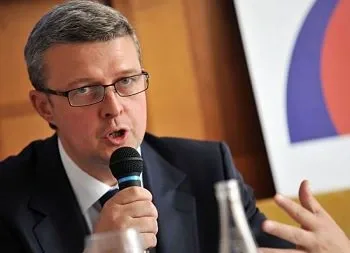
Press Secretary of the Czech Association of Small and Medium-Sized Enterprises Karel Havlíček
According to Radio Prague, at present, under Czech law, a person who has applied for asylum does not have the right to work for a year. Several months ago, the Ministry of the Interior prepared a draft of a new law reducing this period from 12 to 9 months. There is no single standard in the European Union, so in this case the Czech Republic is free to make its own decisions.
Why can't people work for a whole year? Ministry of the Interior officials gave three reasons. It is easier and simpler for people to apply for asylum than to get a work visa. Why give permission to someone who may not get asylum and will have to leave the country? There is unemployment in the country, and citizens need to be employed.
Currently, the unemployment rate in the Czech Republic is extremely low – 6.2%. Interior Minister Milan Chovanec acknowledges this fact and, as he said, "is ready to start a debate so that migrants could get the right to work in the near future." However, as the minister stressed, this right should not be a financial incentive for them, otherwise economic migrants from all over the world will flock to the Czech Republic. Prime Minister Bohuslav Sobotka reacted to the entrepreneurs' proposals with one phrase. "I am all for allowing refugees to work," he said.
Are entrepreneurs really ready to hire five thousand migrants at once? "If it were not for the current asylum legislation and administrative barriers, it would be realistic," says press secretary of the Association of Small and Medium-Sized Enterprises Karel Havlíček. "Of course, I cannot say that all five thousand refugees, or more precisely, we are now talking about 3-4 thousand, would immediately and without problems find a job. But let's look at the labor market. Yes, we have the lowest unemployment rate in several years, but right now companies, factories, various firms need 100-200 thousand employees of different specialties."
The only problem, as Karel Havlíček noted, is that refugees do not know the Czech language: "Part of the problem is also that many people from Arab countries do not know the Latin alphabet at all. But right now the labor market needs not only those with higher or secondary education. People are needed for assembly of various products, construction, agriculture, cleaning. And for these jobs, it is not necessary to take retraining courses. The employment process there would be very fast, and without a doubt, it would help many of our firms."
However, it turned out that not all Czech businessmen are ready to hire refugees. Among them is the owner of the company Best, Tomáš Březina. His company produces paving stones for streets, tiles for terraces, balconies and stairs, and so on. An editor of Czech Television asked Tomáš Březina live: "Are you ready, like others, to hire Syrians?" This question greatly surprised the entrepreneur.
"Is it really true that they plan to employ Syrian migrants? I cannot even imagine that in this wave of Syrian, Kosovar, Balkan, Afghan refugees, someone will knock on our doors tomorrow, and we will offer him a job. A standard process is possible when an immigrant comes with great humility, and in no case with demands. And at the same time, he will not be accompanied by the Minister for Human Rights Mr. Dientsbier or the Minister of Labor and Social Affairs Mrs. Marxová-Tominová, who will say that we must give the person a place. The migrant must know the Czech language and have the necessary qualifications, only then can he work for us," said Tomáš Březina.
But the company Best is in the minority. The Union of Industry and Transport, the Economic Chamber, and the Association of Small and Medium-Sized Enterprises demand that the country's leadership act decisively. "The government needs to be more active. It must react to the situation like lightning and quickly change laws. There is no point in crying and finding out the reasons for this crisis. There are many such reasons. But now we need to solve the current situation. Those refugees who come and will come to the Czech Republic should quickly get a job, especially since employers are interested in them. People must be given the right to support themselves. Not so that they stand on the street with an outstretched hand and live on social benefits," says press secretary of the Association of Small and Medium-Sized Enterprises Karel Havlíček.