
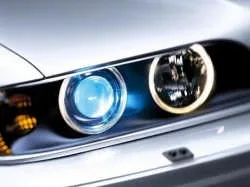
Despite its relative expense, xenon is gaining more and more popularity among motorists.
Xenon is gaining more and more popularity among motorists, despite its relative expense. Indeed, a xenon kit is significantly more expensive than halogen lamps, but xenon not only shines twice as bright as halogen, it also lasts significantly longer. Therefore, in the end, installing xenon can be justified in any car. Brand-name German xenon lamps have specific bases of some characteristic types, while Korean manufacturers have launched production of inexpensive xenon lamps with a wide variety of bases, including bi-xenon, i.e., a lamp that combines the function of low and high beam simultaneously.
Thus, domestic motorists got the opportunity to install xenon kits on any car, regardless of the headlight design. But it's not that simple, because to turn on a xenon lamp, a powerful electric charge is required; most often the car's onboard wiring is not designed to create and maintain the required voltage. Therefore, the xenon kit includes, in addition to the lamp, a xenon unit, also called an ignition unit (xenon ballast). Like xenon lamps, ignition units have been produced in several generations of models by different companies, and the quality of the ignition unit directly depends on the manufacturer.
A good high-voltage ignition unit operates silently and turns on xenon lamps, almost instantly converting standard 12 volts into 25,000 volts, which are necessary for the occurrence of an electric arc between the electrodes in the lamp filled with xenon, and after the start of illumination, 80 volts are enough. Original brand-name German ignition units ensure fast and smooth ignition of xenon lamps, which extends their service life, while they have low starting currents and work in any season, as they are not afraid of temperature fluctuations. In addition, they have a built-in matching unit that 'fools' the car's onboard computer, because many modern cars that do not have xenon in standard equipment do not provide for such voltage surges in their electrical system without compatibility matching.
In the ignition unit system, fuses and voltage stabilizers are necessarily present, which ensure uninterrupted operation of the entire xenon kit. Ignition units for motorcycles have also existed for a long time – they all have convenient mountings, small dimensions, and often the warranty on them is separate from the xenon lamps (for example, the warranty on the ignition unit may be one year, while on the xenon lamp only six months – everything directly depends on the manufacturer). Modern ignition units of the latest generations have an external voltage multiplier, they are easy to install, but still it is best to entrust the installation of the xenon kit to professionals from a car service, because adjusting headlights with xenon lamps is a delicate matter, and connecting the xenon kit to the car's electrical system has its own nuances and pitfalls.
As an advertisement