
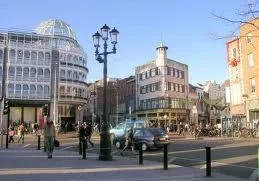
On the streets of Dublin
O.: First, about money. When I arrived here, I earned only $700 out of the promised thousand USD. With the most modest expenses, I managed to save about three hundred a month. Now, having stayed for the next term and more or less adapted to the language, I've proven myself a diligent guy, taking on various side jobs. Sometimes I reach up to 1,500 a month. But now I manage to save no more than 600 dollars.
When my wife came to me a year ago, expenses naturally increased. We planned it that way: to have a child here so that the offspring gets a normal European passport. For the first six months of pregnancy, Lera worked as an assistant in an Irish family and earned on average $700 per month. I had to give up the barracks in favor of a cheap hotel in the suburbs, where we settled with my wife. Our Patrick is already five months old. We deliberately gave him a local name, and he was born on March 17. And Saint Patrick's Day is one of the favorite Irish holidays. The child immediately received a passport with a photo, which only needs to be changed after three years. Among those coming here, there is an opinion that Ireland is almost the last country in Europe where you can still get something when a child is born. But they say that after the upcoming elections in October and the introduction of the European currency in 2002, this right may be abolished. We can only hope that it will be discussed in parliament for at least another five years with the characteristic Irish slowness. We don't want to stop at one child, but having another is not possible yet.
Unfortunately, the baby's citizenship did not provide us with permanent residence, but we obtained resident status, which allows all family members to work without a permit. This status is granted for one year and then renewed annually. After living legally in the country for five years, we can apply for naturalization, i.e., a passport. They say the application is processed within a year. That's according to the most optimistic forecasts.
P.: Yes, many, quietly raising children, simply "hatch" citizenship. I heard that Ireland takes care of its little citizens "to the fullest." They pay social compensation for everything, even for a stroller. Maybe it's rumors, I don't know. But that's not the point. I, probably, will now try to get citizenship in a simpler way. For example, I'll marry an Irish woman. By the way, Mag, are you single? (The girl, laughing, gestures: no!) Because even after getting a residence permit and having been here for 5 years, I'm tired of waiting silently. And nothing else remains. I know families that have been working here for 10 years – and nothing. It's a shame! And as for money, when coming here, an IT specialist can hardly expect an amount exceeding 17,000 per year.
And here's the breakdown. In a month, you have one and a half thousand. A third of that is tax. If you pay tax regularly for each year for five years, you can hope to get citizenship – without that, no way. Out of the remaining thousand, if you save very hard, you can put aside about 600 dollars, paying about 200 for accommodation and 200 for food (and in Ireland, believe me, they are very expensive). Husbands whose wives intend to give birth in Ireland should take this into account, because it is known that pregnant women are especially fond of food, so expenses increase accordingly. Childbirth is free, yes. But medications are amazingly expensive. Bringing your own is not very wise either, if you don't have a special permit for those medicines; customs will simply confiscate them.
So a child's passport also "costs a pretty penny." 600, later 700, 800, or even 1,000 "net" per month is not such a big amount by local standards. If you are a good specialist, you can earn that amount at home too. The only thing that can be comforting here is the "residence permit" or "citizenship" with the ensuing social benefits.
So, I think our "computer brains" would be better off trying their luck in other countries. Moreover, the recent wave of layoffs from international companies such as Intel (1,500 people), IBM + Lotus (500 people), Motorola (120), Ericsson (100), Xerox (400) should alert newcomers. It's clear that not only your compatriots are affected by this wave of cuts. But in Ireland, finding an alternative to your job is much easier than in any other European country. Also, by law, any discrimination is prosecuted: on the basis of gender, religion, nationality. Here everyone is equal in rights: both locals and visitors. Everything is fair. And the salary for people with the same experience within the same company is the same.
I often hear this from the head of the family that hosts me in Ireland as an au-pair. I am not seeking Irish citizenship or high earnings. I have fairly wealthy parents. Italian prospects also suit me fine. I am here to discover something new in culture, traditions, find new acquaintances and friends, have a good time, learn something, and live in a language environment. Later, I will study foreign languages at university.
M.: I'm not married at 25, but that's not a problem now, because usually Irish youth don't think about starting a family before 30. Only 13% get married before 30, and that, as a rule, out of necessity. The Catholic religion, protesting against abortion, urges young people to give life to children and not deprive the child of a family. If there is a mother, there must be a father. And getting permission in our country is very difficult: the church does not approve. 47% manage to start a family between the ages of 30 and 40, the remaining 40% start families at a fairly mature age and material well-being. Because in youth, everyone primarily thinks about career.
Ireland provides a good education, but even having it, women, as a rule, could not fulfill themselves because they gave birth and raised children (and four was the 'subsistence minimum'). Now mothers, without stopping giving birth, strive to find their place in the business world, hence the demand for governesses, contract assistants, cooks, and au-pairs.
For people coming to our country to work for a year, it would probably be useful to know that the concept of vacation here is literally 'stretchable'. Per year, you are entitled to at least 20 days off, plus one day for each year worked, plus 9 official public holidays. In total, about 4 weeks. Usually, they are 'stretched' to 1-2 weeks once a season. This rule also applies to newcomers.
As for citizenship, I was born in Ireland to Irish parents, so I never thought about it. But I know that those who marry an Irish citizen (it is enough to provide a marriage certificate and documents of cohabitation) become Irish citizens. This right is granted 3 years after marriage. The Irish spouse must have had citizenship for at least three years. Those married to Irish citizens have the right to live in our country and even work without a work permit. And if you have a residence permit, you need to live in the country for 5 years and pay taxes regularly. Then, no problems, probably. Everything is legal. By the way, besides laws, we also have internal rules. You've probably heard that the Irish are terrible conservatives. So, it is not customary here to stay at work after 6-7 PM, to refuse beer in a pub, to visit strip shows (since they are officially banned, as are brothels).
– So, we've come to the question of how they spend their free time after work?
O.: One person very succinctly, I think, formulated the answer to a similar question: 'pubs, pubs, pubs, church, shaping, and TV.' I would add excursions to that. Honestly, I haven't gotten used to the pub culture yet, and after work I go home to my family. Although the atmosphere there is quite pleasant.
ACCLIMATIZATION
– In Kyiv now, as in Ireland, it's rainy: for a month already, going out in the morning without an umbrella is quite risky. Everyone hopes that at least in July-August the sun will spoil us.
P.: But we have already stopped hoping. Here the weather changes every half hour: you put on sunglasses – a few minutes later you find raindrops on the lenses. You open your umbrella – the rain has already stopped. You never know how to dress. In Ireland there is no separate summer or winter clothing. Everything is off-season.
O.: Exactly. But you don't have to drag your winter wardrobe (including boots and fur coats) with you here if you are going, say, for a year. Sneakers and off-season boots will always do. The sporty style – sweaters and jeans – is quite acceptable. Most Irish dress exactly like that; there are no sharp temperature fluctuations.
M.: Well, heat is nothing, it happens. But you should see how the Irish react to snow! It is an extremely rare phenomenon here, and often the snowflakes melt before they even reach the ground. But it seems as if the whole city freezes: pedestrians immediately stop and start looking up at the sky in bewilderment. Cars stop, creating traffic jams – for drivers it is a real natural disaster, because if the snow does reach the ground, they will have real problems. Here in Ireland, there are no snowplows, like in your homeland. And we don't have street sweepers with brooms. I remember, about ten years ago, my mother, hearing on the radio that snow was expected, did not let me and my brothers go to school. The fact is that once in her youth she slipped on the first snow she ever saw and broke her arm. So the Irish have their own prejudice against this type of precipitation. And, to be honest, an Irishman who rarely leaves the island finds it hard to imagine how one can live in a country where snow lies all winter or the temperature does not drop below 38 degrees all summer. What do you say, Fabio?
F.: I am actually a bit cold here. Such weather, which prevails here in July, is typical only for northern Italy, and even then in January-February. For me, a southerner, it is somewhat difficult to acclimatize. But when you remind yourself that you are breathing almost the cleanest air in Europe, you immediately forget about the climatic inconveniences. It is known that the winds from the Atlantic blow all the 'dust' from the island where Ireland is located onto the part of the land belonging to Great Britain. Both in winter and summer – emerald meadows and groves. And with such an abundance of greenery, breathing is very easy and pleasant.
As for precipitation, here in Dublin, which is located on the eastern coast, it occurs almost half as often as in the west of the country. From this point of view, let's consider that you and I are lucky.