
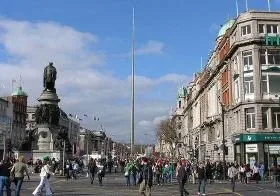
On the streets of Dublin you can meet many of our compatriots
LANGUAGE WILL LEAD YOU TO DUBLIN
It is worth noting that no self-respecting employer will consider a candidate who cannot express themselves at least in basic English. Let us discuss this aspect.
O.: People often joke about English: we write 'Manchester' and read 'Liverpool'. It seems to me that this is a purely Irish joke, because in this country most of the time you read it as it is written. For example, the word 'bad' the Irish, contrary to all transcription rules, pronounce as 'бад'. Consequently, 'bus' sounds like 'бус', 'one' – like something between 'он' and 'ун', 'bag' – like 'баг'. So in many ways this simplifies overcoming the language barrier. You don't have to rack your brains too much, just your tongue a little.
Of course, it makes no sense at all to go without a basic knowledge of English. It should be borne in mind that your level of English will directly proportionally affect your earnings from an Irish employer.
P.: That is exactly why you should prepare in the first months (or even years) of your stay in this country for the fact that, having left your familiar place and social status, you will automatically drop here several levels below the social position you held at home. And you will have to start practically from scratch. After all, it's one thing to know how to create your own website, and quite another to work for one of the world's most famous companies. Let's say, you can improve your language in about three months. But is it worth missing even those three months if, for example, suddenly not receiving the money you expected, you cannot find out the reason for this discrepancy and/or enter into peaceful negotiations for a salary increase? You must admit, it's still much easier to solve such issues with your own people, in your own language.
And as for the Irish accent – yes, it is present. And our Slavic ear is very sensitive to it. At first it is terribly jarring. Then you get used to it. This is not quite the English we were taught at school. Therefore the task becomes more complicated.
F.: I don't quite understand the subject of the dispute. I speak 'Italian' English, Mags speaks its Irish variety, you speak Russian... This, of course, is noticeable. The main thing is that we understand almost everything and kindly forgive each other for some mistakes. At least, we don't react painfully to them, as, for example, my English acquaintances would. They believe that someone who does not speak as they do would be better off keeping quiet altogether. By the way, I now live with an Irish family and would like to note their loyalty in this regard. If I, as an au-pair, suddenly forget to do something or carry out an errand incorrectly, they always put it down to the fact that I simply misunderstood them while adapting to an unfamiliar language environment.
M.: I think, guys, you would joke less about Irish English if you had to delve into our 'Gaelic' (the local language). Rejoice that we found at least some COMMON language.
I've heard that in Ukraine they also are not very willing to speak their native language, preferring Russian. We have the same situation with Gaelic. You can hear it on the radio, on television, and on road signs, but hardly in a supermarket. In the west it remains a household language in some places, not just another official language. But in Dublin everyone speaks English. Overall, it cannot be said that our education system does not try to instill national heritage in the younger generation. In the school where I teach, in the first half of the day lessons are conducted in English, in the second half in Gaelic. The next day it's the other way around. Until 12 o'clock, a student answers learned material in Gaelic, and after lunch everything goes in English. This is regardless of the subject schedule. It turns out that children learn each subject in two languages at once.
PARALLELS
– Mags drew an interesting parallel between the language problems of Ukrainians and Irish. Perhaps you have also managed to find something in common?
O.: First, the peculiarity of the sense of humor. Second, love of freedom. Third, unpretentiousness.
By education I am a historian, and I was curious to note some nuances that explain some of my observations. Please note: for a long time both Ireland and Ukraine were under pressure from their 'big sisters' – Russia and Great Britain. They desperately fought for independence and, in the end, got it. Independence in both countries (somewhere earlier, somewhere later) led to a deep economic depression. Needless to say, until recently Ireland was considered almost the most backward country in Europe. Now Ukraine bears those 'laurels'. But at the same time, the economic rise caused by 'reasonable taxation and a competent approach to management', as local newspapers write, makes the country one of the most prosperous regions. It remains to be hoped that such a turn of the 'Irish question' awaits the homeland we left. I want to believe that the tendency will be a regularity.
Under the influence of constant oppression by England, a local system of humorous values also developed. The Irishman, as a rule, appears in folk anecdotes similar to our 'вуйку'. He is resourceful, good-natured, and has a fine self-irony. Substitute in any of our jokes the word 'Irishman' for 'Ukrainian', and 'Englishman' for 'Russian', and the Irish will laugh uproariously over beer.
P.: So you mean that the English tell the same jokes about the Irish as the Russians do about Ukrainians, and those about Moldovans. Somehow this state of affairs does not please me much, because in this cross-section both the Irish and the Ukrainians look not as attractive as they might like. That's the first thing. Second: yes, both Ukrainians and the Irish are eternal seekers of truth, accustomed to fighting. They are still fighting now. Not everyone, however, understands what for, and even more so – with whom or what.
After five years spent here, one is tempted to say: tilting at windmills. But they are fighting – and their cause is just. What we know about Ireland is mainly that it's not peaceful on religious grounds. Well, we haven't lagged behind in a sense either. Here and there we have disturbances: now the 'White Brotherhood' is raging, now a pogrom on Sophia Square, now Orthodoxy rises against the visit of the Pope... Tell me, isn't that a parallel?
Also, if I'm not mistaken, the word 'unpretentiousness' was uttered. I agree. The fact that both Ukraine and Ireland once experienced the 'Great Famine' left another mark on the shabbiness of our existence. We are used to living modestly. Our migrant worker, with modest meekness, is ready to live in a barracks (where besides him there are 5–7 other people) which the employer offers with modest generosity. And indeed: people come here to earn money, not to spend it, for example, on a modest hotel where the room rate per night ranges from 15 to 40 pounds. With a minimum wage of 5 pounds per hour, it turns out that exactly half a day you work solely to pay for housing.
This, above all, should be taken into account by arriving unskilled workers. Those who are invited to a serious company as a specialist with appropriate training can count on different conditions. For example, traditionally, the first month of accommodation is paid by the company, even if you arrive with your family. But it's better to be prepared for anything. In general, the Irish employer (like any other, non-Irish) very much welcomes accommodating, diligent, and undemanding workers who are ready to put up with various inconveniences.
It should be noted that separate taps for hot and cold water, the absence of central heating as such, and sockets with three holes are the most minor of them. It is precisely as not too demanding that Ukrainians have become known, whom, as far as I know, Irish 'landlords' prefer over Russians, Belarusians, and Poles.
I know several guys from 'our' people who previously worked on construction sites in Syria. They say it's heaven and earth (heaven for them, of course, is here). They are still surprised that I constantly grumble. I'm not grumbling, it's my nature.
F.: It's hard for me to draw parallels between Ukrainians and Irish yet. In my opinion, both are quite open people, all their emotions are on the surface. I noticed that we all love to sing. Yes, you are more similar than different.
M.: Last year, Ukrainians worked on my uncle's farm. He was very pleased: responsible, honest, and easygoing people. And if, say, Slovaks were cunning, shifting work from hand to hand, then your guys handled the assigned tasks excellently. He often paid them 'bonuses' and invited them this year to work for a higher salary too. But they turned out to be very attached to their homeland and decided to take a year off. But by winter, they'll probably come again. My uncle is really looking forward to them.
We understand perfectly well why your people go to other countries to earn money. After all, not so long ago, the Irish themselves 'toured' the world in search of a piece of bread. And even today, not all of us understand why so many people come to Ireland to earn money. Although many Irish who left the country then in search of work are now actively returning home, and the employment office has been conducting a serious campaign since the beginning of last winter to recruit workers from the UK, Australia, New Zealand, the Czech Republic, Latvia, Russia, France, Germany, India, and South Africa. As far as I know, over 50,000 work permits have already been issued to people who came to Ireland from other countries, mostly non-European.
Not everyone has yet become accustomed to the abundance of foreigners on our territory. And to this day, some people turn around on the streets of provincial towns when they hear a foreign language or see an African American. Unlike Britain, whose population, as they say, will be more than half black by 2005, here blacks are still a curiosity. First, our country was considered closed until recently, and second, it was poor: what's the point of coming here?
To be continued.