
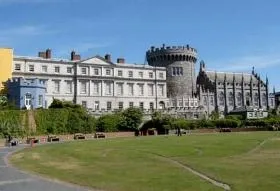
At a wonderful time for Ireland, many of our compatriots turned their gaze to this country...
We must sing praises for this turn of events to at least three authorities.
Firstly, the EU, which, implementing a plan for the experimental creation of an "European Japan" in almost five years, began investing enormous sums in the Irish economy.
Secondly, the Ministry of Labor of the island of Eire (at least its eastern, southern and western parts), which gladly supports this program because it has no other choice. It has to issue a great many work permits to citizens of other countries who strive to kindly help the Irish people "build their new world". And it is precisely on this construction site that there is a catastrophic shortage of labor. This shortage of auxiliary force is caused by the fact that the traditionally well-educated "Irish people", figuratively speaking, filled their market with architects and foremen, and only then discovered that there was essentially no one to build! According to the Irish government, the country currently needs up to 30 thousand workers per year over the next three years to fill all available vacancies in the labor market.
And thirdly, to God Almighty – for providing us with a chance as well.
Armed with information that appears from time to time in the press, people who have not been able to realize themselves at home buy a one-way ticket to a very definite destination – Dublin (usually with a transfer in Budapest – this is the most affordable option price-wise: from $360).
They say it's good in Ireland now. Currently, there are many factors contributing to the development of this trend. Take, for example, the steadily rising level of Ukrainian unemployment with a corresponding drop in the solvency of our employers. And this at a time when the mass media unashamedly state that in Ireland the picture is completely opposite: unemployment, which until recently was around 16%, now virtually tends to zero (3.5%), and the standard of living along with wages is striving for the highest European indicators. The country creates one hundred thousand jobs annually, and therefore the employment department of the Irish government has launched a global campaign to attract foreign labor. That is, it turns out that Ireland today is becoming on a par with such obviously attractive regions for employment (with the prospect of emigration) as the United States, Canada or Australia.
It is not I who noticed that every positive thing has its poisonous "but", just as every negative has its inevitable "however". It is from this point of view that I want to introduce you to Ireland – a country where we are invited to earn money by various recruiting firms working with this region. They promise us "real employment" and a bright future. By how much should we divide this promise: by "2"? by "3"? by "5"?
Of course, the preparation of this material would hardly have been effective without having among my acquaintances people with that invaluable Personal Experience that is perhaps the only thing worth trusting.
ALLOW ME TO INTRODUCE
For Oleg in Ireland, where he moved a year and a half ago, everything (or almost everything) seems to have worked out. He is 32 years old, has a higher education, works as an ordinary builder. His wife Valeria, who gave birth to an Irish Citizen this spring, joined him a year ago. Oleg is a romantic optimist by nature. His task in our conversation is to find those same positive "howevers" related to the prospects of possible work in Ireland, as mentioned above.
To reveal the most unexpected "buts" agreed 34-year-old Pavel, a conscious realist, a practicing programmer. He has been in Ireland for 5 years. And believe me, the guy has something to tell.
"You don't have to look far for these 'buts', because they are obvious," Pasha exhaled, accepting the invitation to talk. But! In fact, he also knows how to smile. You should have seen how his face brightened when I said that Mags would join the conversation!
Mags – short for Margaret – is my old friend and an Irishwoman. She works in an elementary school in the town of Kilkenny, about 60 km from Dublin. The cheerful and lively teacher is 25. She is terribly interested in hearing what the guests say about the country where she was born, about her compatriots. Talkative Mags always tries to put in her five kopecks (sorry, pence).
Margaret, who is sociable (like most of the population of Eire), brought with her a young man named Fabio. He is an Italian student who attends a language school in Ireland, participating in an Au-pair program. It turns out that he also has interesting observations from the past six months of his stay in Ireland. Well then, ladies and gentlemen of the jury...
...THE ICE HAS BROKEN
– So, in the life of each of you came a moment when it became clear that it was time to leave your cozy place. I will not specify what caused such a decision, because the reasons are generally clear. First of all, it is interesting why exactly Ireland was chosen?
Oleg: All these talks about the economic boom, the demand for my specialty, equality with residents of the country, legality of employment, personal prospects, the dream of a "European future" for children – all pointed to Ireland when the answer to the question of whether to go or stay was ripening. And what finally convinced me of the advisability and necessity to take a risk was confirmation of the information that, by law, an Irish employer does not have the right to discriminate against foreign "labor" and pay less than five dollars per hour, on par with local workers.
In our country, an employer can do anything. Here, he is under the watchful eye of the relevant services. And we all here know the office where you can openly complain if necessary. It is the Ministry of Labor itself, with which no Irish employer wants to quarrel.
Pavel: The logic is simple. Australia is far, the States are expensive, Canada is a bit complicated. And since I speak English, the English-speaking countries left were New Zealand, England, and Ireland. Having weighed all the pros and cons, as you can see, I settled on the last option. I won't say I regret my choice too much. But today I would think more seriously about my choice than I did then, five years ago. In principle, I won't deny that Ireland is a quite digestible option. Although, of course, not without its own 'cockroaches'.
Fabio: Italians, naturally, won't tell you this out loud, believing that their country is the most wonderful. Yet Ireland is somewhat superior in development to both Italy and Spain. Of course, Germany, France, and the same Great Britain surpass it in development, but overall, Ireland is quite attractive for any European. Very low crime rate. Highest level of education. Pleasant society. And learning English here is cheaper than in London.
Mags: I think I've heard from Russians that one doesn't choose one's homeland. But if I were given a choice, it would be my Ireland. I guess I'm a patriot (laughs).
To be continued.