
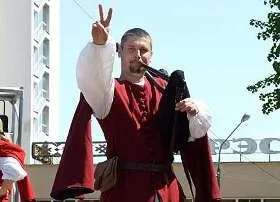
The revival of 'Dudarski Fest' began in 2006
The beginning of dudar parties was laid back in 1990, when masters Ales Los and Tadar Kashkurevich performed together in Vilnius at the festival "Skamble kankles". Soon they were joined by master Ales Zhura. A. Los, T. Kashkurevich and A. Zhura began to gather and play together. In 1991, Igor Mikhno learned a set of Belarusian, Latvian and Lithuanian dances and started the tradition of dance parties to the bagpipe, which took place in different cities of Belarus (Minsk, Grodno, Brest and others). Traditional Belarusian dudas (bagpipes) began to actively expand the scope of application.
In 1992, the successful expansion of the Belarusian bagpipe movement led to the holding of the first bagpipe festival in Minsk. A concept was prepared for it, which assumed that the Dudarski Fest would unite the bagpipe traditions of the Baltic region, which according to its history includes Belarus. Therefore, the festival was originally called "Dudarski Baltic Fest".
The very first "Dudarski Baltic Fest 1992" included a whole set of various events. These were concerts, meetings, dance parties, reconstructions of Belarusian rituals. In addition, the first conference of bagpipers in Belarus took place. The festival was so successful that the next year "Dudarski Baltic Fest 1993" was held.
The events of the festival – concerts and other activities – attracted the attention of ethnographers, folklorists, historians, and gave the bagpipe a large number of fans. The festival expanded to international scale – bagpipe masters participated not only from Belarus, but also from Latvia, Lithuania and even Scotland. The initiators and organizers of the dudar festivals in 1992-1993 were the Center of Ethnocosmology "Krivia", the company "Volkolaka" and the Foundation for the Development of Traditional Ethnic Culture.
In 2002 and 2003, two bagpipe festivals "Zaslavsky Dudnik" were held in Zaslavl (near Minsk). The festival fit into the framework of a larger festival of medieval tradition and culture "Zaslavsky Nabat". In the building of the Zaslavl School of Arts, two conferences were held on the topic of tradition and style of playing Belarusian dudas with reports by A. Los and V. Puzynya, and on the open concert stage there were demonstration performances in two categories: solo bagpipe and bagpipe in an orchestra. Dudars from Belarus played – Minsk, Gomel, Grodno, Mogilev, Zaslavl were represented. The patriarch of the Belarusian bagpipe Vladimir Puzynya, musicians A. Zhura, Z. Sosnovsky, V. Koltsey and others performed. The organizer of the festival "Zaslavsky Dudnik" was Vasil Grin from Zaslavl.
During 2003-2006 festivals were not held, but the bagpipe movement in Belarus expanded and strengthened its positions. Yuras Pankevich, Denis Sukhoi and Ales Surba opened their own workshops for the production of bagpipes. Belarusian dudas penetrated almost all styles of music – from folk jazz to heavy rock. The beginning was laid for the "Dudarski Club", and also for the "Dudarski Brotherhood of St. Basil".
In 2006, the leader of the medieval music group "Stary Olsa" Zmitar Sosnovsky decided to revive the Dudarski Fest and became its producer himself. Now the festival is held annually, in the spring, and attracts a lot of attention from the press and simply interested people.