
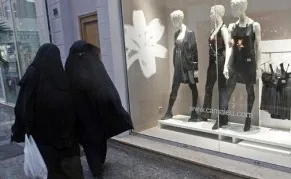
Belgian deputies voted unanimously for a complete ban on wearing the burqa and niqab in public places
The absence of a functioning government – Prime Minister Yves Leterme resigned on Monday – did not prevent deputies of the lower house of the Belgian parliament from passing on Thursday evening one of the most high-profile bills with pan-European significance.
Belgian deputies voted unanimously for a complete ban on wearing female Muslim attire – the burqa and niqab, which cover the face – in public places. Only two parliamentarians abstained in the vote.
Now the bill will go to the upper house of parliament, but a vote on it may take place later than usual due to the government crisis. But no one doubts a positive decision: both Walloon and Flemish parties, whose confrontation has already paralyzed the state more than once, have jointly opposed the burqa.
Liberal Denis Ducarme, after the announcement of the voting results, congratulated his colleagues and all residents of Belgium on the victory of democracy. "We are the first European country to push back the bolt behind which a huge number of women were in slavery, and we expect that France, Switzerland, Italy, the Netherlands, all countries where there is reason will follow us," AFP quotes the politician as saying. Freedom from the dominance of tradition over free will is "the foundation of universal values," his party colleague Daniel Bacquelaine asserts. "Humanity is manifested through the face," he quotes French philosopher Emmanuel Levinas.
Critics of the law noted that Belgium already has rules adopted at the municipal level banning "masks" and other forms of face concealment, which the police are supposed to enforce. The law carries symbolic significance, deputies agree, who did not include a single word about Islam or religion in general in it.
The law does not directly refer to Muslim headgear. The ban applies to anyone who conceals their face. Those who "appear in public places in clothing that completely or partially covers the face to the extent that (these people) are not identifiable" now face a fine or imprisonment for a term of one to seven days. Exceptions are provided only for participants in entertainment events, such as carnivals, which are held with the consent of municipal authorities.
Human rights activists, on the contrary, are outraged by the decision of Belgian deputies. Amnesty International has announced the creation of a "dangerous precedent" in which, citing the protection of gender equality and freedom of expression, legislators "violate the right to freedom of religion of those women who wear the burqa or niqab" for religious reasons.
In Belgium, which has a population of 10.5 million, 400,000 people consider themselves Muslims, and only a "marginal part" of them, the deputies themselves admit, adhere to an orthodox understanding of Islam that requires a woman to cover her body as much as possible. However, fear of the Islamization of society is accumulating, and far-right forces are actively cultivating it.
A law similar to Belgium's is currently being discussed in France, where, at the initiative of President Nicolas Sarkozy, heated debates are underway about "national identity." In November last year, Swiss citizens voted in a referendum to ban the construction of minarets.
Bans on wearing traditional Muslim clothing of varying degrees of severity are in force in many countries. For example, in the Netherlands, it is forbidden to appear in a burqa or niqab in any public place, but the ban does not apply to the hijab (a headscarf that does not cover the face). In eight federal states of Germany, wearing the hijab is prohibited in educational institutions. In Turkey, Morocco, Algeria, Tunisia, and Uzbekistan, it is forbidden to wear it in schools, universities, and government institutions. Since March 2009, Kyrgyzstan has joined the list of countries where wearing the hijab is banned in educational institutions.
Alexander ARTEMIEV.
Gazeta.Ru er="0">