
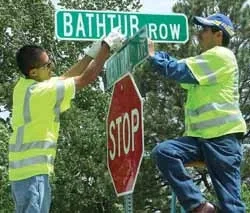
According to the U.S. Census Bureau, the most popular street names in the United States are: Second, Park, Third, Fourth, Fifth, First (in fifth place!), Sixth, Seventh, Washington, and Maple. It is indicative that numerical names prevail primarily because streets in larger cities are named that way. American suburbs and villages prefer to give streets beautiful names. Developers and local residents usually insist on colorful names, as living on such streets is psychologically more pleasant, and houses with such addresses sell better.
Interestingly, the American tradition of giving numerical names to streets has religious origins. This practice was established by the famous Quaker William Penn. At the end of the 17th century, streets in the North American colonies were named after the largest property owners (their houses were the most noticeable landmarks). Penn opposed this practice, believing it expressed inequality, and proposed replacing personal names with numbers.
This practice has undergone many changes, but the tradition has survived. For example, in Washington, 'vertical' streets have numerical designations, while 'horizontal' ones have letter designations. As with any rule, there are exceptions. All letters of the English alphabet are used for horizontal streets, except for the last three: X, Y, and Z. Additionally, for unknown reasons, J Street is missing, but it is called Jay Street, after former U.S. Supreme Court Chief Justice John Jay.
Streets are periodically renamed. For instance, Malbone Street in New York was renamed Empire Boulevard. The reason was the terrible railroad disaster of 1918, which went down in history as the Malbone Street wreck.
Sometimes the reasons for renaming are political. After the U.S. entered World War I, anti-German sentiment significantly increased in the country. One result: New York's Hamburg Avenue became Wilson Avenue (after then-U.S. President Woodrow Wilson), and in Cincinnati, German Street became English Street.
Administrative changes also prompted renaming. The city of Washington, as the U.S. capital, was built from scratch. Nearby was the old town of Georgetown, which was included in the new capital but remained a separate settlement. By the mid-19th century, Washington had grown and absorbed Georgetown (a special resolution to abolish the city of Georgetown was passed by the U.S. Congress in 1871). This resulted in a mass renaming of Georgetown streets that were continuations of Washington streets.
Another Washington story occurred in 2005. After the death of President Ronald Reagan, a group of citizens proposed renaming 16th Street to Reagan Boulevard. City authorities initially refused to do so to avoid spending money on mass replacement of road signs, maps, etc. However, a compromise was found: the street received a second name — it is called 16th Street, with Reagan Boulevard in parentheses.
An amusing story happened in 1998 in the town of Concord, New Hampshire. It was discovered that the city map listed two Walnut Streets. This caused serious problems for utilities, police, ambulance services, etc. The municipality suggested that residents of one of the streets choose a new name. Debates continued for a long time, but none of the options pleased the majority of locals. However, a Solomonic solution was found: the street became Black Dog Street, because, by a strange coincidence, many dog lovers who preferred black animals lived there. But then the minority — people who do not like dogs — demanded a review of the decision. Several weeks later, a new name finally satisfied everyone: Orion Trail.
The United States cannot be imagined without a highly developed network of highways — interstates. The vast majority of them have personal names.
By the early 1920s, more than 250 so-called 'named highways' had been built in the U.S., named after historical figures and events. The most famous of these was the Lincoln Highway, which crossed the entire United States from New York to San Francisco. In 1925, the Federal Aid Highway Act was passed, creating a new system of highways under state control rather than private companies. Moreover, each highway received a numerical code.
Many states, along with the numerical code, continued to give names to various sections of these highways on their territory, as there was and still is a belief that a nameless highway brings bad luck. An example of such a highway is the John F. Kennedy Highway, which is now a 100-kilometer section of Interstate I-95, stretching over 3,000 km from Florida to Canada. This highway is located in Maryland and is named after President Kennedy, who officially opened traffic on this section of the road. As it soon turned out, this was Kennedy's last appearance at an official ceremony — he was assassinated a few days later. On the first anniversary of the assassination, in 1964, the highway was named after Kennedy.
In 1953, Dwight Eisenhower became President of the United States — a strong advocate for creating a national highway system. In 1990, in recognition of Eisenhower's contributions, then-President George H.W. Bush signed a law renaming the national highway network the Eisenhower Interstate System.
Interestingly, today there are dozens of roads named 'Veterans Memorial Highway' in the U.S. There are also six Pearl Harbor Memorial Highways.
American buildings also receive names, and not only important ones but also completely ordinary ones. This is often a way to recognize the efforts of philanthropists who donate significant sums to fund institutions in the education system, social services, etc.
Schools are also usually given famous names. According to the US Department of Education, the most common are schools named after presidents Abraham Lincoln, Thomas Jefferson, John Kennedy, and civil rights activist Martin Luther King.
American congressmen and senators often engage in "pork." In American political slang, "pork" is federal funding of local programs or structures for obscure reasons. Any line item in the expenditure part of the state budget is considered "pork" if it meets at least one of the following criteria: it is initiated by a single congressman; it was not publicly discussed during the budget approval process; the funding serves only the interests of residents of one electoral district, etc. "Pork" is distributed unevenly across the United States — its amount depends on the influence and political skill of the congressmen and senators representing a given electoral district. Sometimes, as a token of gratitude from voters, a congressman's or senator's name is given to a major structure built with "pork" money.
There are many such examples. For instance, the airport of Anchorage was named after Senator Ted Stevens. Stevens chaired the Appropriations Committee and secured federal money to modernize the airport. Senator Bennett Johnston from 1980 to 1990 successfully inserted into the federal budget a line item for financing the construction of a series of canals, dams, and docks on the Red River — he achieved success despite having to fight off the administrations of five US presidents. As a result, this waterway is called the Bennett Johnston Waterway.
Influential Senator Robert Byrd was sometimes called the "Prince of Pork" by the press. In his home state of Virginia, more than 40 bridges, roads, dams, and buildings were named after Byrd. Senator Thad Cochran secured significant federal funds for the state of Mississippi. Result: his alma mater, the University of Mississippi, named two research centers after him, and the state named a business park after Cochran.
However, such honors can be short-lived. In early 2005, the state of North Carolina decided to remove the name of former Lieutenant Governor Earl Morris from a road that had borne his name for almost 30 years. The reason was the bankruptcy of the company he managed after leaving public service. Morris was convicted of fraud. A similar fate befell the Bob Ney Sports Complex. Ohio University made that decision after Congressman Bob Ney was convicted of corruption. Sometimes the immortalization of a politician's name doesn't even happen. The University of Tennessee was building a new building that was supposed to be named after state Senator Ward Crutchfield in 2005 — this idea was reconsidered after the senator was charged with bribery.
Some US states and cities are trying to change this practice. In 2003, the state of Georgia established a rule according to which such naming is only possible for people who are recognized at the national or regional level and have not been in public service for at least two years.