
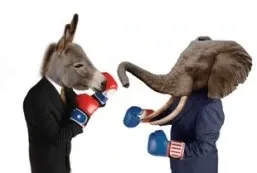
One of the most important and ancient traditions of the US is public battles between "donkeys" and "elephants"
Washington ProFile offers readers an interview with Norman Ornstein. This scholar is a resident scholar at the American Enterprise Institute, an expert in elections, author of many books. The most famous of them is "The Broken Branch: How Congress is Failing and How to Fix It".
– What is the history of bipartisanship in the US?
– Once the New York Times published an article by a political scientist who argued that bipartisanship never existed, that it is nothing more than a mistaken concept. However, he is wrong. There were periods when Republicans and Democrats worked together very successfully, and sometimes this cooperation even extended to painful issues. Democrats and Republicans jointly created the civil rights movement (mainly advocating for the elimination of racial discrimination in the US, this movement reached its peak in the 1960s). This movement could not have happened without Republicans.
If you analyze the period of the 1930s–1960s and even the 1970s, you will find that then about half of the Democratic Party members were white Southerners who were more conservative, and the other half were urbanites from other regions of the US who held more liberal views. About a fifth or even a quarter of Republican Party members were liberals and moderates (traditionally in the US, carriers of political ideologies are divided into three groups – "conservatives", "liberals" and "moderates" – Washington ProFile), living mainly in the northeastern part of the country or on the West Coast. As a result, Washington was quite often de facto governed by the so-called "conservative coalition", that is, Southern Democrats united with most Republicans. That is, this is not bipartisanship from the point of view of those researchers who believe that real bipartisanship occurs only when liberals unite with moderates, but it is real bipartisanship by all other standards. This also does not mean that as a result of such bipartisanship, governance was based on the principles of coalition government, where two sides try to overcome their differences.
Bipartisanship is always part of a democratic political system. Initially, the authors of the US Constitution did not mention parties in its text; they did not think in such templates. However, this system appeared from the very beginning.
That is, if parties exist, then there are party differences and party interests. The difference between the situation of the past and the situation of the present is that previously members of the other party were perceived as rivals. If it is a rival, you can disagree with him seriously today, but in the future it is possible to turn him into an ally. A member of another party was perceived as a personal friend with whom there are certain disagreements – this attitude prompted politicians to watch their language. And today, representatives of another party are perceived not as rivals but as enemies. Obviously, an enemy should be destroyed. This creates a completely different dynamic of relations.
– What is the reason for this transformation?
– On the one hand, this is explained by the regional divide in American politics. From the end of the Civil War in 1863 until the 1960s, the American South was overwhelmingly Democratic. Democrats held a majority in the US House of Representatives for six decades – mainly because they won almost all elections in the South. Republicans were based in the Northeast and West Coast of the US. When President Lyndon Johnson signed the Voting Rights Act in 1965 (eliminated numerous obstacles due to which black US citizens could not successfully participate in the electoral process – Washington ProFile), he whispered to one of his closest aides that this law would cause the Democratic Party to lose the South for a generation, maybe longer. In the 1960s, the American South began to transform – first becoming a place of fierce political struggle, and later turning into a base of the Republican Party. At the same time, the Northeast lost most of its Republican congressmen and senators. On the West Coast, the states of Washington, Oregon, and California turned from a bastion of moderate Republicans into a citadel of Democrats.
This happened because the parties became more homogeneous, they began to resemble European parties – Democrats moved to the left, and Republicans to the right. Moreover, one should not forget the role played by modern media – political battles go on constantly, which leads to what is sometimes called a "permanent election campaign". And do not forget that starting from 1994, party competition in elections was extremely intense, leading to even clearer inter-party demarcations.
– Under what conditions does cooperation between the two parties become difficult?
– Bipartisan cooperation is usually difficult when things are going well, when the country is not in crisis. It is even more difficult to cooperate when the gap between the majority party and the minority party is very small, that is, the minority feels that it can regain the majority. The best way to achieve this is to refuse cooperation with the majority party. On the contrary, the minority needs to make life as difficult as possible for the majority in the hope that the majority party will make mistakes that can be exploited to win over voters. Tensions are added by the media, which increasingly assess the situation from ideological positions.
– In the past few decades, many observers have noted that the U.S. population is becoming increasingly ideologically divided. Various labels are used to describe this: “conservatives” versus “liberals,” “traditionalists” versus “secular progressives,” and so on. Does a deep ideological divide exist in modern America?
– There is no divide. For example, if you look at the early 1950s, presidential candidate Dwight Eisenhower, a Republican, received about 40% of the African American vote. In 2008, Republican John McCain got about 3% of the black vote. So, certain differences exist. But they are liberal-conservative differences – for instance, over what the government should be: large and powerful or small and weak.
Some social differences – for example, issues of abortion and same-sex marriage – were absent in the 1950s (these topics are traditionally stumbling blocks in battles between liberals and conservatives; the former support free termination of pregnancies and legalization of same-sex marriage; the latter consider abortion murder and same-sex marriage an undermining of the family institution. Any American politician must state their position on this – Washington ProFile). Abortion became a major issue only in the 1970s, when the U.S. Supreme Court legalized it. Same-sex relationships were not an issue until the last decade. However, some differences between parties and within a single party (for example, “Wall Street Republicans” and “ordinary Republicans,” “big business” and “small business,” etc.) existed then and continue to exist today.
– Does the two-party system allow for better governmental decisions? What are the advantages and disadvantages of this system?
– Making better political decisions does not require eliminating differences between parties. However, if you intend to implement any serious social changes that will radically disrupt people’s lives, the greater the bipartisan support, the more likely the public will approve them, even if they have to suffer.
One of the most serious problems of government is making long-term decisions. The government must regularly tell people: “Trust us, tomorrow life will become harder, but in five years the situation will improve.” Most U.S. residents do not trust their leaders, and if government officials start saying “trust us...” and the opposition party comments “they are lying, don’t believe a single word they say,” then Americans are much less inclined to accept the government’s promises.
That is, the majority party is better off adopting some ideas of the minority, because sometimes these are truly good ideas. Moreover, some political issues are not necessarily right, left, liberal, or conservative. For example, in the energy sector, there is nothing particularly liberal about calls to conserve resources and nothing particularly conservative about calls to extract more oil. There is no reason why a compromise between more aggressive energy development and more aggressive energy conservation would be impossible.
– Modern American media are also clearly divided along ideological lines. Is this a result of the two-party system or a specific business model?
– This is a modern phenomenon, but a similar division was observed in the 19th century. Party-oriented newspapers emerged back then. The main reason is economic. It is a phenomenon of globalization. In an era when you can get information from the Internet, young people no longer read newspapers.
Previously, there were many evening newspapers – most people rode home by train or bus and could read them. However, public transportation changed, and these newspapers went into crisis. TV broadcasts used to be watched by everyone; television companies had the largest audiences. Now they are dying – finding their target niche proved successful. Fox News was the first to move in this direction and succeeded. Audiences of such channels constantly return to them, and it is the partisan views of the channel that attract loyal viewers. Clearly, this trend significantly complicates cross-party cooperation.
One consequence of people being divided into “left” and “right” is that the U.S. population does not have the same basic information. Public opinion polls show that Americans view facts completely differently if they watch conservative Fox or liberal MSNBC. That is, they receive not facts but arguments that reinforce their already formed point of view. This definitely makes cross-party cooperation more difficult.
Moreover, this process also affects politicians. Every congressman wants to get on TV. But if he is a centrist, it is much harder for him to get into a TV studio compared to someone who expresses ideologically defined views. A good example of this phenomenon is Michele Bachmann, a congresswoman from Minnesota, a very conservative Republican. Most colleagues consider her not quite adequate because she periodically makes extravagant statements, many of which are untrue – afterward, Bachmann corrects herself and apologizes. Yet Bachmann constantly appears on TV because she says things that Fox News likes. This encourages politicians to move to the edges of the political spectrum.
Another phenomenon is this: most electoral districts clearly belong to either the Democratic or Republican Party. And when congressmen return home, every voter in the district repeats the same things to them, which reinforces the congressmen’s respective beliefs.
– Are there ways to improve the situation with the inter-party split and create a more effective scheme for making government decisions?
– One very simple way is to change the order of business in Congress. Previously, all members of Congress lived in Washington with their families; they interacted with each other, forming personal relationships that sometimes turned into friendship. It is hard to consider someone an enemy and say terrible things about that person if the next morning you meet at the school your children attend. But that system has changed. For the most part, the families of congressmen and senators stay at home, and in Washington the elected officials spend 2-3 days a week. They live either right in their offices or in small rented apartments, interacting little with colleagues. If we change the order of Congress's work, say by returning to a five-day work week for three weeks each month, it would lead to congressmen communicating more with each other, which would add humanity to politics.
The second thing that would be worth doing is to create and adhere to a certain strict order in the legislative process. If the minority party has a real opportunity to debate and participate in the drafting of bills, it has fewer reasons to vote against everything that comes to mind. It is difficult for the majority party to agree to this because it would have to admit the possibility of losing. However, this is where we should start if we want to create a different atmosphere in Washington.
Based on materials from Washington ProFile.