
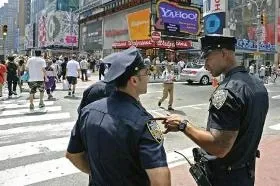
The largest police department in America by size is New York's, with 40 thousand cops serving in the NYPD
Sheriffs, Rangers, Constables
When I drive around New York and its surroundings and see a police car nearby, I instantly tense up inside. I immediately check my seatbelt, toss my phone into the cupholder just in case, and start driving slowly and carefully like a rookie, which I assure you I am not. I thought I was the only pathetic coward. I talked to friends, and many are embarrassed to admit it, but they instinctively freeze at the sight of a stately striped cruiser with a "disco" on its roof. Both personal experience and knowledge of objective realities come into play.
With the police in America, you don't mess around. A formidable force. They are feared, they are respected. Are they loved? That's an open question. As a reporter and journalist, during fifteen years of living in the US, I have communicated with police officers in various situations many times. And I became convinced that you cannot paint them with one brush, black or white.
The US has 18,760 police departments and precincts, employing about one million people. An army! About $51 billion is spent on it annually. And notably, only 15% of that amount comes from the federal budget. The rest comes from local budgets – states, counties, and cities.
There is a homespun logic to localized funding. After all, the police protect not the president, not the vertical hierarchy, not the bosses, but ordinary Mr. and Mrs. Smith. Therefore, it is more convenient for local authorities to maintain law enforcement in uniforms and plain clothes. And to hold them strictly accountable for how well they maintain order.
The 10th Amendment to the US Constitution leaves the right to form police forces to state administrations. The police are divided into municipal and county. Under state administration may be special units – for example, SWAT or highway patrol. Under county administration – railroad police or special services for patrolling Indian reservations. Municipalities may have a dozen police services – for ports, train stations, residential areas, schools. Many large universities and colleges have their own police precincts. Each state has its own peculiarities.
In Florida, for example, they like to structure everything rigidly. There are special services for monitoring forest and household fires, for illegal sale and consumption of alcoholic beverages. By the way, scenes I observed in the Moscow metro, where groups of young people chugged beer straight from the bottle in the cars, are unthinkable in America. Here, even the most hardcore drunks know: drinking in public places is prohibited, you'll be fined immediately. And on the street, you can only drink from a bottle if you wrap it in an opaque bag.
What cannot but amaze is the incredible diversification of police services compared to other lands. Hollywood somewhat simplifies the picture in this regard. There, it's all patrol cops in long cars, dashing detectives in plain clothes, always in pairs, plus seasoned sheriffs in cowboy hats with huge star-shaped badges on their chests. But the assortment of cops is not exhausted by these.
Historical and regional features are reflected in the names. In Texas and Arizona, order is kept by Rangers, in Colorado – Rangers, but mounted, in Pennsylvania – "Capitol Police" and Constables, in New Mexico – Mounted Police, and so on. Police departments under state authority may be called "Department of Public Safety", "Law Enforcement Department", "State Justice Administration", and a dozen other variants. There are their own police forces in federal law enforcement agencies – the Departments of Justice, Homeland Security, and Interior. The Military Police serve the Pentagon and the military departments.
Of course, they cannot do without sheriffs either. In the US, there are about 3,100 of them – at the county level, they are the main structural unit of law enforcement. Most are elected, like other key officials at the county and state levels. In some counties, for example in Louisiana, order is kept by two sheriffs: one is responsible for criminal matters, the other for the civil sector. Sheriffs have other duties as well. They manage county jails, serve court summonses, and provide security for courthouses.
Most municipal police departments are small, with ten or fewer employees. The average number of cops in a typical police precinct is 25 people, not counting civilian contract workers.
I once ended up in the town of Moscow with a population of a couple thousand, in eastern Pennsylvania. Since I myself am a native Muscovite, I was overcome with curiosity about where the Pennsylvania Moscow came from. In the town hall, a modest two-story building, they pointed me to an office where a person was supposed to answer for the toponymic matter. It turned out that a nice lady named Ivy Brenzel was the head of the Moscow police, and under her command were two retirees, each working half-time.
Ivy said that the town was named by some Russian emigrant in a long-ago year. There are no special incidents here, a couple of thefts a year, and those are not by locals but by outsiders, and occasionally domestic violence cases disturb the peace. Nevertheless, Brenzel faithfully stands watch, patrolling the streets. There are more than 800 precincts like Moscow's, consisting of one person, in America. According to statistics, two out of three small towns in America do not have their own police precincts. And they survive.
How They Forge Personnel
In street usage, police are addressed as 'officer', which is not quite correctly translated as 'офицер'. In fact, it's a variant of the Russian 'начальник' (boss), only less familiar. A cop is most likely not an officer, but a private, sergeant, or corporal. Police chiefs are called commissioners, chiefs, and superintendents, and also sheriffs. The most common officer rank is lieutenant, under whose command there are two, three or more sergeants. Detectives and investigators are also considered police, but they usually work in plain clothes. And finally, the corporal and that same private 'officer' without any insignia.
At the start, recruits receive very little by American standards. In New York, the starting salary for a patrol cop is $32,000 per year. In other cities and states it can be higher, up to $40,000. But seniority bonuses constantly accrue, and after 10-15 years of impeccable service, the salary can double. And chiefs earn close to $100,000 or more per year.
There is competition for the police, though usually not very high. The requirements are as follows. First, you need a high school diploma, and at the federal and state level, a bachelor's degree is desirable. Many colleges offer a 'criminal law' program for those who have chosen police work as their future profession. Second, be physically strong – weaklings are not accepted into the police. You need to pass tests for reaction, strength, vision, and hearing. Third, you must have a clean record, or as they say in certain circles, a 'clean nose'. All badge applicants are run through databases of violations, and if they catch that you were once detained for drugs or systematic traffic violations, you can stop bothering. Fourth, the applicant must pass oral and written exams. Moreover, often the interview, the decisive stage for hiring, is conducted by the head of the police department himself.
After enrollment, the recruit is immediately sent to a police academy for 3-4 months. In the famous Hollywood comedy series, cadets do God knows what, but in reality they are loaded to the gills – classroom lessons, physical training, situational analysis, training in shooting, self-defense, and first aid.
The majority of recruits are veterans who have completed their military service. After five years, a private 'officer' gets the opportunity to advance to sergeant. Vacation is initially 10 days per year and gradually increases to a maximum of 25 days. The retirement age varies by state. On average, to qualify for a full police pension, you need to work 20-25 years. Cops usually retire at 40-50 years old and in their last years of service they already look for a new career. They often go to work as instructors in shooting and martial arts in private and departmental clubs or as employees of security agencies.
My acquaintance, former police officer Joe, opened a landscaping company and mows lawns. Pensions for retired cops are quite good. In New Jersey, for example, they amount to 65% of the earnings from the last year of service.
A huge problem, which the press tirelessly harps on, is the small percentage of national minorities in the police community. The police have been a white preserve from time immemorial. Racism in words has long been eliminated, but it manifests itself time and again. White police officers beating an innocent black guy seems like a picture from the past, but even today such cases are not uncommon. Only relatively recently have representatives of the same nationalities as the majority of residents been sent to ethnic ghettos for patrolling. For example, in the city of Huntington (West Virginia), 10% of the population are minorities, but in the police force of 86 cops, there are only two. As a big event, the local newspaper recently reported that for the first time in 16 years, an African American will begin service.
Breathe, sir!
First off, when I first arrived in America, I was told a horror story about our emigrant who fell victim to Russian carelessness. He was stopped by a police officer on the highway, and instead of rolling down the side window and patiently waiting for the lawman to approach, out of habit he jumped out of the car and trotted to the cruiser. And he reached into his inner breast pocket where the documents were. The police officer, without thinking twice, pulled out his 'piece' and shot the dangerous stranger.
What I know for sure – there have been cases when people from the former Soviet Union tried to bribe patrol officers to avoid a fine or arrest for drunk driving. And they ended up under arrest. Those tricks don't work here, and if they do, it's an extremely rare case. The explanation is not that all law enforcement officers are angels without wings. A cop earns well, has considerable social benefits, values his status, and won't take risks.
Once I got lost during a heavy rain and in the dark I happily saw a police 'Chevrolet' with flashing lights. I pulled up and asked for 'directions'. The cop politely and thoroughly explained, and then coldly wrote me a ticket for crossing a solid line when approaching him. 'But, sir,' I pleaded, 'it was pitch dark and a downpour!' Useless! Some kind of RoboCop!
On the other hand, there are many cases where people in uniform help in life. Actually, it's not at all a heartfelt impulse, but a clear job description. When you call 911 in the US, three services arrive – ambulance, fire department, and police. And if the police get there before the others, they will professionally provide first aid and perform artificial respiration.
But it's not just about the instructions. Probably about the people too. In Pennsylvania, in a deserted forest area, the GPS acted up, and my wife and I couldn't find the entrance to the park. We asked a ranger. He said, 'Follow me,' put aside the papers he was busy with, and about 15 minutes later led us to the desired place. Waved his hand and sped off. And just the other day in Boston, my daughter inadvertently found herself without a car in an unfamiliar place. A patrol car drove by, and after hearing her explanation, the officer drove her to the right address. Free of charge, of course.
And yet it is noticeable that in recent years the police have become somewhat bristly. The reason is the September 11 attacks. The fight against the understandable criminal element has been joined by the fight against the not-so-understandable terrorist one. Cops are brainwashed about this at the academy, courses, and briefings.
By law, you cannot be stopped – whether in a car or on foot – without sufficient reason. There must be a strong suspicion. For example, you resemble someone wanted. Or you're driving erratically, breaking the rules. And once they stop you with 'just cause,' they may ask you to open the trunk, or tear off the interior upholstery in search of a hiding place for drugs.
Although sometimes it reeks of the infamous vigilante campaign. Once, late at night, I was returning from Manhattan to New Jersey, where I live, and at the entrance to the Lincoln Tunnel under the Hudson, I found myself, to my amazement, in a full-scale roundup. All cars without exception were stopped, the cop gestured to roll down the window, stuck his head into the cabin, noisily inhaled the air, and cheerfully asked, 'Have you been drinking today?' Later I read in a city newspaper that this experiment was deemed a failure after numerous protests by human rights activists and lawsuits.
Interestingly, the anti-alcohol campaign was at one time turned against the police themselves. New York Police Commissioner Ray Kelly issued a nine-page order for random blood alcohol tests of his subordinates. For decades, friendly drinking of various alcoholic beverages, from beer to whiskey, had been an unspoken but strong tradition of the police brotherhood of the Big Apple. But the commissioner got tired of making excuses for scandals and criminal incidents caused by New York police officers.
Something similar is being attempted by their colleagues in Chicago, Los Angeles, Philadelphia, and Miami, but none of them have thought of mandatory random 'integrity' checks. Experts in police life are sure that this endeavor is doomed to failure.
Corruption is the mother of disorder
The largest police department in America by number of officers is New York's. The NYPD has 40,000 'finest,' as the department's motto immodestly proclaims.
The restless metropolis is literally stuffed with police, and when some major event occurs, like a convention of one of the two main parties or a session of the UN General Assembly, it seems that blue uniforms are a sea all around. The department is headed by the aforementioned Ray Kelly, a stocky Irishman, a Vietnam War veteran who has served in the police for over thirty years. His reputation is high, which cannot be said of his predecessor Bernard Kerik, who is currently serving a 4-year sentence for tax evasion and perjury.
The scandal with Kerik, whom Bush proposed for the post of Secretary of Homeland Security, is a kind of symbol of corruption. The most common offenses for which cops are caught are consumption and trafficking of confiscated drugs, protection of gambling and prostitution, theft of property from suspects, bribery, and blackmail.
According to the NYPD Internal Affairs Bureau, from 1992 to 2008, approximately two thousand New York police officers were arrested. The zeal of the bureau's employees, numbering 650, causes muted discontent among cops, for example, when they fine police cars for illegal parking. After all, it is commonly believed that cops can park anywhere. 'Internal affairs officers' are called 'cheese-eaters,' and their unit is the 'rat squad.' Those they hunt are also classified: into 'herbivores,' who take whatever falls under their feet, and 'carnivores,' who actively seek spoils.
Both types of 'werewolves' were fiercely fought by the legendary Frank Serpico – perhaps the most famous American police officer. If you remember, he was immortalized in a famous film by Al Pacino. Serpico himself is alive and well, although he is careful about his safety – he lives in the Catskill Mountains and keeps a low profile. He still fears retaliation. Serpico's sensational revelations prompted then-Mayor John Lindsay to appoint a commission of inquiry headed by Judge Whitman Knapp. On February 3, 1971, during an anti-drug raid, Serpico was shot in the face by a thug and miraculously escaped death. Many believe his fellow cops set him up...
Some time ago I met with Serpico and asked him to assess the current level of the New York police. 'I was talking to a guy recently,' Frank told me. 'He asks me: how to improve the quality of police work? Why, you at least maintain the current level! The mayor of New York is reducing the salaries of rookie cops. That's an invitation to corruption! The quota system is completely flawed. Everything is quota-based in the police. Want to get a promotion? Show zeal, make more arrests, hand out more fines. To prove the guilt of an arrestee, they go so far as to falsify evidence, plant evidence...'
Not all Americans believe that 'my police protects me.' But even in their worst nightmares, they cannot imagine their country 'a state without police.' It's better to stay away from cops, but without them, life is somehow uncomfortable and unsettling.
Oleg SULKIN.
