
I have always respected the Decembrists' wives. But to be one myself... In a blizzard, in frost, in eternal cold, and without a mink coat at that. No, thank you. And yet – here it is, permafrost underfoot. But not Siberian. "Do you really love the cold?" a nice lady at the American embassy asked me. Her eyes were full of horror. "Are you really ready to live there?" – "No, actually I love warm seas, palm trees and sandy beaches. But I love my husband more... And he has a contract in Alaska." She smiled sympathetically (what an unfortunate marriage!), handed me the papers. "Good luck!" she wished at the end.
And now we have been living for nine months in the northernmost state of the USA, on once Russian land, where the rest of America is disparagingly called in a lump "the Lower 48." The first observations and conclusions have appeared. And the first anger at those who make hasty judgments, passing them off as the ultimate truth. In this regard, a note: before every evaluative phrase one should read: "in my opinion/according to my observations, in Fairbanks/in Alaska/in America."
No, America is not paradise; there is no paradise on earth. But it is a nice country, in many ways very humane and sensible, although "with cockroaches" (which seem much more harmless when you look at them up close). And Americans are not so very different from us.
Frying pan with a handle
We were not just brought to America – that is, not to the place with skyscrapers, Brighton Beach, familiar to everyone from films and memories of compatriots, and not even to some one-story Dogville where our person slowly but surely goes mad from silence, idleness and routine. We ended up in Alaska. It has many names – "the last frontier," "the frying pan with a handle" (the handle is a narrow mountainous strip of land in the south), "the land of the midnight sun." It used to be called "Russian America" as well. And right after the purchase, Alaska bore very unpoetic names: "Seward's Folly," "Seward's Icebox," "Seward's Iceberg." It must be said that in 1867 America was not particularly eager to buy anything, but Russia just wanted to get rid of an inconvenient territory. And so William Seward, the then U.S. Secretary of State, lobbied for the purchase of Alaska. The purchase took place despite the fact that very many were "against." The free American press amused itself as best it could, scolded Seward and invented new names for the unsettled territory (since at first there was neither government nor laws). One of them roughly translates as "Russian Walrussia": "Walrussia" (from walrus). It is clear that after huge amounts of gold were found in Alaska, the newspapermen had to quickly shut up. And Seward's name was given to a delightful town on an ice-free fjord, one of the few where the atmosphere of the gold rush era has survived to this day.
The capital of Alaska is Juneau. A very small city in the southern part of the state, on a narrow strip of mountains near the Canadian border (the very "handle of the frying pan"). You can only get there by plane. If only we could do the same – move the government somewhere between the Lower and Podkamennaya Tunguska, let it work! The main city of Alaska is Anchorage. On one side are towering pointed snow-capped mountains, on the other a huge ocean bay with tides up to ten meters high, and in the middle – a modern city with mirrored and non-skyscraper buildings of banks, oil companies, with Marriotts and Hiltons, a water park and nighttime performances, a flea market, etc. And in the very middle of Alaska, between two huge mountain ranges, in the wide valley of the great Tanana River, stands the city of Fairbanks. That's where the plane brought us nine months ago.
"The Golden Heart of Alaska"
Thus, in a thoroughly Soviet way, Fairbanks is called – the capital of the "gold rush," in general, a small city by our standards (35 thousand inhabitants within the city limits, 80 thousand – with all the houses spread over a gigantic territory of the Fairbanks borough). Downtown consists half of "cabins" (cabin – a log house), half of quite modern buildings, including: the courthouse named after a certain Rabinovich, Marriott, Westmark, several banks, the city administration building, a huge hospital and polyclinic. The infrastructure is amazing – excellent roads, an incredible number of supermarkets, no parking problems even in the center. If you take any domestic city with a similar population, the comparison will be depressing.
The gold found here a hundred years ago continues to bring profit today – tourists are taken through endless "mines," given a pan and set to wash some sand, dressed in old-style costumes and photographed "in sepia." All these entertainments are quite expensive, but tourists have no choice: you came for this – pay.
In addition to places connected one way or another with the glorious era of the gold rush, Fairbanks is famous for several "northernmost" objects in the world, namely: a synagogue, a Masonic lodge (actually, there seem to be three of them) and a "McDonald's." Well, maybe the supermarket of the world's largest chain Wall-Mart is also "the most." The synagogue, however, is quite modest and even shabby. But the Masonic Temple (a meeting place), although also small, is very good. This is, it seems, the only building in Fairbanks graced with a classical portico with columns. The pale-cream-colored house stands on the bank of the Chena River, in the city center. It was built at the very beginning of the "rush," as soon as, besides the dashing prospectors, more solid people appeared in the new settlement.
The people of Fairbanks in general are quite nice and good-natured – I have never encountered aggression here. This impression, however, can be spoiled by an encounter with a group of drunken Alaska natives or deranged youth, as well as by statistics: only this year Fairbanks left the honorable fourth place in the ranking of the most criminal cities in the U.S., compiled by some journalist (frankly, I don't believe it). The event was put, if I'm not mistaken, on the front page of the local newspaper bearing the proud name Daily News-Miner. However, the local newspaper can put anything on the front page – even a photograph of a wolf skin teeming with fleas (readers flooded the editorial office with indignant letters and threatened to cancel their subscriptions, as many had their appetites spoiled, and it was Sunday, the day of brunches, that is, a big feed). Well, that's by the way.
The city is very dependent on the weather. Spring arrives rapidly: at the end of March the frantic sun furiously melts the snow. Summer is dry, hot, with forest fires and an almost true white night. Then another sharp transition – here one acutely feels the swiftness with which an incredibly beautiful autumn passes. Birches turn yellow and shed their leaves in a couple of weeks, and first only a yellow border appears on the leaves, and every day this deadly gold captures a larger and larger part of the leaf, and then greenery remains only along the 'veins' – and that's it. The little trees stand in their autumn beauty for a week, no more, and frost completely tears off the browned leaves. It cannot be otherwise: the trees stand almost all winter under a thick layer of frost that grows with each arrival of freezing fog. Winter, though, is beautiful. But it simply drains the soul.
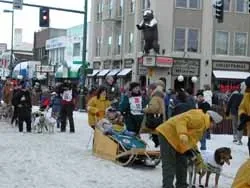
No, there are, of course, winter entertainments – skiing (alpine and cross-country), dog sled races, sledding and skating, snowmobiling. But it's cold! And people wait for spring. Moreover, quite in the manner of Ehrenburg: 'And in strong icy resentment, blinded by dry blizzard' – people suffer from darkness. The Arctic Circle is nearby, and the day at the end of December is very short – about three hours, the sun barely rises above the horizon. Winter depressions begin, especially among the unemployed, the lonely, and simply those weak in soul and will. Lethargy, loss of strength, vague ailments – all this is traditional for Fairbanks in November-February. People shrink and withdraw into themselves. The local hospital, as well as the university, have special rooms equipped with bright lamps simulating sunlight. People visibly come alive under them.
We and They
We come here, to America, with our established notions, myths, often very far from reality. Yes, they are quite different from us. But they differ from us not in intelligence or stupidity, not in being obsessed with work, not in extreme individualism (look at yourself – do you yearn for communal apartments?) and not even in economic savvy, expressed in the fact that everyone plays the stock market. The main, striking differences lie elsewhere.
First of all, one is struck by some kind of extreme benevolence. Don't suspect me of taking for kindly attitude the trivial, much-vaunted by detractors 'rubber smile of an American.' It exists, it is present, it is everywhere. But it is simply a national gesture. A slight wave of the hand could serve just as well in its place. It simply means 'I see you' and can apply equally to an acquaintance or a stranger. The same goes for the 'Excuse me!' that sticks in the ears, habitual and already actively used (Negresses – pardon, African American women – pronounce it terribly drawn out: 'ikskyu-yu-uz'). This is very convenient in supermarkets, when the clientele is absorbed in examining the shelves, and you are trudging behind with your cart. So you keep calling out at every step: 'Excuse me?!' – so that some inattentive person doesn't bump into you, fall, get hurt, and so on.
No, the benevolence is quite sincere. Both on the part of officials and private individuals. All this was tested by personal experience – when they literally fussed over me at the local, so to speak, education department, where two weeks after my arrival, still completely speechless, I was finding out how to get my child into school. And at the university's human resources department, where a woman literally explained some financial matters to us on her fingers. Well, and when the first ice covered the Fairbanks hills and our little car, not yet fitted with studded tires, was sliding, uncontrollable, down an icy slope, a hefty guy (not to be confused with a gay) got out of the first Jeep, hooked us with a cable, and pulled us out onto a flat road. He checked, saw that we were driving on our own, and only then went about his business.
What strikes one is the real, not merely declared, caring attitude toward the disabled. Society perceives them as normal people who simply need help. No deformities will force a person to stay at home, hiding from the public. Thus, in Fairbanks I saw a lady with arms amputated up to the elbow. The lady walked calmly through the store, swinging her stumps, her children of various ages hanging around nearby. Later I met the same woman at a water park. She did not hide her arms. She was comfortable. She felt completely in her element. There too, a pretty girl with a severe spinal defect was enjoying life, as were some other not entirely healthy children. All this, so natural here, is not difficult but impossible to imagine in our homeland, where weakness is a vice, where physical defects are a shame, and where defective children are abandoned in maternity hospitals with a 90% probability. The fate of Sparta does not concern us.
From here, from Alaska, one can clearly see what a cruel country we have. The book by Booker Prize winner Ruben David Gonzalez Gallego, “Black on White” (don’t let the Spanish surname confuse you, he’s one of us) is a terrible documentary testimony to this cruelty. This mosaic of stories about orphanages for sick children reads like memoirs of prisoners in fascist concentration camps. Here is a quote: “I’m on my last day in America. Tomorrow they will take me to the airport... The plane will deliver me to Russia on time. There, in faraway Russia, they will carefully lay me on a sofa and sentence me to life imprisonment within four walls. Kind Russian people will feed me and drink vodka with me. It will be satisfying and, perhaps, warm. There will be everything except freedom. I will be forbidden to see the sun, walk around the city, or sit in a cafe. They will condescendingly explain that all these excesses are for normal, full-fledged citizens.” Yes, it is here that the weak are culled, those lost in life are destroyed (by circumstances or skinheads), a person thrown out onto the street (like an animal) is doomed to perish. In America, both people and animals are protected, and it is somehow here that I suddenly felt sorry for those baby seals that died to become the decoration of my fur coat.
National priorities
The first thing children are taught in school is “follow directions.” This is truly important here, at work and in daily life. In high-tech America, instructions come with everything. And they really must be followed. If a muffin recipe (these are their cupcakes) says “add such-and-such mix, then stir seven times with a spoon,” you should not stir eight times – it will not turn out right.
Respect for authority. It is especially felt in comparison with the Russian anarchic view of the state. I won’t say anything new, but people – on the whole – perceive the state, the police, and other authorities as something useful. They criticize them harshly, without mincing words. But they also believe. Yes, of course, corruption exists. But it has not eaten through everything, from the smallest cogs to the highest authority.
However, as always, exceptions happen. So, in Fairbanks not long ago there was a scandal: out of pure hatred for the police, some waiter spat into a policeman’s hamburger. How the matter ended – I won’t lie, I don’t know, but the guy certainly didn’t get away with it.
The American state is a strong state. Many people escape here to Alaska precisely to feel less pressure. But, nevertheless, preference is given to strong power. “Fear the government that fears your gun,” I read on a sticker pasted on the rear window of an expensive car. The one here doesn’t fear it yet.
Well, and democracy, of course. Here it sometimes manifests itself even comically. Here is a sketch from life, sent by e-mail from my husband from a distant northern shore: “The village of Barrow, the northernmost point of the USA, to the left is the Chukchi Sea, to the right the Beaufort Sea, population 4,500, mostly Eskimo. A canteen in a dormitory, we are standing in a common queue (various scientists from all over the world, port workers, local drifters, etc.). Four US senators appear (out of the 100 available), including Hillary Clinton – they have an inspection trip to the north, finding out about climate warming on the spot. There is no security at all; it is only due to Hillary by law, but we didn’t notice any. No entourage, no video cameras, no particular interest among the public – just restrained greetings, a few people came up to shake hands. I really regretted not having a camera, because suddenly a fat Eskimo woman jumped up to Hillary and performed the famous Eskimo kiss (in the sense that they rubbed noses). You had to see it! Hillary, to give her credit, withstood the test with honor. The senators stood in line, got some food, and sat down to eat with the people. I really liked how one elderly senator began to ask something of some research girl. She, without lifting her butt from the chair, continued enthusiastically gnawing a chicken leg, lazily answering something to the old man leaning over her. Right, no old goats should distract a girl from an important activity. That was the kind of fraternization between servants and the people they had. I tried to imagine anything similar at home – I couldn’t, but I laughed for a long time...”
Another priority is responsibility. Responsibility is one of the most common American words. From an early age, American children are taught that everyone has a “zone of responsibility,” and how a person tends to that zone, so it will be. For example, the elementary school gave us an entry package of documents, in which, in particular, the zones of responsibility of the school (academics, safety, help, etc.), parents (inspire the child, help to understand, explain the meaning of education, make sure he doesn’t skip school, and all that) and the child (do homework, be polite, follow school rules) were indicated. The school principal, the parents, and the child himself signed that they agreed with this distribution of duties – each for himself. In other words, children are not led by the hand here. And rarely, only in vitally important situations, do they shield them with themselves. But then they are proud of the independence of their grown children. One lady once told me that her son had recently been in Russia, somewhere in Siberia. To my stupid question, “How did you let him go there?” she first became embarrassed, then spent a long time choosing politer words, and finally said that her son was already old enough, smart enough, and independent enough to be responsible for himself. The young man was about twenty.
Responsibility grows with a person. And if an adult American signs some paper, document, or contract, he is fully responsible for what he signed. This applies to student papers (try plagiarizing something at least in your freshman year – you will not get away with it), journalistic articles, medical recommendations, and notes of school staff. The price of a signature here is very high. It is absolutely equivalent to the seal of any legal entity – a ministry or an enterprise.
Personal goodwill
Personal responsibility means that a person cares about his good name. Reputation is expensive in every sense; lose it – you won't find it. That is probably why there is very little petty, worthless theft here; no one would dirty their hands for pennies. Supermarket security cameras rarely catch a customer stuffing unpaid goods into his pockets or frantically eating glazed cheese curds (though there are no cheese curds here, actually). Accordingly, no one has probably ever heard of any 'left-luggage lockers' or machines for sealing your bags at supermarket entrances. It is frightening to think what an uproar there would be if a Fred Meyer manager (one of America's large retail chains) decided to look into a consumer's bag. It is cheaper to factor in a reserve for losses.
A careful attitude toward one's own good name, combined with respect for property, works wonders. It is not customary here to appropriate things lost by other people. My ten-year-old daughter was the first to experience this pleasant trait: within the first days, she left her toy in a cafe. Half an hour later she remembered and burst into tears – the toy was new, not yet slobbered on... We went back, not hoping for anything. The toy had been carefully placed in a visible spot and secured so that it wouldn't accidentally fall under people's feet. At that moment the child said, for the first time, that maybe it would be possible to live here. Later my husband left a satellite communications system worth about $4,000 on the bus (when the bus driver returned the device to him, it was unclear who was happier – my better half or that lady), flash drives, gloves, hats, jackets, and so on were lost. At schools, children are encouraged to bring found items and money to the office. They (the children) are photographed and the photos (now the photos, not the children) are put up with a comment on the school honor board.
Children
Children are exactly what strikes you after Russia. They are very different from ours. They probably won't be able, en masse, to prove the Pythagorean theorem by the end of middle school. Well, I could, we all could, and so what? Did it help us in life? They probably won't learn to say the word "stroboscopic" without stumbling. But for life in general and for life in society, they will be prepared much better than our children.
American children here have a completely different facial expression (adults too, but that is somehow less contrasting). First, there is none of that stamp of degeneracy that has become familiar on the faces of many of our teenagers. There are no dull, sluggish faces with vacant eyes, no angry or envious faces. Of course, they also get angry, swear, and occasionally fight. But there is no imprint of these feelings, no expression of being hunted, preoccupied, or suspicious of the whole world. "Ha!" the reader will say. "Why do they all shoot at each other there with anything they can? Ten to fifteen people at a time!" It happens. School shootings are indeed a problem, and every time it's an emergency. And, as with us regarding terrorists, children and school staff notify the police that one of the children might be carrying a weapon. Then the children are led through metal detectors, and everything is under control – that's how once my daughter was brought home an hour later than usual, when I had already started to panic seriously. But let's imagine for a moment that weapons were freely sold in Russia, going by such an ad in "Iz ruk v ruki": "ROMANIAN AK-47, new in box w/all accessories $450. Ammo & Extra Magazines Avail". How often would children shoot each other? Better not think about it.