
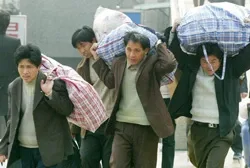
Test runs of the "forgiveness mechanism" for visitors who do not burden themselves with formalities are under way in Moscow and the Moscow region since the end of August and will end on December 1.
According to Vyacheslav Postavnin, head of the external labor migration department of the Russian Federal Migration Service (FMS), 2,000 guest workers have been legalized in the first two months. True, only a few construction sites were selected for the experiment "Migration and Amnesty". The essence of the demonstrative forgiveness campaign in a nutshell is this: if a migrant does not go to the FMS, then the FMS goes to the migrant. That is, FMS teams, arriving at a site, kindly explain to frightened workers and employers that their intentions this time are good and that officials are not going to fine illegal migrants but to register them "in accordance with the procedure established by law".
Both illegal migrants and those who employed them reacted to the unexpected friendliness of migration officials in a quite predictable way. "An employer, already a gray-haired man, was amazed that in our country, it turns out, you can get all documents processed so quickly and without red tape," Vyacheslav Postavnin said the other day. As a result, the Moscow experiment has already been recognized as successful, and it is now planned to extend it to a number of other regions. In addition to Moscow and the Moscow region, Primorsky Krai and Sakhalin, Irkutsk Oblast and Krasnodar Krai are ready to grant concessions in processing documents for migrants.
However, the specific timing of the amnesty for illegal guest workers has not yet been determined due to the lack of an appropriate legislative framework. For the same reason, only migrants from countries with which Russia has visa-free entry agreements will be able to receive documents retroactively. That is, as Vyacheslav Postavnin explained, those migrants who violate administrative legislation but who do not have "criminally punishable acts" on their record, including crossing the border without a visa. After the amnesty is announced, such an illegal migrant will receive his basic documents in a simplified manner: a migration card and a work permit. According to the FMS representative, this will take no more than ten days, whereas currently this process can take months.
Alongside preparations for the amnesty, the FMS is also preparing changes to legislation that would make the accelerated acquisition of documents not a one-time event but a legal norm. According to Vyacheslav Postavnin, if the amendments are adopted, Russia will receive "the most liberal migration legislation". In the meantime, according to the official, the simplification of the process is hindered by red tape at the regional level and the need to register foreign workers at their place of residence, for which the employer needs to have housing stock. He believes it is necessary to change this norm to a notification-based registration at the place of stay.
As Vyacheslav Postavnin said, according to various estimates, between 5 and 15 million illegal migrants currently live and work in Russia, about 80% of them are citizens of the former Soviet republics. They have lived in Russia for years, many have started families and, apart from the lack of documents, have actually integrated into Russian life. "If we do not legalize them, we will make them rightless and push them onto the path of crime. They can be organized into any kind of disorder. But if everything is fine with them, they are unlikely to take risks," the official explained.
According to FMS estimates, about 1 million guest workers will be forgiven and set on the right path during the amnesty in the eight regions. True, such an amnesty by definition cannot be the last: other illegal migrants will come in place of some, and sooner or later they too will need to be forgiven and provided with documents. At least, as Postavnin acknowledged, this is exactly how it happens in many countries with extensive experience in receiving workers from abroad. "Amnesty is not a panacea," he said. "But it is at least a kind of valve to relieve tension in society."
BY THE WAY
According to official statistics, an absolute decline in the working-age population will begin in 2006. If current demographic trends continue, by 2050 there will be no more than 100 million Russians. By that time, scientists predict, a country such as Bangladesh will have three times as many people. The demographic crisis is so serious that the decision to change from deportation policy to migration policy was made personally by the Russian president in the spring of 2005.
According to amendments to the Code of Administrative Offences that came into force in 2004 and toughened penalties for violators of the migration regime, a company that uses illegal labor must pay a fine of 50 to 200 thousand rubles (500-2,000 minimum wages), the head of an enterprise - 2.5-10 thousand (25-100 minimum wages), and an individual (the illegal migrant himself) - from 500 to 2,000 rubles. For providing housing to illegal migrants, the host party must pay an additional fine of 10-50 thousand rubles. In addition, a fine has also been introduced for transport organizations that carry people across the border without proper documents - 50-100 thousand rubles.