
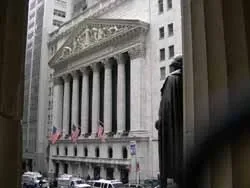
After the collapse of the Twin Towers, the police blocked driveways and passages with concrete barriers, some streets were closed to traffic entirely, and security services of financial corporations and government agencies moved out of buildings onto the street, under canvas tents, which also hindered movement.
The exchange guards also sit in such a tent. These guys in special jackets similar to police ones know their maneuver thoroughly. First round: they check all your belongings manually. Second: who are you going to and why? They call that person out of the building so that he nods - yes, this is my guest - and shows a piece of paper. A guest is not allowed in alone, only with an escort. Third round: already inside the building, X-ray scanning of belongings. I had a corkscrew in my bag among papers after an editorial party; they spotted it, examined it carefully, and after some hesitation returned it. Fourth round: the guest is photographed and immediately given an ID badge, which must be worn on the chest and must be surrendered upon exit.
The dress code matches the inspection, also strict. Formal trousers (no jeans), boots (no sneakers or sandals), shirt with classic collar, jacket, tie. The exchange workers themselves wear blue and brown satin jackets with sewn-on numbers and surnames. The head of the exchange's press service, Christian Brakman, led me to a balcony gallery overlooking the trading floor. A huge under-dome space with a skylight and glass wall, with checkerboard-placed trading posts around which buyers scurry. The hall evoked associations with a central market in the capital: a bazaar is always a bazaar, whether they trade eggplants, oil, or company stocks. There are five such halls in the exchange, differing in size and design nuances. The exchange over the years swelled and expanded, requiring new living space. And it all started with... a fence.
In 1653, Dutch settlers built a wooden palisade four meters high across all of Lower Manhattan – from the Hudson to the East River – to protect against attacks by the British and Indians. Thirty-two years later, Wall Street (literally 'wall street') was laid along the palisade. In 1790, the stock market was born in the USA. The US government paid off war debts by issuing $80 million in bonds. They could be bought and sold at market quotes. Two years later, trading in securities, both government and private, began. Under a sycamore tree on Wall Street, on May 17, 1792, 24 brokers signed the Buttonwood Agreement establishing the New York Stock Exchange. In 1817, the organization adopted a constitution – a set of rules and standards. At the same time, the exchange rented headquarters for an anecdotal by today's standards $200 a month.
In 1835, a great fire destroyed seven hundred buildings in Lower Manhattan, including the exchange. It had to be rebuilt. The current exchange building was designed and built at the beginning of the 20th century. The competition, which involved eight leading architects of New York, was won by the neoclassical design of George B. Post. The old building was demolished, and in April 1903, a new one was opened in a solemn ceremony. Six massive Corinthian columns adorn the proud facade. Everything is done with a claim to grandeur. Marble-clad walls, an intricately ornamented ceiling, an air conditioning system unprecedented for that era. Over the years, as the American and global stock markets grew, the exchange absorbed surrounding spaces, acquiring extensions and trading floors. Today, the exchange is a model of technological advancement. With the advent of the electronic era, the exchange's computer system is updated every day, or rather, every night. $400 million a year is spent on technological equipment upgrades.
1,366 chairs
As a humanities person, to whom Camus's existentialism is more understandable than debit and credit, the mystery of the exchange always seemed unfathomable. Who are these people scurrying around the hall? Why do they have to yell? What are those pieces of paper that litter the floor after trading?
So, kind people explained to me, trading on the NYSE is a continuously operating auction in a democratic format of 'everyone dance'. Who dances the lezginka, come to podium number one. Those doing the twist are asked to gather at podium number two. Samba lovers - come here, and hopak fans - way over there. That is, each trading post on the exchange floor trades stocks of a certain group of firms. All buyers representing investors gather around a specific 'post'. There are a total of 1,366 of these trading places. In English they are called 'seats' because until the 1870s, exchange members sat on chairs. Now few people sit; trading is mostly in a buffet style, only without champagne (after trading, as much as you want). In 1868, the organizers agreed that there would be 533 seats, but then the 'limit' was increased several times until in 1953 they decreed for ages: 1,366, and not a seat more.
These places today are far more expensive than the chairs from Madame Petukhova's set. After all, they give the right to trade stocks of the largest companies directly, without intermediaries. It is believed that the highest price for a seat was paid in 1929, when it was bought for $625,000, which corresponds to $6 million today. In recent years, seats have sometimes sold for $4 million, and during the downturn in 2001, they were barely taken for a million.
Having said that the exchange, briefly called by its first letters NYSE, is the largest in the world, we should immediately clarify. Yes, it is the largest in terms of capitalization of companies traded here. If you add up the market value of the securities traded here, the sum will exceed $22.5 trillion, of which about $7 trillion is the capitalization of non-American companies. For comparison: the US gross national product, according to the CIA, amounted to $12.4 trillion in 2005, and Russia's - $1.6 trillion (at purchasing power parity). In terms of the number of traded companies, the exchange lost its primacy in the 1990s, yielding to the electronic and therefore more dynamic NASDAQ exchange. But in terms of total capitalization, the old lady NYSE is about five times heavier than its competitor.
Listing on the NYSE is an indicator of a company's global level. Getting into it is difficult and troublesome. You need to meet many very strict requirements. And pay substantial sums. The initial fee is $36,800 plus a certain fee for each million shares. The annual listing fee depends on the number of shares issued and ranges from 16 thousand to half a million dollars. For example, if a company issues 4 million common shares, it will pay a one-time listing fee of $81,000 and an annual fee of $16,000.
Getting listed on the NYSE is both desirable and painful. Painful because of the need for full transparency. Above the NYSE stands the incorruptible federal Securities and Exchange Commission (SEC), which reports to Congress. A multi-level control pyramid - no room for mischief.
America's Newsmaker
The hierarchy and dialectics of trading are very complex. But if we simplify a bit, the whole crowd of shouting people on the exchange can be divided into two categories. The first is brokers, the main fighting army of the exchange. It, in turn, is subdivided into in-house brokers, a kind of exchange elite representing large financial investment corporations like Merrill Lynch and Bear Stearns, agent brokers working on commission from numerous brokerage firms, and independent brokers, lone wolves. The second category is specialist traders. They perform the functions of auctioneers, agents servicing special orders of brokers, 'catalysts' stabilizing prices and maintaining the market in normal mode, and finally 'principals' - dealers spending their own capital to reverse a negative trading trend. Complicated?
Not at all: in each of the five trading floors there are about 400 specialist traders. Each is assigned to his own 'post'. And around them sways a broker sea - in total, about three thousand 'dancers' hang out on the exchange at the same time. Everyone knows where in the market the shares of certain companies listed on the exchange are traded. Orders to buy and sell come by phone or email from anywhere in the world. So at the intersection of supply and demand, the price is formed at a given moment. During the trading day, millions of shares change owners. A kind of quicksand of finance.
Traditional exchange members consider this relapse of the Novgorod veche to be a very effective mechanism for determining stock prices. The auction tug-of-war between live buyers and sellers radically distinguishes the NYSE from impersonal electronic markets, where the cries and groans of brokers are replaced by the beeping of computers and the blinking of monitors. Of course, electronics also play an important role on the NYSE, but the human factor still remains decisive here. Although recently the process of convergence has been increasingly active - a 'hybrid market' is being born, combining elements of traditional and virtual exchanges.
The exchange's working hours are from 9:30 am to 4:00 pm. During this time, half of America, whose money is invested in securities either directly or indirectly through pension funds, watches the Dow Jones Industrial Average (DJIA) on TV or the Internet. This brilliantly simple financial barometer was invented at the end of the 19th century by Wall Street Journal editor Charles Dow and statistician Edward Jones. The index is calculated based on the quotes of thirty largest industrial corporations and reflects the current state of the American and, to a large extent, the world economy. Through the DJIA, the exchange communicates with the world of ordinary people.
For the average John Smith, the index means where he stands today with his shares. After all, many remember well how at the end of the last century the shares of newfangled computer and internet bubble companies crashed and millions of investors got burned badly. On October 27, 1997, the Dow Jones index fell by 554.26 points, and the exchange management had to resort for the first time to the 'circuit breaker' rule, that is, to halt trading for a while. The idea of this safety valve is very simple - investors should cool down and rethink their financial strategy. The stock market crash of 'Black Tuesday' on October 29, 1929, when investors in panic began dumping all shares indiscriminately, taught the NYSE management a lot. Over time, a system for stabilizing and protecting investor interests was created on the exchange. But playing with securities, with all conceivable 'safety cushions', still remains a nervous and risky business.
It should be said that there were moments in the exchange's history when the ritual bell, with the strike of which the working day begins, did not ring - force majeure! The exchange was closed due to World War I, but reopened a few months later to urgently sell war bonds. Life here also froze from September 11 to 17, 2001, due to the terrorist attack on New York.
There were also scandals. On August 24, 1967, hippie leader Abbie Hoffman led a group of his followers to the balcony gallery of the exchange. The leftists, protesting against the beastly grin of imperialism, began throwing handfuls of fake dollar bills down below. And the brokers, obeying instinct, began frantically catching them. Hoffman pointed triumphantly at the greedy scramble, denouncing the sin of avarice.
And in 2003, the exchange was shaken by a scandal of a different kind. Richard Grasso, then head of the NYSE, grabbed a premium package worth $140 million, which stunned even the most seasoned Wall Street sharks. Legal battles ensued, and Grasso was sent into retirement. The former top manager is being asked to return at least part of the bonus. Incidentally, an intriguing version of these events was put forward by publicist Gary Weiss in his book "Wall Street vs. America." He believes that the exchange kings rewarded Grasso for preserving the archaic model of the trading floor, which, as Weiss writes, "should have long been buried in a marble mausoleum."
People of the Exchange
As Christian Brakmann notes, today the margin (difference) between the selling and buying price of stocks is shrinking, so traders and brokers need to increase sales volumes to earn more, meaning they have to work non-stop. They come here straight after finance college, start as assistants and aides, fetch and carry, and reach their growth ceiling around age 40-45, unless, of course, a heart attack from overexertion takes them down. However, there are exceptions: they say the oldest broker is a 94-year-old veteran.
Exchange workers are on their feet from early morning – by the opening bell they must be prepared, familiar with the indices and currency rates of the London and Tokyo exchanges. There is no lunch break; no one goes to a restaurant for lunch; they snack on hamburgers and coffee in paper cups on the go. An apprentice starts with a base salary of $50,000 a year; over time, for the lucky ones, it grows to six-figure numbers. And the senior partners of brokerage teams are almost all millionaires.
Specialist traders, like traffic police, vigilantly monitor financial traffic and compliance with rules. Brokers must be loyal to their clients and not use confidential information for personal gain. Spotting suspicious transactions, the controllers immediately take note of the participants. If something untoward happens again with the same players, a secret investigation begins. Violators of the convention, whether in the area of insider trading (when exchange employees, in breach of commercial secrecy, whisper to relatives and friends on the side – buy or sell, and split the profit) or spreading false information (like "we are declaring bankruptcy tomorrow," when they are not, and profiting from the panic), are severely punished and, of course, permanently expelled from the exchange.
And why, after all, is the entire exchange floor littered with trash at the end of the workday? Tradition, however. Transactions are recorded electronically, but most brokers prefer the old way of writing down numbers in their notepads. When quotes change, they tear out the pages and throw them on the floor as useless. It seems they disrespect the work of the cleaners, but on the other hand, they ensure a steady income for them. The dialectics of capitalism.