
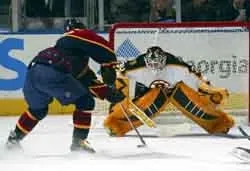
One can long debate the charms of this not-so-easy game (injuries in hockey lurk at every step), but one cannot deny the fact that after 1998, when the IOC and NHL leadership found common ground, the hockey tournament significantly improved its image.
For a long time it was believed that only amateurs could compete at the Olympic Games. They say professionals have nothing to do here. However, if we take only hockey, even Canadian amateurs at the dawn of the Winter Olympics were so strong that they won tournaments by a wide margin. It was the Canadians who became the first winners of the Olympic Games; they are also the current champions and will come to Turin to defend the title.
In the history of hockey, a special place is occupied by the 1956 Olympic Games, which, like now, were held in Italy. Then the USSR national team debuted at the Winter Games and, led by the famous footballer and hockey player Vsevolod Bobrov, won a confident victory. Having unexpectedly stumbled four years later in the USA, Soviet hockey players then became champions several times in a row, which considerably upset the Canadians. They even demanded that the USSR be prohibited from fielding at the Olympic Games a team made up of players competing in the national championship. They say, what kind of amateurs are these if they earn a living by hockey alone? In fact, the NHL championship was in full swing, which made it impossible to gather all the strongest players, and no one was going to stop it for the Olympics. However, the Canadians' claims were left unanswered, and then they pretended that the Olympic hockey tournament was a farce.
And so, on the eve of the tournament in Nagano, it became known that the NHL leadership, in order to popularize its League, decided to take a break in the regular season so that the leading hockey players of the planet (and it is the stars who play in the NHL) could take part in the Olympic Games.
Since 1998, hockey tournaments once every four years have become a real exhibition of talent, and predicting who will become champion is simply unrealistic. One can only guess, because several super-powerful national teams come to the Olympic Games at once – Canadian, American, Russian, Swedish, Finnish, Czech and Slovak. From time to time, Latvians and Belarusians resist the favorites, and Ukrainians have also shown that they were once part of the Soviet school.
Our national team will not be in Turin; it failed to overcome the qualification barrier, but this will not diminish the attention of Ukrainian hockey fans to the Olympic Games. After all, the very cream of society will gather to perform in the capital of Piedmont!
It is enough to pick up the rosters of the national teams and then compare the entries with the NHL statistical data. You will see that if you spare a little time during the Olympic tournament, you will enjoy the play of outstanding masters. Even despite the fact that it was not possible to gather absolutely all the strongest (mainly due to injuries). For example, some of the world's best goaltenders will not play: Mika Kiprusoff (Finland) and Nikolai Khabibulin (Russia), defensemen Scott Niedermayer, Ed Jovanovski (both – Canada) and Niklas Kronwall (Sweden).
For gold medals in Turin, the following will certainly compete (unless some force majeure happens): the current best NHL scorer, Czech Jaromir Jagr, the League's best sniper, Russian Ilya Kovalchuk, the best rookie – another Russian, Alexander Ovechkin, who burst into the NHL like a meteor, the highest-scoring defenseman Lubomir Visnovsky of Slovakia, and many others.
The Canadian team looks quite strong. Probably, it is the main favorite of the tournament. The "Maple Leafs" have three excellent goaltenders – Brodeur, Turco and Luongo, excellent defensemen (Blake, Foote, Pronger and Redden), and a star forward line (in addition to the snipers mentioned above, the roster includes Lecavalier, Iginla, Richards, Nash and Bertuzzi).
A decent selection of players was assembled by Pavel Bure, the famous former Russian national team player, who became its general manager. Bure, who shone in Nagano-98, was close to having three NHL goaltenders at his disposal – Khabibulin, Nabokov and Bryzgalov. However, as we already said, Khabibulin got injured, and his place will be taken by Sokolov, a representative of the Russian Super League.
The Czechs also claim first place, whose ranks will be defended by the legendary Jagr and Hasek. Also the Finns with Selanne and Koivu, the Slovaks, whose roster has practically not changed in recent years. And, of course, the Americans, who have a unique hockey player – Chris Chelios. For the 44-year-old defenseman of the Detroit Red Wings, these will be his fourth Olympic Games. But that is not the main thing, because similar achievements can be boasted by American Tkachuk, Germans Ustorf and Benda, Swede Jonsson, Czechs Hasek and Lang, Finns Numminen, Lehtinen, Selanne and Kapanen, Italian Topatigh and Russian Kasparaitis.
The most interesting thing is that when Chelios takes the Olympic ice in Turin, he will become the first hockey player to compete at the Winter Games 22 years after his debut (at the 1984 Olympics in Sarajevo). To date, the record in this category belongs to Swiss player Bibi Torriani, whose gap between his first and last Olympics was 20 years (1928–1948).
In addition, the veteran defenseman could become third on the list of oldest participants in hockey tournaments in the history of the Olympic Games. In this category, he is surpassed only by Hungarian Bela Ordody and German Alfred Steincke, each of whom took part in the 1928 Olympics in St. Moritz at the age of 48.
It is also curious that to become a record holder, Chelios had to wait 14 years after Sarajevo-84 until the NHL leadership released League players for the Games in Nagano. That tournament became only the second in the veteran defenseman's career, and then he took part in the 2002 Olympics.
Another well-known hockey player representing the Latvian national team, Sandis Ozolinsh (who plays for the Mighty Ducks of Anaheim), was forced to undergo treatment for a harmful addiction before the New Year. The nature of Ozolinsh's addiction is not specified, but it is usually either an addiction to alcohol or to narcotic drugs. As reported by news agencies citing the NHL Players' Association, the 33-year-old defenseman will undergo a special course of treatment. Anaheim general manager Brian Burke stated in this regard that the club respects Sandis for having asked professionals for help and will do everything to support the player. However, this did not prevent Ozolinsh from making the Latvian national team for the Olympic Games, which will be his second. It is worth noting that Ozolinsh is one of two Latvian hockey players representing an NHL club. The second is defenseman Karlis Skrastins from the Colorado Avalanche (the rest play for European clubs).
A similar picture is observed in the Kazakhstan national team, where only two – goaltender Vitaly Kolesnik and forward Nikolai Antropov – play in the NHL. The former is in the Colorado Avalanche, the latter in the Toronto Maple Leafs.
It remains to add that the men's ice hockey tournament (and, more recently, the Olympic Games have also featured competitions for women's teams) will begin on February 15 and end on the 26th, the closing day of the Games.