
At the ceremony on July 7, 2007 in Lisbon announcing the new Seven Wonders of the World, the following were recognized as such: the Great Wall of China, the rock city of Petra in Jordan, Brazil's Christ the Redeemer statue above Rio de Janeiro, the ancient Peruvian city of Machu Picchu, the Mayan pyramid complex of Chichen Itza in Mexico, the Roman Colosseum, and the Indian mausoleum Taj Mahal. Among the leading contenders, the Eiffel Tower in Paris held on until the last moment, but in the end it was overtaken by the Roman Colosseum – the only representative of Europe among the new wonders.
The voting took place over two years on the project's website, launched by Swiss Bernard Weber, and via SMS in all countries of the world. UNESCO never supported the project, considering it merely a distraction from the truly important tasks of preserving world cultural heritage. Despite the global nature of the event, fewer than 100 million votes were cast for the 21 finalist candidates, although it was quite easy to vote multiple times.
The new Seven Wonders of the World represent very different eras in human history. The earliest in time on this list is Petra in Jordan. It is believed that the first structures in this city were built as early as the 2nd millennium BC, and there are no buildings later than the 6th century AD.
And the longest to build was the Great Wall of China. It is also the largest 'wonder' – the length of all the wall's lines is 6,350 km. It is the only man-made creation visible from space with the naked eye. Its construction began during the reign of Emperor Qin Shi Huang (Qin Dynasty), during the period of the 'Warring States' (475-221 BC). A fifth of the country's population at that time, i.e., about one million people, took part in the construction. The sections of the Great Wall that have survived to our time were built mainly during the Ming Dynasty (1368-1644).
The only new wonder of the world that went to Europe is the Roman Colosseum. The largest surviving Roman amphitheater is actually called the Flavian Amphitheatre, and the building, completed in 80 AD, got its name from the colossus (giant statue) of Nero that stood next to it.
Two 'wonders of the world' relate to the pre-Columbian cultures of America. Chichen Itza was the political and cultural center of the Maya in the north of the Yucatan Peninsula (Mexico). It was founded probably in the 7th century AD. In the 10th century it was captured by the Toltecs. From the mid-11th century, Chichen Itza became the capital of the Toltec state. In 1178 it was crushed by the combined army of three city-states – Mayapan, Uxmal, and Itzmal, led by Hunac Ceel. By the time of the Spanish conquest, Chichen Itza was in ruins.
Machu Picchu (literally 'old peak') is sometimes called the 'lost city of the Incas'. This city was created as a sacred mountain refuge by the great Inca ruler Pachacutec a century before the conquest of his empire, that is, approximately in 1440, and functioned until 1532, when the Spaniards invaded the territory of the Inca Empire. In the same year, all its inhabitants mysteriously disappeared. The city is located on the top of a mountain ridge at an altitude of 2,057 meters above the Urubamba River valley on the territory of modern Peru.
The Taj Mahal mausoleum is built on the banks of the Yamuna River near famous Agra. The building was erected by order (and possibly with the active participation) of Shah Jahan of the Great Mughal dynasty in 1630-1652 for his beloved wife Mumtaz Mahal, who died in childbirth. The distorted name Mumtaz gave the name to the mausoleum (later Shah Jahan himself was also buried in it). About 20 thousand people took part in the construction. Historians of Indian Muslim architecture name the famous Persian architect Ustad Isa as the architect of the monument. The structure is a five-domed building about 74 meters high with four minarets around it. Now this newly-minted wonder of the world has turned yellow from dirty air and regular hygienic procedures have been prescribed for it.
The only new wonder of the world that can be considered truly new is the Christ the Redeemer statue, erected on Corcovado Mountain above Rio de Janeiro in Brazil. This 38-meter statue was built over five years. The grand opening of the sculpture took place on October 12, 1931.
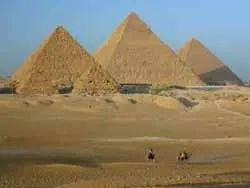
Besides the Moscow Kremlin, another 13 cultural monuments failed to garner the required number of votes. The Egyptian pyramids at Giza ceased to be a wonder of the world (from the point of view of voters, of course). Such monuments as the Eiffel Tower, the Alhambra, Timbuktu, the Statue of Liberty, the Bavarian castle Neuschwanstein, the Acropolis in Athens, the Cambodian temple Angkor Wat, Hagia Sophia, and the Japanese temple Kiyomizu, the megalithic monuments of Easter Island and Stonehenge did not make it onto the list.
Let us recall that of the previous seven wonders of the world, only the Egyptian pyramids at Giza remain. The Hanging Gardens of Babylon, the Temple of Artemis at Ephesus, the Statue of Zeus at Olympia, the Lighthouse of Alexandria, the Colossus of Rhodes, and the Mausoleum at Halicarnassus have not survived. Therefore, in 2001, Swiss millionaire Bernard Weber proposed to declare a global vote to select new seven architectural masterpieces.