
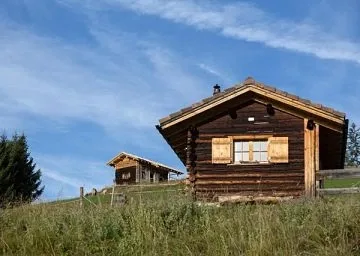
In the Swiss Alps, you can find many attractive huts
But, alas, converting old buildings to a new style is not at all easy. And foreigners wishing to do so need a residence permit in the country, because buying real estate does not grant the right to a local "green card."
Meanwhile, as Swissinfo.ch notes, among the buildings there are indeed very interesting objects: stone or wooden huts look as if Heidi, the heroine of a famous Swiss children's book, might appear from behind the door. Some are completely abandoned, half-rotten, filled with trash, and you don't even want to enter them. But the view from the window is incredible! Long ago, they served as summer housing for farmers and herders who drove cattle to mountain peaks in summer and to valleys in winter.
Such structures are called differently in different regions: "mayens" (from the word for "corn"), "rustici" (from the word for "ancient"), or simply "Stall" (stable). These half-residential, half-agricultural temporary shelters in the Alps, having completely lost their practical use, have nevertheless retained a peculiar charm. It should be noted that the price for such buildings, despite their unpresentable appearance, is quite high. Be prepared to shell out from 30,000 to 150,000 francs.
Do you know what's interesting? Our ancestors built with remarkable conscientiousness. All these abandoned huts, despite their considerable age, remain in good "physical shape" today. Of course, some are literally falling apart, but as builders say, "the whole substance" is in place and quite solid, meaning they can still be repaired. However, the Swiss "Association for Spatial Development, Landscape Architecture, and Protection of Natural and Cultural Monuments" (Verein für Raumentwicklung Kultur und Landschaft – RAKUL) believes that such buildings disfigure the landscape.
This organization maintains a database with information about such objects, photographs them, and investigates what prevents owners from putting their property in order. As the association says, the goal of this inventory is to prove that the Swiss federal law "On Land Zoning and Cadastre" (Raumplanungsgesetz) causes significant harm to the tourism business of the canton of Graubünden.
In reality, such "sheds" and "huts on chicken legs" can be repaired and used as country houses or rented out to tourists. In terms of size, they are quite suitable: compact, from 25 to 50 square meters of living space. It is quite possible to fit everything needed for a short vacation or even a holiday there.
Real estate agents Armin Agten from the canton of Valais and Gian Derungs from the canton of Graubünden specialize in rural housing and show interest in abandoned buildings. "I could sell one such 'corn hut' every week!" says Armin Agten.
Foreigners have little chance
He could! If not for various legal obstacles. "Literally 99% of such huts are located within agricultural zones," explains A. Agten. This means that the buyer "cannot simply move into their property and settle there. To use a former stable or forest lodge as a residential or vacation home, permission from the authorities is required. And here the potential buyer most often hits a brick wall," says A. Agten.
His colleague Gian Derungs confirms that, based on his experience, all current procedures for obtaining permits and approvals are still complicated and tedious. It is very difficult to understand and prove what part of the hut was used for what purpose (residential or not) as of 1972 (the year when Switzerland began to distinguish between zones for construction and zones where construction is prohibited). After all, it is based on this data that Switzerland today assesses the prospects for renovation and expansion of a building.
And if a lodge or old storage shed has already begun to deteriorate, permission to convert them into residential premises may not be granted. This is based on the fact that the objects are located within zones designated for agriculture. "There are fairly good chances of obtaining a renovation permit if the hut is on the list of protected monuments, meaning it is under state protection," explains A. Agten.
In other words, the more picturesque such a forest or mountain house looks and the greater its value, the more likely the authorities will allow it to be repaired and given new life.
Sometimes A. Agten and G. Derungs are approached by buyers from abroad. But selling country houses to foreigners without a residence permit in Switzerland involves even greater difficulties. Depending on the canton, such an endeavor is either completely hopeless or involves obtaining a special permit.
Costly repairs
But the "complicated" law is not the only obstacle to realizing the dream of a small house in the Swiss mountains. The second problem awaits the potential owner inside – often the deplorable condition of the hut. That is why A. Agten recommends bargaining to the last and in no case overpaying. After all, repairs can cost several times the purchase price.
"For your money, you'll get something like a wooden frame on bare ground," explains G. Derungs. "Renovating a 'rustico' or 'mayen' for less than 300,000 francs? Don't even dream of it. But you'll get a truly miniature country house that meets high Swiss quality standards."
A. Agten recommends not overdoing it with renovations, but simply enjoying the antiquity without making too many changes. After all, those who care for a forest or meadow hut while preserving its pristine state thereby make a notable contribution to preserving the natural diversity and culture of the region. Keeping a building in a state close to the original is especially valued in Switzerland. And a willingness to maintain it will please local authorities for the protection of natural and cultural monuments (whose opinion also carries weight when obtaining renovation permits).
To avoid unpleasant surprises, J. Derungs advises checking not only the date and purpose of construction but also ensuring the full legal purity of such a "corn storage." "It is worth obtaining from the municipal and cantonal archives all previous building and renovation permits. This is a paid service, but it pays off," he explains. "This way, you can verify whether all changes made were indeed authorized at the time." Otherwise, there is a risk that you will be required to restore everything to its original state at your own expense.
Primitive living conditions
"Another thing to note: Swiss mountain huts were generally built as a kind of mini-complex consisting of one or two small living rooms and a barn or stall for livestock, since they were intended for short-term use, not for permanent residence, especially in winter," says A. Agten. However, he adds that in regions where "there is no serious danger of avalanches, you can use such a hut, remodeling it as needed, even in winter."
Another important point to consider is that most of these huts have no connection to electricity, running water, heating, or sewage systems. They are simply too far from settlements with modern infrastructure.
But even here, clever alternatives exist: a solar panel on the roof can generate electricity, and a composting toilet replaces the sewage system. Some hut owners also use wastewater tanks that are emptied by farmers once or twice a year. "In winter, you can melt snow to get water, fortunately it's clean in the mountains," suggests A. Agten. "And in summer, rainwater tanks allow you to take a shower," adds J. Derungs.
But no matter what we come up with today, life in mountain huts, despite all the tricks, will always dictate the same conditions and rules as in Heidi's time, being an example of simple and modest peasant life in direct contact with nature.