
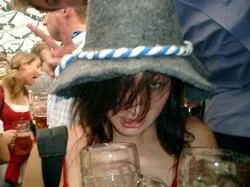
Here you begin to feel the breadth of the German nature: how can one call petty people who drink alcohol from one-liter mugs. Though the alcohol is no great shakes. Not teeth-shattering whiskey, rum or vodka, not exquisite wine... Just beer — a drink of the proletariat. At the mention of “Oktoberfest”, German intellectuals first wrinkle their noses with disgust, but still look in on this largest drinking binge of the year, and after the second mug their noses straighten out and their owners have a wild time together with the common people.
To understand what Oktoberfest is, it is quite enough to visit it just once: from year to year nothing fundamentally changes there. Well, maybe they set up different rides and prices rise, but the essence remains the same. A huge area — Theresienwiese — is divided roughly into two parts. In one of them alcohol and gluttony rage, while in the other, various swings and carousels try to shake all that you have drunk and eaten back out of you.
That is German dialectics — the unity and struggle of opposites. In the beer tents themselves the atmosphere approaches extreme. They are almost always filled to capacity, everyone smokes, and the stench is such that a thrown axe literally petrifies in the air. You watch the poor regulars and marvel at their courage, long-suffering, and ability to enjoy life in these unbearable conditions.
My personal record of staying in a tent was no more than half an hour, after which I shamefully fled, conscious of my failure to match the steely characters of Bavarian beer lovers. The impression is reinforced by incredibly loud music both inside and outside the tent. This music, with rare exceptions, is of the kind they call Volksmusik in Germany, that is, jaunty songs of German peasants, maximally poppy-fied by the most loathsome German popsters. I have never heard anything more disgusting in my life. Except perhaps the output of the amazing Russian pop scene can outdo them.
Now to practical advice. I would like to say a few words about how to properly drink beer from the aforementioned one-liter beer mug called a “Mass” in Bavaria. Naturally, people who are not versed in the subtleties of Bavarian aesthetics grab this mug by the handle and begin greedily consuming the drink. By this sign you can always tell a “sucker” from a “seasoned veteran.” An experienced Oktoberfest-goer will never take it by the handle. He will slip four fingers and his palm through it, and with his thumb grip the handle from above, tenderly embrace the “Mass” around its nonexistent waist, and only then begin the sacred rite.
If you have come to Bavaria, even if only for Oktoberfest, you must taste the local culinary and alcoholic delicacies. The main ones are considered to be unfiltered beer Weizen, produced only in Bavaria, and special white sausages Weisswurst, which are also eaten only in the south. For Weizen beer there is a special vessel. Since it is unusually foamy, it is poured into a special half-liter glass, wide at the top and tapering toward the bottom. Only a complete ignoramus or a person who is indifferent to everything in life would drink an ordinary Pilsner from such a glass.
The fact that Oktoberfest for Bavarians is not just a drinking binge but a patriotic event is indirectly confirmed by the abundance of people in national costumes at the festival. All year this exotic attire patiently waits its turn, forlornly gathering dust in old chests. But at Oktoberfest it shines like no other! Incredible women's outfits, called here by the monstrous word “Dirndl” (Dirndl), with huge décolletés proudly displaying the considerable charms of local beauties, suede shorts and collarless jackets for men — a touching tribute to tradition and bygone times. This is definitely worth seeing. If you meet a person in such attire in Munich or somewhere in Bavaria during these days, you can be sure — he is going to Oktoberfest.
Also striking is the absolute absence of aggression among such a huge number of completely drunk people. But do not think that after drinking beer, Germans become sluggish and pensive. Quite the contrary: they carouse so that the heavens get hot. Once I watched a very tipsy lady dancing on a table, shaking the petticoats of the notorious dirndl with all her might. And it turned out she was a gymnasium teacher, a lover of Mozart and Schiller, and outside Oktoberfest it was utterly impossible to imagine her on a table, hitching up her skirts.
It seems to me that the matter lies in some peculiarities of the local air or geomagnetic conditions, and the intoxicating drinks here produce a truly intoxicating effect. Everyone guffaws and chats like mad. A completely drunk two-meter-tall fellow with a substantial beer belly, coming out of the tent, falls, unable to take another step. This causes a fit of furious merriment among the onlookers, who all rush to lift the poor fellow up, contrary to the advice of old Nietzsche. He falls again, and the merriment grows to truly Homeric proportions. Policemen strolling along the Theresienwiese watch this condescendingly and almost affectionately — as if to say, we'll all be there. Fraternization and peaceableness are simply amazing!
And all this disgrace is crowned, or rather hovers above it, by the huge statue of Bavaria. Mother Bavaria stands on a hill and lovingly watches her children have fun.
But the most interesting part comes after the festival. In a few days all the giant tents, colossal rides and Ferris wheels are removed completely. One would think all this was built for centuries. And a week later there remains a perfectly flat, empty area, and it is absolutely impossible to imagine that almost five million people from all corners of the globe were raging here quite recently.
Petr SYTENKOV.Gazeta.Ru