
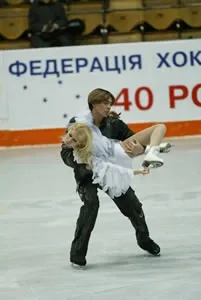
Over the past seven years they have been gradually improving their skills and now are rightly considered among the main contenders for medals at various competitions. In the Ukrainian championship they have no equal, and yet in 1997 they finished only third. At the World and European Championships they previously only made the top ten.
The turning point came in 2001-2002, when the skill of the Ukrainian pair reached a level that the perennial favorites, the Russians, began to fear. And if the Odessans have not yet conquered either the European or the world peaks (the guys even sadly joke that being eternal fourth is their diagnosis), then at the Grand Prix stages their piggy bank was replenished with three gold medals from 2002 and three silver medals from 2003.
And at last at the 2004 European Championships the dream came true! The charges of Nikolai Morozov won their first medal of the continental championship - bronze. They were joined by Kyiv singles skater Elena Lyashenko, whose silver became her second award after bronze at Euro-95.
Many attribute such a rise to Elena and Ruslan's move to the USA. There, unlike Ukraine, which has only four rinks suitable for training serious athletes, they have a wonderful opportunity to do what they love. In addition, in the States this pair can train with leading coaches, primarily Russian ones. So, they collaborated for more than a year with Tatyana Tarasova, who raised more than one champion, and now work with another grandmaster of the coaching craft, Nikolai Morozov.
What prompted you to move overseas?
(Elena Grushina) We worked in Ukraine for a long time, trained at our native Odessa rink, but upon receiving an invitation from the States, we could not refuse it. Now in our country it is very difficult to maintain ourselves at the level, so we decided to try working in North America.
In the near future you will once again have to 'sort out relations' with the same rivals (the Russians Tatyana Navka and Roman Kostomarov, who took first place at the Europeans, and the silver medalists from Bulgaria, Albena Denkova and Maxim Staviski. - ed. note). What are you counting on at the World Championships?
(E.G.) We are going to Dortmund for medals and will fight for them. I hope we manage to make it into the top three. Our skating at the Grand Prix stages and final, as well as at Euro-2004, proved that we can handle any rivals. The more our opponents fear us, the further the judges try to push us back so that there are no problems. This really interferes - after all, we have to fight not only on the ice but also beyond it.
(Ruslan Goncharov) If our pair were not as strong as it is now, we would not be placed in positions that clearly do not match our level. I consider the Navka/Kostomarov pair to be strong rivals for medals, because through the influence of the Russian federation they have weight, they are listened to. If we manage to break this tradition, we will be able to fight not only with them, but in general, I think, with anyone, even with aliens.
What medal are you realistically counting on?
(R.G.) We, of course, aim for the highest level. That we can be first is as clear as day. But achieving it is very difficult. This year we are counting on second or third place.
You have been living and training in the States for more than a year now. How do you feel there?
(E.G.) In purely professional terms, it is much easier for us there: in the USA there are enough rinks, we can train calmly. And we have not had any moral problems. There are many friends and acquaintances. By the way, not only Russians, but also Americans. When we lived in Denver, we had friends there, and when we moved to Connecticut, new ones appeared. The only thing that leaves much to be desired is the language: we still have problems with English. But we try to learn, to communicate, but of course we do not understand everything. Although this does not prevent us from living fully in the USA.
Have you already felt what nostalgia is?
(R.G.) There is no nostalgia as such. There is work and training; there is simply no time for it.
How often do you manage to visit Ukraine and your native Odessa?
(E.G.) We come to Ukraine only on vacation - in summer, in June. In pre-Olympic years we participate in the national championship. That is, when there is an opportunity, we definitely go to our homeland. And the fact that we do not often participate in the national championship is not our fault; it is a financial problem of the Figure Skating Federation of Ukraine.
The national championship was held at not the most convenient time, and the stands were almost empty. Have you probably become unaccustomed to performing without spectators?
(E.G.) The lack of advertising and the bad timing of the competition had an effect. At least the exhibition performances could have been moved to one of the weekend days. Of course, we have already become unaccustomed to performing in front of half-empty stands.
(R.G.) Honestly, the impression was that we had simply come to a training session.
(E.G.) In the States, about the same number of people come to our training sessions. But I cannot say that the low attendance somehow hindered us or, conversely, helped.
The lifespan in big-time sport is short; have you already thought about your future career?
(E.G.) This question is very difficult. We ourselves often think about what to do next. But we come to only one conclusion: while we are in big sport, until we achieve what we have set, we cannot resolve this question. Whether we will go into shows, do something else, it is hard to predict now.
- (R.G.) Two years ago we didn't know we would gain such popularity. When we read fans' letters and hear their shouts "We love you!", we want to keep performing. There was an interesting case last year when the Grand Prix final was held in St. Petersburg. Before arriving, we were a bit afraid of the public's reaction, since we are among the main rivals of the Russians. But the reception exceeded all expectations - I was even a little shocked at how well the spectators received us. Of course, a somewhat different audience comes to figure skating than, say, to football, but even for our sport this was surprising. And that's not to mention Ukrainian fans.
- And yet, after your career ends, do you plan to return to Ukraine or stay in the USA?
- (E.G.) As they say, where there is work, there is a person. So we don't know yet, it will be seen later.
- (R.G.) Viktor Petrenko is a good example in this regard, who together with the national federation holds various events in Ukraine. He does a lot to popularize our sport. Also, Ukrainian coaches, while in the USA, try to train their compatriots. Of course, it is preferable to work in the States. And it's not that we don't love our homeland or don't want to return. Not at all. It's just that all conditions for training and work are created there. I love my city and my country, but I work in the USA...
- (E.G.) In our free time we do part-time work - we train young people, which is quite interesting. We have something to teach children. But these are again Americans. We cannot pass on knowledge to Ukrainian children because of the problem with ice.
- (R.G.) I think everything will be fine. After all, it cannot be otherwise - in Ukraine there are people who can afford to build grandiose buildings for banks, various holdings, etc. I think there will also be those who will build new rinks or at least help restore old ones.