
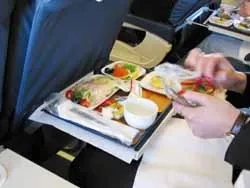
"Why chicken again?"
According to airline employees, this is the favorite question of the average airline passenger who has finally been served lunch. And there is a detailed answer to it, dictated by the requirements of the State Sanitary and Epidemiological Supervision Rules: because a whole piece of meat is the product that best meets in-flight catering standards. Cutlets and other minced meat products, as well as pâtés, sausages, and frankfurters, are strictly prohibited as perishable. What remains? The proverbial chicken and, as an alternative, beef or fish, properly frozen in advance. By the way, it is believed that thanks to shock freezing technology, these products retain their taste.
Moreover, under no circumstances can a passenger be served a salad pre-dressed with oil or mayonnaise; any cream cakes and ready-to-eat culinary products in cellophane packaging are also prohibited. All such food cannot be stored for long even in a refrigerator and can become a veritable weapon of mass food poisoning. In-flight poisoning is the most frightening precedent for airline representatives, which they try with all their might to insure against, with the backing of sanitary and epidemiological supervision. The ban has even extended to mineral water with medicinal properties: what if you make a mistake in choosing your water and trigger an attack of gastritis, and then sue the airline! Mineral water falls into the category of medicines, and it is up to the passenger to provide themselves with the necessary dose if they have a diagnosis.
Where do the rolls come from?
The assortment of "boxed meals" is selected at the preparation stage within the factory walls according to their purpose. If the aircraft for which it is produced is equipped with special equipment for long-term food storage, the task is simplified: natural food can be supplied for the flight – meat, fish, vegetables. Otherwise, canned food saves the day – so the salad may turn out to be from a can.
Canned food is frowned upon by seasoned passengers, but the airline has every right to serve it provided the aircraft has no refrigerator. True, the latter is possible only on flights lasting no more than two hours. Then the meal is classified as a lunch, which may consist of cold appetizers and salad. But if the journey time exceeds two hours, hot dishes must be served. Lunches are put together on the principle of a set of the most popular and standard products accepted as appetizers, main course, and dessert. Most often – vegetables, meat or fish with a side dish, less often – pilaf. Drinks – tea, coffee, juices, water. Bread, a white roll, butter, and cheese are provided with lunch. They may also treat you to jam, honey, and long-lasting yogurt. Only soups are not common on airplanes.
However, all this is the minimum. It is from this, as from a stove, that airlines "dance" when they are interested in feeding passengers in a special way. Because, despite the abundance of prohibitions and recommendations, there is no ideal menu that is strictly followed on all airlines. The difference between the contents of the plates placed before passengers of different airlines and classes can be enormous. The composition depends on a whole set of factors – as already mentioned, on the type of aircraft and flight duration, on the destination, ticket price, food supplier, and, if the flight is chartered, on the consolidating tour operator. Of course, the more you pay the supplier, the tastier and more varied the passenger's lunch will be. On average, a good table with hot meals and wine, designed for economy class, "weighs in" at $10. However, given that competition among carriers intensifies from year to year and ticket prices have to be reduced, some airlines are forced to cut rations in order to save at least on something. So it turns out that instead of a $10 lunch, food half the price ends up on the table – and thus simpler. For example, instead of a real beef cutlet, they may serve finely chopped pieces of second-rate meat in the guise of "beef stroganoff," and cabbage salad instead of any other vegetables is a sure sign that your lunch has been discounted.
However, sometimes dissatisfaction with the meal can be partly blamed on the passenger himself.
Order your meal at the ticket office
When purchasing an airline ticket, passengers at best ask how many times they will be fed during the flight. At that point, interest in the matter is exhausted. Meanwhile, you can take care of your own menu in advance by ordering so-called special meals – and completely free of charge. In this regard, as practice shows, most travelers are unaware, and airline employees are in no hurry to inform them about it. "Of course, special meals cannot satisfy all taste preferences, especially when it comes to ordering individual dishes. For example, if you insist that you be served, say, fried potatoes on the plane, you will certainly be refused: personal preferences are not grounds for ordering individual dishes. But if this dish is prescribed to you by a doctor for daily mandatory consumption, then the wish is regarded as a 'medical meal' and can be taken into account."
However, a comprehensive approach is most often applied to special meals. This is easier for suppliers, who have developed alternatives to regular meals. Some airlines offer up to two dozen options. The standard set of meals is vegetarian, kosher, dietary, diabetic, low-calorie, seafood; some carriers offer dishes of various national cuisines. Therapeutic nutrition implies the widest range of diets, including, for example, gluten-free dishes or low-urea dishes. Children's meals on international flights are included in the standard menu, but on domestic flights they must be ordered.
An order for a special menu is placed together with the air ticket. If you have not done this, you can call the airline later – but no later than 24 hours before departure. The main thing is not to forget to check whether your right to a special meal is recorded in the boarding pass. By the way, theoretically such a meal should be served first on board, but in practice it is better to remind the flight attendants what exactly you ordered.
Wine Route Map
As is known, on a plane you are expected not only to eat, but also to drink. In order to entertain or distract passengers with alcohol during the flight, airlines hire sommeliers. Moreover, an “aviation” sommelier must not just understand wines, but also be able to arrange the on-board bar in such a way that it includes – just in case – drinks that affect the state of blood vessels differently. Therefore, those temporarily occupying expensive seats on board a good airline have the pleasure of choosing between alcoholic drinks that lower blood pressure and those that have the opposite effect.
“First-class” passengers are given the chance to drink several varieties of red and white wine or, at their choice, champagne and cognac. The varieties are far from the cheapest and are of good quality, while preserving the prestige of the country to which the airline belongs. Alitalia treats its passengers to Italian wines, Air France planes pour cognac “Napoleon,” and British Airways passengers are offered drinks created specially for the airline. “Business class” lags behind by one variety and, as a rule, is not left out either. But economy-class travelers are usually not allowed to “let loose” with alcohol – you drink whatever is passed down the aisles. Most often, one variety of the most common inexpensive red and white wines and one type of beer are passed, or even less. For example, starting this year, on Aeroflot flights, economy-class passengers can order alcohol for an extra charge in any quantity and quality, but there will be no more free alcoholic drinks. But, for example, Emirates (perhaps as compensation for the dry law in force in the UAE) has recently been offering even “economy” passengers a whole wine list, including champagne and “colored” wines from various countries of the world.
Foreign Tastes
Foreign air carriers have their own ideas about what constitutes a proper lunch or dinner. The menu in European economy class consists of several dishes; in first and business class the choice is doubled and tripled. Short flights of European companies lasting less than two hours are accompanied by refreshments on the principle of a light snack. Moreover, the standard includes coffee, tea, milk, or yogurt, and with them a choice of a sandwich, a roll, or a slice of pie.
British Airways on short flights in economy class offers a sandwich and a small salad, with portions that are rather modest for our appetite. Lufthansa’s economy class on short distances is also limited to lunch, while long-haul flights imply dinners. A typical menu offered by the catering company serving the airline: for appetizer – smoked mackerel with green bean salad; main course – beefsteak with vegetables and mashed potatoes or fried fish with vegetables and rice; for dessert, coffee and pie. In Swissair business class, lunch implies cocktails with smoked sea scallop as an appetizer, or salmon fillet for those for whom scallop is too unusual, as well as cheeses and fruits with coffee. For lunch, Air Canada can feed “first-class” passengers grilled meat with potatoes and dill sauce, seafood tutti-frutti, or rotisserie chicken – to choose from. All this with a huge assortment of vegetables. For dessert, there is cheese of ten varieties, lemon pudding, or the traditional Canadian dish – pancakes with maple syrup. The Dutch airline Martin Air in economy class offers five meals a day and a wide selection of free alcohol, including gin and tonic, whiskey, cognac, and liqueurs.
Eastern airlines have recently been distinguished by particular sophistication in solving the food question. Emirates offers passengers of all classes, instead of set meals, a menu that includes seafood, poultry (not just chicken!), and various vegetable salads. Passengers of Air Mauritius, regardless of class, will get for lunch baked fish of good varieties in an exquisite sauce with rice and vegetables, fettuccine with cheese, fried chicken “Milanese,” and for dessert – cookies, strawberry soufflé, and local coffee or tea. Alcohol is offered at the cabin bar, which means there is a range of drinks. Thai Airways is also not particularly tied to class, and their regular lunch is as follows: beef, zucchini, stewed tomatoes with onions, or rice noodles with sauce, fried meat, and vegetables; the menu necessarily includes untranslatable names of national Thai or Chinese dishes that replace the salads familiar to Europeans. For dessert, they may treat you to mandarin pastries. On Japan Airlines flights in economy class, for lunch you will be served smoked salmon with potato salad or fried tuna with a side dish, vegetables prepared the national way, and definitely rye flatbreads. True, in the above examples we are talking mainly about long-haul flights.
But those who are planning to fly on a low-cost airline should not hope to have a substantial meal on board: low-cost implies total savings on everything, and therefore it is logical to be content with a modest sandwich and a cup of coffee for lunch. Some discount carriers on domestic flights do not feed passengers at all. However, having paid a token sum for a ticket, is it fair to count on more?
And what do pilots eat?
Crew meals are a separate item. As Novye Izvestia notes, they are entitled to a richer menu – usually it includes everything served to passengers of all classes, plus a special ration. And necessarily in several variations. According to the instructions, each pilot should have a separate menu – so that, God forbid, not everyone goes out of commission at once due to catering. Corn, cabbage, mushrooms, watermelon with melon, prunes, legumes are contraindicated at the controls – in short, all foods rich in fiber and complicating digestion. And, of course, alcohol is banned in the first place. But it will not be possible to deceive the vigilance of the monitoring services and bring a contraband pickled cucumber or marinated oyster into the cockpit: usually the range of dishes for crews is compiled together with the doctor of the airline's flight squads.