
In Captivity
In the airport we were met by a young man in a black suit. Glancing from under his black glasses, he said reservedly: “My name is Mauricio. I will drive you around.” So we fell into captivity - not to the mafia, of course, but to the island of Sicily. Sicily captivated us immediately - it was flooded with piercing sunlight, filled with the cries of seagulls and the smell of blossoming orange trees, it rose to an unimaginably blue sky with green mountain peaks and cliffs dropped into an emerald sea.
From the sea jutted a small island with a stone tower. “What island is that, Mauricio?” we asked. “It is Isola delle Femmine, the Island of Women. Fishermen used to go out to sea for swordfish, leave their wives there, and pick them up on the way back. Because why should fishermen at sea think about what their wife is doing?” We looked at the serious Mauricio, at the lonely tower, and realized that not everything on Sicily is as simple as it seems from the airport window.
To understand an island, you need to walk around it properly, swim in its bays, listen to the noise of its streets. With Sicily, it’s more complicated. It is difficult not only to walk around but also to drive around: it is the largest island in the Mediterranean and the largest region of Italy. Five million people live there, whom Italians from Milan and Naples do not consider Italians. Sicily is very close to the mainland: it is the very ball that the Italian “boot” reaches for, and the lights of Calabria shine brightly across the narrow Strait of Messina.
However, the island does not look like a ball at all, but rather like an uneven triangle. The ancient Greeks called Sicily that way - the “Island of Three Capes,” or Trinacria. Trinacria is depicted as the face of Medusa or Fortune, from which three legs extend. This funny figure still remains the symbol of Sicily. It is considered a talisman, invokes Fortune’s favor, and also embodies eternal movement. Trinacrias decorate the walls of houses and balconies, and are sold in all forms in souvenir shops. When a Sicilian is asked why legs are attached to the head, he replies: “What is there to understand? You walk with your legs, not your arms!”
Sicily also has three seas: the Tyrrhenian, the Ionian, and the Mediterranean, which is called the Sea of Africa. Africa is much closer than Rome: only 130 km separate Sicily from Tunisia. Malta is even closer - 60 kilometers away.
The Golden Shell
There are two enduring values on Sicily, two well-known things: Mount Etna and the city of Palermo. They are at opposite ends of the island, and both require a full-day trip. We decided to start with Palermo.
That day Mauricio was especially kind. He braked smartly on the highway, swept his hand over the landscape, and said laconically: “Conca d’Oro, the Golden Shell.” Before us lay a huge amphitheater: mountains surrounded the Gulf of Palermo, descending smoothly to the sea like the valve of a giant shell. The bay was closed by Cape Zafferano and Mount Pellegrino, and between them lay Palermo, with white specks of ships breaking off from it and melting in the sea’s azure.
In the Sicilian capital, times and mores, customs and cultures, legends and myths are mixed. Here fairy tales intertwine with reality in the narrow canyons of streets and on sun-drenched squares. Cruise ships in the port, a stone gate arch with armless Saracen figures, colorful marzipans in pastry shop windows. Pedestrian streets where every building has an ice cream café. The sacred Mount Pellegrino, where the hermit Rosalia, the city’s patroness, lived.
All this is a living illustration of Sicily’s turbulent history. Three thousand years ago, Palermo was founded by the Phoenicians, then settled by Greeks, Carthaginians, Romans, Arabs, Normans, French, and Spaniards. Three centuries of Byzantine rule left golden mosaics in cathedrals, two centuries of Islam - Arabic motifs in palace architecture and orange groves. Palermo was the capital of the Sicilian Emirates and the Norman kingdom. Under King Roger II, during one dark night in 1132, 300 mosques were destroyed in the city, and in their place rose cathedrals of the amazing Sicilian “Arab-Norman” style. The Catalans left behind Gothic facades, the Aragonese gave the city Baroque palaces and squares lavishly decorated with statues and fountains.
In the center of the city is the tiny Piazza Quattro Canti, or Four Corners. Facades with Baroque sculptures dedicated to the four seasons and four Sicilian kings face onto it. Nearby is Piazza Pretoria with huge naked statues. They say they were made so naturalistic to tease the nuns - the windows of a Dominican convent look onto the square. Enclosed nuns still live here, at the church of Santa Caterina, but they are unlikely to be interested in erotica: their average age is 75.
The second center of the city is Piazza Giuseppe Verdi with the Teatro Massimo, the third largest in Europe. It seats 1,600 spectators and holds an ancient belief. They say that when the theater was being built, a chapel was demolished on the square, and a nun cursed the place. Since then, Palermo’s residents climb the theater stairs only on the left: on the right edge of the stairs people have more than once broken heels and legs. In the last century, the theater so often became the site of mafia showdowns that at one point the citizens stopped going there altogether, and for several years the huge building on Piazza Giuseppe Verdi stood empty. But the times of gunfire have passed, and life has returned to the theater. And in Palermo monuments to the victims of the mafia have appeared - iron covered with rust, like blood.
Ethnology
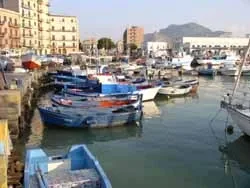
To get from Palermo to Etna, you need to cross to the other side of the island, from the Tyrrhenian coast to the Ionian. This is very difficult to do, because along the way there are many temptations. You need to pull yourself together so as not to stay forever in the medieval town of Cefalù, whose name means "Mullet". There, the walls of bastions gnawed by wind and sea guard the harbor with fishing boats, and tightly fitted cubes of houses hang over the sea abyss, and above them rise the austere towers of the Norman cathedral. Even higher - above the cathedral, above the city, the cliffs of La Rocca rise to the sky with the ancient temple of Diana on the top. In the evenings, on the square near the cathedral, residents walk their dogs and children, eat fresh ice cream and exchange gossip.
The road winds through the mountains, steps over streams, and one day the white cone of Etna appears in the sky above it. Taken by surprise, we stop, jump out of the car, inhale the sweet air of an idyllic green lawn. Etna reigns over the village of Cesaro and a herd of horses, rising as a shining mass above the forest, above the other peaks, above all of past life. We drive on, and it becomes higher, captures the horizon, grows and wrinkles with folds, and white smoke rises from its summit.
Suddenly, against its shining background, a city appears with a majestic cathedral, an ancient bridge and houses of black lava stone. This is Randazzo - a city at the foot of Etna that has never been destroyed - neither by volcano nor by conquerors. A little more Norman, Catalan Gothic and Aragonese Baroque, a Swabian palace and a monument to the Cyclops.
Beautiful Taormina
Finally, a blue glow appeared ahead. The Ionian Sea was as emerald, fresh and calm as the Tyrrhenian. "Mauricio, please, let's pull over to the shore!" we groan, and kind Mauricio drives into the bay. "My God, what beauty!" we can't believe that such a thing exists. The blue bay bristles with white sails of yachts, and above it rises a rocky mountain, and on this mountain stands a city, unbelievably beautiful in the rays of the evening sun. Above it another mountain rises, and on its top there is also a city. "What is this, Mauricio? Where have we ended up?" It seems we've ended up in an unusual place, since even Mauricio, frozen, stares at the magical city. Finally he exhales: "Taormina".
So we saw the best place in Sicily, and perhaps on the whole Earth. We did not yet know how intricately its ancient streets wind along the slope of Mount Tauro, had not yet walked through the arches of medieval stone towers guarding Norman churches and Aragonese palaces on Corso Umberto, had not yet inhaled the sweet scent of the gardens of Villa Comunale Duca Colonna di Cesaro.
Taormina is a very historical place. First it was the ancient Greek and Roman Tauromenion, then it became the Byzantine capital of Sicily, Taormina.
The Greek theater on the mountain is a real hymn to Hellenism, a hymn to beautiful people who knew how to enjoy art and create masterpieces. Via Teatro Greco leads to it - an ordinary narrow street: souvenir shops, Indians laying out colorful beads on the asphalt. And then comes the Theater: columns of an ancient temple, fragments of capitals in the grass, turtle doves cooing in the crevices of brickwork. Stone steps of staircases leading to the sky, stone rows of benches - in the 3rd century BC, 5,400 spectators sat on them.
It seems that from the heavenly height of the theater you can see the entire Ionian coast - both Catania and Syracuse, and the blue bay of Giardini-Naxos with the white sails of yachts. You can see the islets of Cyclops - the very stones that the Cyclops Polyphemus threw at the ships of Odysseus, and the town of Acireale, named after the shepherd turned into a river by Poseidon. Reality spreads, dissolves in the blue of the sea, mixes with a fairy tale. Times intertwine, leaving space for imagination. And only the giant tent of Etna, reigning in the sky over the Cyclops, over the sea and over Taormina, guards reality.
Ethnography
In Sicily you can understand what it means to "live on a volcano". Because Etna is the largest active volcano in Europe, its height is 3,340 m. The mountain has many times destroyed fragile human structures. Seven times it wiped Catania, located 40 km from it, off the face of the earth. The sea also got it: one of the eruptions poured lava into the sea depths, growing an island 16 km away. Sometimes miracles happened. Take, for example, the town of Zafferana, bravely perched on the side of the volcano. On the walls of its houses, scars from earthquakes are visible. But no traces of lava are visible in the town. In 1992, it stopped ten meters from the last house - the secluded cottage of the beekeeper Giuseppe Musumeci. They say the city was saved by the Madonna - a small white statue raised on a black pedestal of lava stone at the turn of the road, right next to Giuseppe's cottage on Via Federico de Roberto. The lava reached the almond and peach trees of his little garden - an ominous black mass, infernal mud, frozen into untidy dark stones.
After a visit to Giuseppe, tourists drive on - to the black lava fields where foxes live among twisted trees, and to the black lava fields where there are no trees, no foxes. They go up by cable car, then ride in jeeps, and then walk on foot to feel the hot stones of Etna in their palms, to peek into the underworld of its craters. There are four main craters, from which whitish smoke rises. Around the slopes, dozens of large and small cones and craters are scattered.
On the summit of Etna there are only two colors: black and white. Black lava and white snow. By August the snow melts, and the white color is replaced by red: millions of ladybugs fly to the volcano's slopes to mate on the warm lava, as if on a freshly plowed field of black soil. The lava cools and forms over 10 years, so the ladybugs always have a fresh warm field. No one knows why they chose this ominous place for their mating games. Perhaps the heat attracts them, or the cosmic force of the volcano feeds them? Or maybe these little suns fly here to hide the blackness with their red wings, to repaint reality, leaving only the most joyful colors for Sicily.