
This is no bazaar
You should start a journey through this beautiful and hospitable country with its capital. And in Warsaw, the first thing to do is visit the Market Square, surrounded by colorful houses. It is there that souvenir shops, art galleries, restaurants, cafes and bars are hidden. In summer, all of this spills out onto the street, and the square becomes noisy, fun, delicious and, at the same time, quite inexpensive. An excellent lunch with wine, for example, will cost only €20.
It is worth staying in Warsaw for a few days, and then heading to northeastern Poland, to the "land of great lakes". You can travel across the Masurian Lakes without leaving a boat, because most of them are connected by a system of rivers and canals. After the cruise, you can have a good rest in a Masurian tavern, where they serve vendace, the tastiest fish in the world according to locals. Then you can head to Krakow.
In Krakow, there is accommodation for every budget. A solid "four-star" on the outskirts will cost from €70 per night, in the center - from €80. The city also has plenty of inexpensive family hotels from €15-20. Moreover, in Poland, in both hotels and restaurants, unlike Western Europe, not to mention resort countries, the price exactly matches the quality, so you get exactly what you pay for. After checking into your chosen hotel, go straight to the Market Square.
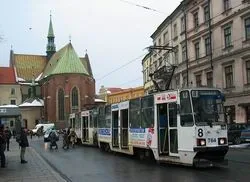
It was built in 1257, and today it is one of the largest city squares in Europe. Above it rise two bell towers of the Basilica of the Virgin Mary - the symbol of Krakow. Every day a few minutes before noon, a nun opens the central altar of the Church of the Virgin Mary, one of the largest and extraordinarily beautiful Gothic altars in Europe.
In the very center of the Market Square, you will see a building built in the 14th century - a mix of Gothic, Renaissance, and Neo-Gothic. This is the Sukiennice (Cloth Hall). Today they sell mainly souvenirs here: amber jewelry, lace, crystal, traditional Stryszawa wooden toys. It is pleasant to walk around the market. This is no Eastern bazaar! True, there are no bright colors or intoxicating aromas, but no one hovers around you like a snake, trying to palm off a fake papyrus. If you are just browsing, the merchants immediately understand and do not bother you. You can safely bargain in Russian; the Poles understand it perfectly.
Tourist trails can sometimes be very tiring even in such a beautiful city as Krakow. If your feet are buzzing, head to the most interesting district of Krakow - Kazimierz. Every street, every house in this area is connected with the history of Polish Jews; here is the Old Synagogue, one of the most valuable and oldest in Europe. After the war, Kazimierz became empty and continued to deteriorate for a long time. But in the early 1990s, the descendants of the former owners regained their rightful property, and the district blossomed. Numerous restaurants, cafes, and clubs opened in the renovated buildings. There are also some very original restaurants here. For example, in one of them, Jewish cuisine dishes are served on a Singer sewing machine.
The salt of it
Ten kilometers from Krakow is the small town of Wieliczka, its main attraction being the Salt Mine. To the uninitiated, it might seem that going down into a salt cave is not very interesting, especially since there are plenty of ancient castles around Krakow that are worth visiting. But this is not the case. First, the mine is very old; salt has been mined there since the 13th century. Second, these are not caves at all, but rather an underground crystal city at a depth of 64 to 327 meters, with palaces and chapels, chambers adorned with beautiful sculptures and scenes from miners' lives.
All these sculptures were made by the miners themselves in different years, of course, in their spare time, from a readily available material, namely salt. For example, the Chapel of the Holy Book, hollowed out in a block of green salt, is a rare work of art. The huge hall is lit by chandeliers made of salt crystals, and the polished floor is made from a single piece of salt. Along the edges are figures of saints, and on the walls are high reliefs on biblical themes. It should be noted that the chapel is functioning; on holidays and on the occasion of particularly significant events, liturgies are held here.
You can order a wedding ceremony in this salt temple. In general, balls, concerts, conferences, sports events, and festivals are organized in the salt city. The "Warsaw" chamber, hollowed out in a layer of fine-grained salt, is adapted for this purpose. There is a concert area, and the room is decorated with a monument to miners, carved from salt by miner Stefan Kozik in 1961. In total, this salt city has 200 km of galleries and 2,040 chambers. The tourist route through the mine is two kilometers long; in two hours, visitors will see 20 chambers. But there are so many wonders around that time will fly by instantly.
Rural fun
In Poland, recreation in rural areas and active entertainment are highly respected, and the amazing beauty and diversity of nature contributes to this. You can stay at the resort of Zakopane. In our country, it is better known as a winter resort, but in summer you can also have a great rest here: mountain walks, cycling trips, river rafting, themed excursions, and much more. You don't have to stay in hotels, although Zakopane has both luxury hotels for the wealthy and inexpensive budget options. Travelers can choose apartments or rent an entire cottage; many locals rent out rooms to tourists. It costs very little - only €10-20 per day.
But for lovers of real rural life, small tourist bases located in villages are more suitable. For example, on the road from Krakow to Zakopane, not far from the village of Kluszkowce, there is a wonderful tourist base Osada Turystyczna Czorsztyn - right on the shore of a reservoir. Cozy and brand-new wooden hotel houses stand right by the water. The owner of these hotels is an Indian who came to Poland five years ago, married a local beauty, and now warmly welcomes tourists, treating them to traditional Polish dishes: soup made from flour sourdough with sausage, warm bread with lard, smoked sheep cheese "oscypek" and... ostrich meat. Because not far from the tourist base there is a real ostrich farm. Ostriches are trusting birds and expect a treat from any viewer. And after a bunch of grass has been solemnly fed to the big-eyed bird, you somehow don't want ostrich meat.
There are also two ski slopes here, but the lift also works in summer - not only so that tourists can admire the views of the mountains and valleys from above. You can go down on sleds that race along a rail track. There are plenty of other entertainments here, the most popular excursion is rafting on the reservoir and the Dunajec River.
Five connected boats form a mountain raft. On this structure, under the direction of a helmsman, you move from the calm waters of the reservoir into the turbulent Dunajec. Part of the route passes through the Pieniny National Park, the most beautiful in Europe - a mountain canyon of the river. The excursion lasts only three hours, but impressions last a lifetime.
These places will also be remembered by avid fishermen. They say the Dunajec is the most popular place in Poland for fly fishing. In addition to fish typical of mountain rivers, burbot and eel are caught here. You can rent a boat at hotels and tourist centers.
There is plenty of scope in Lesser Poland for lovers of historical monuments and especially fans of wooden architecture. One of the most unique pearls of Podhale's sacred architecture is the Church of St. Archangel Michael in Dębno Podhalańskie.