
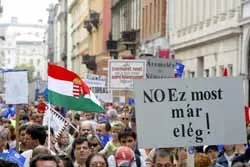
These people, whether formally right-wing (like the Kaczyński brothers currently ruling Poland) or left-wing (like new Slovak Prime Minister Fico), did not shy away from the most incredible promises, actively using – and continuing to use – the energy of Eastern European nationalism for their own interests. In the 1990s, the latter was to some extent pushed into the background by the liberal-democratic ideology associated with the coveted European Union. After 2004, the invisible reins were loosened. Eight countries of the former socialist camp joined the EU, formally on an equal footing with "old" Europe, thus gaining the opportunity to solve their internal problems without much regard for what the West would say.
The results are known – and predictable. The growth of nationalist sentiments in Eastern Europe (a significant and most "militant" part of the Hungarian demonstrators are right-wing radical activists) is akin to a high fever indicating a sickness in the organism. This illness has economic, political, and psychological causes.
From a psychological perspective, Eastern Europeans today find themselves in a situation familiar to almost everyone: a long-desired, coveted goal has been achieved – and suddenly it turns out that there is "no happiness"; the ideal state that was dreamed of is still far away. EU accession brought many positive aspects (from the opportunity to work freely in Western Europe to an influx of investments and additional funds allocated by Brussels for infrastructure development in Eastern Europe), but did not solve most problems. Moreover, it created a number of new ones. The same liberalization of the pan-European labor market led to an outflow of labor from Eastern Europe to the West. For instance, in less than three years, a million (!) Poles, tens of thousands of Latvians and Lithuanians, etc., left for work in other EU countries, primarily the UK and Ireland.
There is also noticeable labor migration within Eastern Europe itself, whose countries differ in living standards and incomes. For example, Slovaks actively and in large numbers go to work in neighboring Czechia and Slovenia (the most prosperous of the new EU members). But even so, the unemployment rate in some regions of Slovakia reaches 15-17%, and in Poland even 20%. The situation prevailing in many provincial towns and villages of southeastern Poland, Slovakia, and Hungary can be summed up in one word: hopelessness. Yet it is quite likely that the living standards there would seem very good to many residents of the Russian or, say, Ukrainian hinterlands – not for nothing have thousands of "people from the East" already taken up work as guest workers in the former socialist countries.
From a political perspective, Central and Eastern Europe is also experiencing a crisis. By and large, even the populists who have been winning recently do not have much of a credit of trust – at least not the kind that the first generation of post-communist politicians had 15 years ago. The rating of the Kaczyński brothers and their party in Poland has fallen noticeably, although they have been in power for less than a year. The victory of Robert Fico's party in the June elections in Slovakia was far less convincing than expected. In Hungary, the "soul" of the unrest became activists of the radical movement "64 Counties" (after the number of provinces of the Kingdom of Hungary within its borders before 1919), whose popularity on a national scale is hardly greater than, say, the popularity of the also recently "famous" DPNI in Russia. Most Czechs, despite everything, still prefer to vote for the two largest parties – the Social Democrats and the Civic Democrats, although the phrase "Politicians only care about the trough" has long been elevated here to the rank of an almost undisputed folk wisdom. In general, along with the undeniable rise of nationalism and populism of all stripes, the region is also witnessing another phenomenon – citizens' disillusionment with the post-communist political class as such.
Hungarian Prime Minister Gyurcsány is obviously paying the price not only for his own sins but also for those of his predecessors, both left and right, whose promises to voters regularly turned out to be bluffs. And since the political culture of the countries in this region is generally less authoritarian than in other former Soviet states, disillusionment with traditional politicians does not lead to the emergence of "strong leaders" and the establishment of dictatorial regimes. (Kaczyński is still not Saakashvili, and Fico is not Karimov.) Protest energy finds an outlet either in support for parties previously considered marginal (like Andrzej Lepper's Self-Defense in Poland), or in street protests (as now in Budapest), or in "voting with their feet," i.e., leaving the country, mainly headed west. By and large, Eastern Europe is now undergoing a sobering from the excessive hopes many Eastern Europeans placed on democratization and EU integration.
It has become clear that this region will not become the "real" West anytime soon – if at all. In fact, this is nothing more than a return to the status quo. After all, from the 16th to the mid-20th century, Central and Eastern Europe, due to historical and geographical circumstances, lay aside from the main trade routes and, consequently, from the most economically developed regions of the Old World. Economically, Prague, Gdańsk, or Budapest could not compete with London, Rotterdam, or the Ruhr. The geopolitical role of Eastern Europe changed over different eras, but in socio-economic terms, it has always lagged behind the western part of the continent over the last 400 years. There is no reason to think that this centuries-old gap can be bridged in one fell swoop – and right now. Nevertheless, the fall of communism, this failed project of "catch-up" modernization, gave rise to hopes that are now coming to an end.
But Central and Eastern Europe is hardly doomed to stagnation. The economies of most countries in the region are consistently growing at quite respectable rates of 4-7% per year. EU accession has brought certain guarantees of political stability: for instance, given the current tensions in relations between Hungary and Slovakia, the absence of a "moderator" in the form of the European Union could have led to the emergence of a new hot spot in the center of Europe. Investment inflows are growing – so much so that shortly before stepping down as German Chancellor, Gerhard Schröder accused German firms of a "lack of patriotism" for moving capital eastward. Under the influence of the European Commission's detailed and tedious directives, which sometimes provoke both laughter and irritation in the media and among the public, the local bureaucracy is gradually becoming more civilized. Much is changing; it's just that the pace and scale of these changes are not as breathtaking as once imagined.
Central and Eastern Europe is unlikely to become the "navel of the earth" dictating the pace and nature of social, economic, and technological development to the rest of the world in the foreseeable future. The "strong point" of Eastern Europe in the medium term will remain assembly plants, light and food industry enterprises, possibly agriculture (if it is possible to push through a reduction in subsidies to Western, primarily French, farmers within the EU), and so on. Nor should we forget the important role of this region as a transit zone.
The East of Europe is currently in crisis – that is beyond doubt. However, this crisis is one of those after which you can send telegrams with the famous quote from Mark Twain: "The reports of my death are greatly exaggerated."