
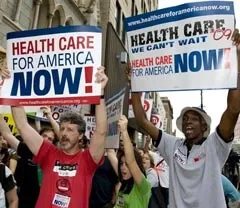
Business lobbyists are also involved in the information war around the healthcare system reform
To begin with, according to polls, most Americans are satisfied with the quality of medical services they receive under the current healthcare system. However, that is not enough to consider it effective. As Lenta.ru notes, Barack Obama has repeatedly drawn Americans' attention to the fact that this system is one of the most expensive in the world. At the same time, huge costs fall on the federal government, state budgets, employers who offer health insurance to employees, and American families.
Choosing an insurance plan is not easy: the average American family receives many offers, each outlined in a small brochure. And many encounter the specific details of their insurance only when they need a certain type of medical service. It may turn out that a particular case is simply not covered by the insurance. It may turn out that with this insurance plan, you cannot get a referral to the needed specialist or receive a certain type of treatment.
Moreover, every step, including treatment and purchasing medications (and the dosage of drugs paid for by insurance), requires approval from the insurance company. Particular difficulties arise for those who want to use the services of an optometrist or dentist. There is no talk of transparency in the system's functioning. Ultimately, insurance holders simply do not know what exactly they are paying large sums for each year, and the overwhelming statistical satisfaction is often explained by ordinary everyday optimism.
According to Obama, American healthcare has long needed reform, and the current economic conditions are such that waiting another year or two is unacceptable – action must be taken now.
The main tenets of the reform, formulated by the Obama administration, naturally sound very attractive. Americans are promised that if the House of Representatives and the Senate support the reform, families will no longer have to go into debt due to unforeseen illnesses. In the long term, employers and the government will also save on insurance; chronically ill Americans will not face difficulties in finding a suitable insurance plan; and specialists who change jobs or lose their jobs will retain insurance on the same terms. And in general, according to Obama's plan, Americans will get sick much less, since significant funds will be invested in the prevention system, including making necessary regular check-ups available and free – from mammograms to control tests for diabetics.
To help achieve these, undoubtedly good, intentions, a single universal insurance system should be created, making insurance mandatory for all Americans. Currently, almost 47 million US residents go without health insurance at all – these numbers have been cited many times. For those who cannot afford even affordable government insurance, subsidies for its purchase are proposed. And the government is supposed to get the funds for this from taxes on families with an annual income of more than $350,000. Here are the first opponents of the reform – those who do not want to pay for medical services for less affluent compatriots.
So far, the main debate has centered around the pros and cons of a "single-payer system," in which all concerns about cost control fall on government structures, which should replace the current system, close to free competition. However, given consumers' insufficient access to information about service prices, it can only be called close with a stretch.
Supporters of the "single-payer system" and Barack Obama's plan in general argue their position quite extensively. In their view, the current system leads to doctors often prescribing unnecessary expensive treatment to patients – out of personal interest in having Americans pay for medical services. Under a universal system, doctors will prescribe treatment only to those who really need it, and those who want additional treatment can get it from private specialists at their own expense – as in Europe. And if diagnostics become free, Americans will be more willing to undergo examinations.
Opponents of this system, in turn, paint a frightening picture reminiscent of the worst memories of residents of the former USSR about free medicine. From the perspective of reform critics, those who are not too busy with work – for example, retirees and housewives – will be the first to go for free examinations. Long lines will form in the corridors of medical facilities, and those who need treatment will have to queue for free surgery.
Particular difficulties will arise in the field of transplantology – currently in the US, the situation with donor organs is more than satisfactory, especially compared to other countries. Business will not be interested in introducing innovations – meaning it will slow down and pull research work along with it. After some time, this will lead to wealthy Americans seeking treatment abroad, "taking" funds out of the US economy.
Barack Obama believes that reducing the number of intermediaries will lower administrative costs in the healthcare system. His opponents argue the opposite: government structures are much more subject to bureaucracy than private ones. Moreover, the very transition to a new system, in their opinion, will lead to confusion that will have to be resolved for decades. Representatives of the presidential administration say that in a unified system, data on the health of Americans will be better protected. Opponents of the reform, on the contrary, believe that this information will become accessible to officials – and that means control over the private lives of the country's residents.
Thus, each side has a set of arguments with which it tries to convince Americans of the advantages of one or another system. However, a reasonable discussion does not work out: brawls and black PR campaigns do not fit into its framework.
From the very beginning, Barack Obama promised voters that those who are satisfied with their current insurance plan will be able to keep it after the reform. However, there was no talk of how much it would cost. Now, when meetings are held in city halls of various cities dedicated to the upcoming reform, local residents do not hesitate to ask this question. And officials, naturally, cannot give an exact answer to it. This only strengthens Americans' fears that they will either have to pay significantly more for the same thing they are getting now, or switch to an affordable universal plan with all its drawbacks, which are talked about so much.
Obama's critics are in a much more advantageous position. Complex explanations from administration representatives are perceived much worse than simple slogans like "Choice is better than leveling" or "The government should not come between you and your doctor". Unsurprisingly, speeches by Republican politicians criticizing Obama's plan are very popular.
Republicans do not deny the need for reform, but refuse to support the "socialist" plan. Republican Senator Charles Grassley is actively involved in negotiations to develop a compromise plan that could get some Republican votes. His speeches are met with applause, while Democratic Senators Arlen Specter and Claire McCaskill were simply berated by dissatisfied listeners. This is not least due to the fact that those who have certain complaints about the administration's proposals attend such meetings. Those who have no objections are less inclined to be active.
Finally, opponents of the reform resort to actions bordering on vandalism, which attract much more attention than the polite email newsletters of the White House. First in California, and then in Florida, posters began appearing on walls, poles, trees, and doors depicting Obama as the Joker from Batman comics. The captions under the portraits vary: "Socialism", "New World Order", and even "Why so socialist?" (a reference to the famous "Why so serious?" of the Joker from "The Dark Knight"). These posters are attached to various surfaces permanently – with glue and staplers. Some of them even appeared on mailboxes – and that is already against the law.
The final reform plan has not only not been approved by the Senate, but has not been prepared yet. The Obama administration asks legislators not to delay, while the president's opponents believe that haste in this matter could lead to regrettable consequences.
Conservative media and bloggers remind Obama of his statements about how difficult a moral issue it is, for example, to provide prosthetics for hopelessly ill elderly people at public expense. The information war is in full swing and will continue with fluctuations in intensity for many months to come. It cannot be forgotten that lobbyists from the medical, pharmaceutical, and insurance industries are involved, so the main battles may still be ahead.
It is obvious that in case of failure of the reform, the responsibility will be placed on Barack Obama and the Democratic Party. A major failure could affect both the length of time during which Democrats manage to maintain their majority in the Senate and the House of Representatives, and Obama's chances of being reelected for a second term. If, in the next three years, the reform is not only implemented but also yields its first positive results, Americans will have no choice but to vote for Obama again – to let him finish what he started.