
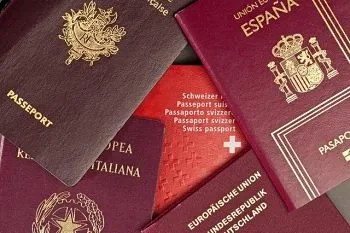
The most attractive in terms of political, social and visa benefits is the German passport
According to RBC, the concept of the study is based on the fact that the attractiveness of a particular citizenship is determined by its internal value (quality of life within the country) and external value (how beneficial this citizenship is in terms of travel, residence in other countries, and full exercise of one's rights abroad). "The external value of citizenship reflects the extent to which holders of such passports can enjoy all the benefits of globalization," the study notes. "As for internal value, the more opportunities a state provides its citizens in terms of wealth, security, education, healthcare, and stability, the higher the indicator."
To assess the internal value of a passport, the size of the economy (GDP according to the IMF or World Bank), the Human Development Index (according to the UN), and internal stability (based on the Global Peace Index, GPI) are used.
The external value of a passport is determined by the possibility of visa-free residence and work in other countries, visa-free travel (taking into account not just the number of accessible countries but also their relative quality).
In total, Henley & Partners experts analyzed 161 citizenships worldwide. Some countries were excluded from the list due to lack of data, such as the Vatican, North Korea, Somalia, and South Sudan. Conversely, the passport of "non-citizens" of Latvia was taken into account when compiling the ranking, since this status can be inherited, although in the context of international law "it is certainly a matter of the status of stateless persons."
First place with 83.1 points in the ranking is occupied by Germany. Next with 83 points is Denmark, followed by Finland with 82. With a few exceptions, the entire top part of the table, 27 first places, are occupied by European Union states.
In fourth place is Norway, which is part of the Schengen area but is not an EU member; 12th place is occupied by the microstate Principality of Liechtenstein, also formally not part of the European Union. 29th place (58.3 points) went to Croatia, letting only the United States (63.5 points) ahead among non-European countries.
Overall, the countries of the world are divided into four categories. "Low quality" of citizenship means that the country scored from 0 to 20 points. "Medium quality" – up to 35 points, "high quality" – up to 50 points, and "extremely high quality" – over 50 points. The global average was 38.7, and the median was only 30.9 points.
The QNI ranking shows the situation as of May 2016, but Henley & Partners experts consider indicators for the period from 2011 to 2015, establishing a certain dynamic. Over the past year, Bulgaria and Romania strengthened their positions the most (adding about 10 points each) and, on the contrary, Ukraine weakened (by 2.2 points, to 30.2).
Among the countries of the former Union (excluding the Baltic republics), the greatest freedom of movement is enjoyed by citizens of Russia, Ukraine, Belarus, Moldova and Kazakhstan, and the least by residents of the Transcaucasian and Central Asian republics. And while travel within the entire region is free with rare exceptions, the rules for relocation and work vary greatly. The most liberal regime was recorded by the compilers of the ranking in Georgia, and a complete ban in Turkmenistan. The other CIS countries have labor quotas and require a work permit.