
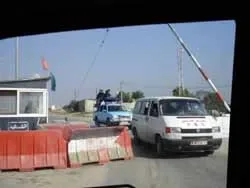
Israeli soldiers were taken prisoner on the morning of July 12. Their armored jeeps were ambushed and destroyed by militants of the Shiite group Hezbollah, based in southern Lebanon. Three servicemen were killed on the spot, and two wounded were pulled from the wreckage by extremists and taken in an unknown direction.
The militants' operation was carried out under the cover of shelling Israeli territory with multiple rocket launchers: the extremists fired several dozen rockets into the adjacent territory. Israel responded to the shelling with an artillery strike on militant positions and air strikes on infrastructure targets in southern Lebanon. During the exchange of fire, the disappearance of the two soldiers was not noticed immediately. The Israeli command confirmed the information about the capture of the soldiers, announced by the terrorists, only several hours later.
After Jerusalem acknowledged the capture of its soldiers, the response was immediate: advanced units of the IDF were deployed to southern Lebanon, aviation and artillery intensified fire on militant positions, and Navy ships began systematically destroying Hezbollah coastal facilities. The General Staff announced a partial mobilization and the deployment of six thousand troops to the Lebanese border, supported by helicopters, tanks, and other armored vehicles. Israel, followed by the United States, the European Union, and other countries, demanded the immediate and unconditional release of the prisoners. To make its words more convincing, the chief of the Israeli General Staff, Dan Halutz, promised to return Lebanon to the state it was in twenty years ago, when the entire country lay in ruins. As confirmation of the military's determination, Israeli Air Force planes appeared over Beirut for the first time since 2000.
However, the militants apparently have no intention of heeding anyone's demands and releasing the prisoners. They issued a statement in which they presented their own demands to Jerusalem. Initially, a Hezbollah representative insisted on the return of Lebanese prisoners from Israeli jails, but a few hours later, a Hamas representative in Lebanon was already talking about the release of all Arabs without exception serving sentences in Israel.
Israel responded with a categorical refusal. The country's Prime Minister, Ehud Olmert, said: "We will not negotiate and will not retreat in the face of terror. This was our rule in the past, and it remains so now."
It appears that Jerusalem, as in the case of the capture of Corporal Gilad Shalit in the Gaza Strip, has decided to rely on military pressure on the kidnappers and the organizations supporting them. In any case, IDF generals do not hide that a large-scale military operation is planned in southern Lebanon.
How effective this approach will be remains to be seen. However, the failure of the operation in Gaza, where the IDF's confrontation with the Palestinians has already lasted two weeks, gives reason to doubt the ultimate success of the invasion of Lebanon. Moreover, Israel's ability to pressure the population and politicians in the Gaza Strip is incomparably greater than in Lebanon. Furthermore, while the movements of Palestinian militants across the barely visible sector on the map are relatively easy to control, in mountainous Lebanon terrorists have significantly more opportunities to hide. The kidnappers could also almost unhinderedly transfer the soldiers to neighboring Syria. Then the task of finding and freeing them would become extremely difficult.
Realizing these difficulties, the Israeli leadership has left itself another option to influence the situation: responsibility for the attack was placed not only on Hezbollah, which takes pride in its actions, but also on the Lebanese government as a whole. Jerusalem's argument is as follows: Hezbollah is a legal political force in Lebanon, its representatives are part of the ruling coalition, and therefore this coalition must answer for the actions of its members.
The Israelis, of course, know perfectly well that only the leaders of Hezbollah can influence that organization, and the Shiite extremists could not care less about the other members of the ruling coalition. Moreover, in the 1980s, Hezbollah members communicated with their current government partners exclusively on the battlefield—through the sights of modernized Kalashnikov assault rifles. But in conditions where room for maneuver is very limited, Jerusalem is forced to use any opportunity to pressure the kidnappers.
Along with the Lebanese government, Syria and Iran were quite justly named by Israel as culpable in the capture of the prisoners—countries that never particularly concealed their support for the Hezbollah extremists. These countries have significantly more influence over Sheikh Hassan Nasrallah, who leads the Shiite extremists, than Lebanon does, but Jerusalem is unlikely to decide to bomb Damascus, let alone Tehran.
Although the task facing Israel is indeed not simple, there remains well-founded hope for the actions of the intelligence services, which have repeatedly proven that they are deservedly considered among the most effective in the world. Shin Bet and Mossad are capable of finding the terrorists' lair and freeing the prisoners. But the question remains of how much time and resources it will take.
The capture of the two soldiers further complicated the already difficult position of Ehud Olmert's cabinet, which found itself in trouble after the capture of Corporal Gilad Shalit. Israeli society, divided into two camps, is attacking the government, demanding a quick resolution to the problem of the prisoner (now prisoners).
The left accuses Olmert of inexplicable stubbornness, which is expressed in his unwillingness to release at least some of the Arab prisoners (which, contrary to Olmert's words, was done in the past) and bring the soldiers home.
The right, in turn, blame the head of government for indecisiveness, which results in marking time in the suburbs of Gaza, Rafah, and other cities. Many Israeli political and public figures believe that it is long since time to start shooting Palestinian leaders from the Hamas movement. In their opinion, this will show the seriousness of Israeli intentions and push extremists to hand over captured soldiers.
Olmert himself understands that both paths can lead him to a political grave: the left will not forgive him the death of the soldier and his comrades in the case of a military operation, and the right will not forgive him weakness and the release of prisoners. In conditions where his government is simultaneously left-wing (Labor, Pensioners' Party) and right-wing (Kadima and Jewish parties), the loss of support from either flank threatens the collapse of the coalition and new elections. And it would be practically impossible for Olmert and his Kadima party to win in the conditions of the most severe crisis. Therefore, the head of the Israeli government constantly has to resort to half-measures: exert pressure but not fight, not conduct official negotiations with terrorists, but continue informal consultations with mediators, and so on.
However, the increasingly aggressive actions of the Arabs, who are convinced of the legitimacy of their methods and the justice of their goals, may push the head of the Israeli cabinet to a decisive step. Which path Olmert will choose - a military operation or negotiations with militants - time will tell. Given that public opinion is increasingly leaning toward a "tough" solution to the problem of prisoners, the prime minister will most likely use the might of the IDF.
Ivan YAKOVINA.
Lenta.ru