
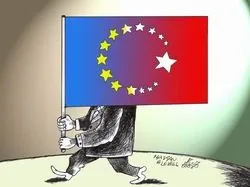
Such a debatable conclusion was reached by journalist Kjetil Wiedsvang of Dagens Naeringsliv (a Norwegian business publication).
Erdogan’s statement
Turkish Prime Minister Recep Erdogan warned EU leaders against turning the organization into a “Christian club,” which would be an obstacle to the start of negotiations on Turkey’s accession to the EU. “Either the European Union is an important player on the international stage, or it is limited to the formula of a ‘Christian club’,” Erdogan said on October 2 in an interview with CNN’s Turkish edition. The prime minister described the EU discussion on Turkey as a test of the organization’s commitment to pluralism and democratic values.
Ministers confer
Foreign ministers of the European Union member states met on October 2 in Luxembourg to discuss the format of negotiations with Turkey on its EU membership. Negotiations were scheduled to begin the next day, October 3. Austria proposed, as an alternative to Turkey’s full participation in the EU, the status of “privileged membership.” The status itself, however, was not defined. Turkey rejected such a procedure, warning that it would not enter negotiations if the Austrian proposal were adopted.
Austria also insisted on the EU starting simultaneous negotiations with Turkey and Croatia. In addition, Austria proposed including in the agenda provisions that the negotiations do not necessarily have to end with Turkey’s acceptance into the European Union. Austria’s position was heavily influenced by the results of a June public opinion poll conducted in the country: eight out of ten Austrians opposed Turkey’s admission to the EU. Since, according to EU rules, decisions on admitting new members are taken unanimously, Austria’s opposition could have derailed a years-long negotiation process.
Hard line
Austria is not among the countries that had previously resorted to this kind of blackmail in relations with the European Union, so such a reaction was quite unexpected for many member states. “This discussion must be approached with all seriousness. The main thing that worries us is whether the European Union can accept a large country like Turkey, along with all its problems. That is why we ask in advance to define the boundaries within which we are ready to conduct a dialogue,” the official representative of the Austrian chancellor commented on the position in the negotiations.
Without a mandate for negotiations supported by all countries of the organization, the EU simply could not begin talks with Turkey on Monday, October 3. Representatives of Great Britain, which had been chairing the EU for six months, took up the search for an acceptable solution.
Punishment for the war
In the end, at the meeting in Luxembourg, the decision to start formal negotiations with Turkey was supported by all 25 ministers of the EU countries. Along with this decision, the issue of starting similar negotiations with Croatia was considered. The problems with that country lie in Croatia’s insufficient, in the view of the EU countries, willingness to cooperate with the tribunal considering war crimes in the former Yugoslavia. Negotiations with Croatia were postponed until March because the EU believes that cooperation has not yet reached the required level. This issue is one of the main conditions for starting the negotiation process.
The journalist’s opinion
“Turkey has entered into negotiations with the European Union on membership in that organization. Turkish membership means the end of the EU, at least the end of the European Union as it was conceived and planned from the very start,” journalist Kjetil Wiedsvang thus begins his article “The End of the EU.” On Monday, October 3, in the afternoon, the 25 members of the European Union said “yes” to starting negotiations with Turkey on its membership in the organization. If the intentions of the EU leaders match their statements, then this means that Turkey could become an EU member after 2015, the Norwegian journalist believes.
The opinion of a representative of a country whose citizens twice voted against joining the EU in referendums is interesting in that it shows clear disagreement with the majority decision. “This marks the end of the EU, but there is no reason for regret. Turkish membership is hardly likely to mean the end of an organization with an administrative headquarters in Brussels, which by 2020 will probably include the absolute majority of European states. It means a sudden halt to the old dream of an ‘ever closer union’,” Wiedsvang continues. In this, the journalist is absolutely right: despite all the vicissitudes of the EU, the number of officials with high salaries and an array of privileges will only grow.
United States of Europe
It is somewhat a pity that the end has come for a project whose fathers in the 1950s were Jean Monnet, Robert Schuman, and Altiero Spinelli, the journalist writes. They saw the United States of America as a model for the union. Their plan did not look absolutely unfeasible, but it was believed that results could be achieved only after the passage of several generations. The first six members of the union of European countries spoke different languages, had fought against one another in the past, but had many common traits.
The idea received a new colossal impetus when Jacques Delors headed the European Commission in the 1980s and 1990s. The common market became the European Union with open internal markets, transparent borders, a common currency, and the hope for a Constitution that was intended to strengthen the federal foundations of the organization. The fact that the project continued to follow the set course long after Delors himself ceased to shape the EU’s fate testifies to the political force of his ideas. Even the weakening of Western cooperation caused by the fall of the “Iron Curtain” did not hinder the further development of the project.
Transformation
But with Turkey's inclusion, the project will be completed. The European Union will be home to approximately half a billion people, and Turkish Muslims will make up a fifth of its population. The largest country in the EU will also be its poorest state. Creating something resembling a "superpower" with such diversity will not fit into decades. It will require centuries. During the transition period, Europe will resemble something most like a free trade zone. The organization's most important task will be to increase the efficiency of markets and strengthen cooperation in areas such as fighting crime and countering terror.
This is quite enough, if only because EU residents consider titanic efforts to strengthen the organization an empty idea; they clearly express their attitude in public opinion polls and when voting on the adoption of the European Constitution.
Changes for the better
At the same time, Turkey's admission to the EU will lead to big positive changes in Europe, believes the Norwegian journalist. This will give the European economy new competitive advantages, as a new dynamic player will join it. The European labor market will be strengthened by the influx of young and relatively well-educated young people. Turkey may well become a vital cultural and economic bridge to Europe's neighboring Muslim countries. These prerequisites are more than enough for the country's EU accession negotiations to have a good chance of success.
Austria remained the only one in opposition to Turkey's admission as a full member of the EU, while there were many more supporting the decision, among which the support of France and Germany is especially important, continues Kjetil Wiedsvang. However, in the future the resolution of the issue will not be simple, since a clear majority of EU citizens oppose Turkey's membership in the organization. The French government promised its citizens a referendum before the decision on Turkey's admission to the EU becomes relevant.
Nevertheless, the accession negotiations will give the situation a new development. Ten years is quite enough time for further mutual adjustment. As a result, Turkish representatives will get seats in European institutions and additional channels of interaction with the organization. European capital will rush to Turkey, which will become another lever of pressure on the country's leaders and will help bring Turkey closer to European standards of the rule of law.
In the interests of the majority
While Europe waits, newly elected Prime Minister Jens Stoltenberg promised that his government will run Norway for at least two terms of the Storting (Norwegian parliament). "It is not impossible that Turkey will be in the EU before Norway. If guided by public opinion results, this is exactly what the majority of the country's population wants," - this is how the article "The End of the EU" in the newspaper Dagens Naeringsliv ends.
The heavily quoted article interests us not in itself, but from the perspective of the prospects for developing relations with the European Union. Let us try to reason how the Turkish dialogue might affect our relations with the EU. It seems that it will be easier for us to deal with a "renewed" European Union. First, with Turkey's admission to the EU, the formula uttered by one German politician will be buried: "Only countries geographically located in Europe can join the European Union." Second, Turkey's example convinces us that healthy bargaining is quite appropriate in relations with the EU: Turkey changed its criminal legislation and is ready to discuss the recognition of the Armenian genocide in 1815 only in exchange for guarantees of serious negotiations with a specific agenda. Third, for us, as for Turkey, free access to EU markets and the joining of efforts with "Greater Europe" in the fight against terror and crime are very important. We would add to this list also the abolition of visa restrictions.
And finally, our officials would not at all be hindered by working in the structures of the European Union. This would serve to strengthen relations with the EU. One can hope that an adequate understanding of the functioning of EU institutions will change the negative attitude toward the Union - both on the part of the political elite and on the part of the majority of our citizens.
Pavel PROKHOROV.
IA Rosbalt