
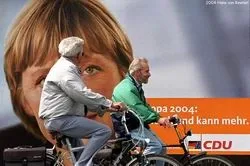
Of the 61.9 million German citizens eligible to vote, about 79% took part in the elections on Sunday - a very impressive result for Europe, but quite ordinary in Germany - Germans have been famous for their discipline for hundreds of years. Even in Bavaria, where the traditional annual beer festival Oktoberfest opened the day before, this circumstance did not prevent German citizens from voting: here 82% of voters turned out to the polling stations. The only exception was the 160th electoral district in Dresden: due to the death of the candidate from the National Democratic Party, Kerstin Lorenz, the elections in this district, where about 219 thousand voters live, were postponed for two weeks.
However, the outcome of the elections in this district can no longer affect the final distribution of seats in the Bundestag. The election results were such that all five main contending parties can rightfully call themselves winners.
The SPD received 34.2% of the votes, losing more than 4% compared to the 2002 elections. Nevertheless, Chancellor Schröder took the podium and stated: "I understand that Germans want to see me continue as the country's chancellor." Why? Simply because the main opponents of the Social Democrats - the CDU/CSU - contrary to all forecasts, received only one percent more - 35.2%. Thus, they also won, but this victory turned out to be conditional. Angela Merkel will not be able, as she intended, to create a ruling coalition with the Free Democrats.
The Liberal Party was the triumphant party of the evening: according to preliminary data, the Free Democrats received 9.8% of the votes (at the very beginning it was even assumed that their success was expressed in a double-digit figure - 10.4%, but later the liberals' result somewhat "slimmed down"). This is the second largest indicator for the FDP in the entire history of Germany; the party received more only in the first post-war parliamentary elections - about 15%. However, what the Free Democrats should do with such a victory is completely unclear, because due to the unexpected weakness of the CDU/CSU, a "black-yellow" government, as already mentioned, will not happen.
The Greens, having received 8.1% of the votes, lost only 0.4% compared to the previous elections, but found themselves before the same dilemma: the previous "red-green" government cannot exist in this form, and with whom to enter a coalition is unclear. The real winners, the socialists from the so-called "Left Party" under the leadership of Gregor Gysi and Oskar Lafontaine, who won 8.7% of the votes and thereby more than doubled their 2002 result, found themselves in isolation. Despite the success, they remain political parvenus in Germany, with whom none of the parties present in the new Bundestag wants to have anything to do. Both Schröder with Fischer and Angela Merkel with Guido Westerwelle, even before the elections, rejected the possibility of somehow coming to terms with the heirs of the GDR's SED; after the elections, they all once again emphasized: we have not held and will not hold any negotiations with the socialists.
Thus, a unique situation has developed: none of the traditional coalitions is able to form a government. Therefore, both journalists and party bosses began a feverish search for non-traditional coalition options.
The most likely option at the moment seems to be the so-called "elephant wedding" - a grand coalition consisting of the CDU/CSU and the SPD. Theoretically, this is quite possible, but two factors speak against it. First, Schröder has already stated that he will agree to such a coalition only if he retains the post of chancellor. As justification for his claims, he put forward a completely Jesuitical argument: of course, by tradition, the party that receives the most votes nominates the chancellor from its ranks, but the CDU/CSU is not one party but two, so the SPD, they say, received more percentages than either of the two conservative "twins." The idea is dubious: the CDU/CSU has always run in elections as a single list and formed one faction in the Bundestag.
But there is another way out: the chancellor becomes not Schröder and not Merkel, but a third person. For example, the Bavarian prime minister and chairman of the CSU, Edmund Stoiber. But this option already belongs to the fantastic ones. In addition, whoever becomes the chancellor of the Grand Coalition, historical experience shows that governments composed in this way possessed huge internal contradictions and often turned out to be simply incapable of functioning.
In the end, it is clear that nothing is clear. Even the most seasoned political scientist cannot answer the question of who will be the chancellor and who will form what coalition with whom. Only one thing is clear: for at least a week, German politicians will conduct feverish negotiations with each other. Everyone else is given the right to patiently await the results of these negotiations.