
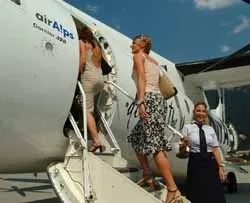
According to the definition, a charter is a contract between the owner of an aircraft and the hirer (in professional terms, the charterer) for the lease of the aircraft for a specific period or flight. In other words, the organizer of charter programs is not the airline, but the hirer, the customer – that is, in our case, the travel agency, which fully buys out the aircraft's capacity for subsequent sale at its own discretion. Thus, it can fill the entire aircraft on its own or sell part of the seats (so-called blocks) to colleagues. In this case, the customer acts as a consolidator of the flight and bears most of the responsibility.
It is a mistake to think that charters exist only to provide an alternative to more expensive, from the passenger's point of view, scheduled flights. In fact, a tour operator places an order for an aircraft and launches such programs, as a rule, in two cases: when demand for a destination significantly exceeds the capacity of scheduled transportation, and when direct scheduled flights to the destination simply do not exist, while the number of people wishing to get there is quite large. The latter circumstance especially plays into the hands of tourists: they do not have to make a transfer at a transit airport, and the time and cost of the flight are sometimes reduced by two or three times.
Operating its fleet, any airline focuses primarily on a combination of routes. Therefore, from a safety point of view, aircraft performing charter transportation are no different from airliners on scheduled flights – simply because the same machine can make a scheduled flight today, and upon returning from it, go on a charter. Moreover, recently our tourist has learned to navigate aircraft quite well, and tour operators, forming their programs, are forced to take this into account.
Most often, the public remembers charter flights with an unkind word when reports come in about another group of tourists stuck at one airport or another. In fact, delays are by no means uncommon on scheduled routes as well. It's just that more attention is paid to charter flights, and each such episode becomes an event, experts say.
However, for passengers in this situation there are still some differences. In the event of a delay of a scheduled flight, ticket holders may be transported on the next flight or on a flight of a friendly partner airline. Clients of charter transportation, however, will have to wait for the causes of the delay to be eliminated or for a special reserve aircraft, which is not always available. Hence the many hours of waiting at the airport with stories about the terrible irresponsibility of charter carriers. But the passenger himself, buying a ticket for a charter flight, must understand that he is dealing with a special type of transportation – he pays less money and, accordingly, receives a smaller set of services.
If in the event of a flight delay, a charter passenger is in a less advantageous position than his 'counterpart' on a scheduled route, in all other respects their rights are equal. When the waiting time for departure exceeds 6 hours, the airline operating the charter flight is equally obliged to provide its passengers with a hotel for the entire waiting period and hot meals. Let us emphasize: it is the carrier, and not at all the travel agency – the organizer of the flight, to which irritated tourists usually address their complaints. If the airline has not fulfilled these obligations, the person has the right to go to court for compensation.
But in-flight meals during the flight, which perhaps cause the most complaints from charter aviation clients, are provided by the tour operator. More precisely, he pays for it, and the quality of the food and drinks provided to passengers depends on the amount of financial investment. Financing, in turn, depends on the route. Complaints are more often expressed by tourists going to mass holiday destinations. However, sometimes meals on charter flights are even better than on scheduled ones. 'Once, the customer of a flight asked to serve all passengers in the highest class, adding caviar and other delicacies to the menu,' says Sergei Bykhal, director of public relations of the Russian airline 'Transaero'. In general, service standards are uniform and depend not on the regularity of the flight, but on the level of the carrier performing it.
It is generally accepted that tickets for a charter flight can only be purchased as part of a tour package. Since the customer of this transportation pays for it in full, the airline does not have the right to sell tickets for charter routes – you really won't find them at regular airline ticket offices. Moreover, such a flight itself is organized for specific purposes and in principle does not involve a sale of seats. However, if you wish, you can still buy a charter ticket. Some brokerage systems on the Internet, for example, offer such a service. The easiest way is to contact the tour operator directly or an agency with which it cooperates. Information about charters and offers for selling tickets can be found on professional travel portals.
Of course, it is easiest to acquire the coveted travel document when it begins to 'burn', that is, when there are a few days left before departure and the seat has not been sold. But there is a chance to buy it long before the planned trip. As you know, each destination has peak moments and a low season. And if, for example, the operator initially knows that at the end of February the low season will begin at ski resorts, it is ready to sell tickets for these dates. Becoming the happy owner of a charter ticket for high dates – say, such as New Year – is not so simple, but theoretically also not excluded.
A ticket for a charter separately from the tour package, of course, will cost more than together with it. But such a purchase is still more profitable than buying a ticket for a regular flight. The price ratio depends on the destination. Charter fares to European countries, according to some experts, can be 300% lower than regular ones, while for long-haul destinations, the difference is not so significant: from 50 to 100%.
A significant disadvantage of charter tickets is that they are usually issued at the last moment – a day or two before departure, or even brought by a tour company employee directly to the airport. This sometimes makes one worry. Moreover, a charter ticket cannot be exchanged or returned. However, as representatives of the tourism market assure, this rule also applies to tickets for regular flights sold at the lowest fares. At the same time, such tickets still cost about one and a half times more than charter ones. But a charter ticket, unlike a regular one, can be easily transferred to another person.