
When our Boeing landed in Taipei, I congratulated a fellow Taiwanese traveler on a successful landing at Chiang Kai-shek Airport. It turned out I was hasty – now it is simply Taoyuan International Airport (named after the local county). 'Generalissimo Chiang Kai-shek has nothing to do with it anymore. We are also debunking personality cults,' said my colleague Hu, who works at a local newspaper. 'Well, how about you, as Chinese...' However, my interlocutor interrupted and declared, 'We are not Chinese at all, we are Taiwanese.' Thus, my acquaintance with the Republic of China on Taiwan (the official name of this unrecognized state) began with unexpected geopolitical discoveries.
Indeed, it is hard to find another country in the world where almost half of its residents deny their belonging to their own ethnicity. According to recent polls, 49% of islanders consider themselves members of a separate Taiwanese nation, while the rest still identify as Chinese. The ruling Democratic Progressive Party has long advocated for the declaration of Taiwan's independence, while supporters of 'Chiang Kai-shekism,' i.e., adherents of the now-opposition Kuomintang, still define their island as a 'non-communist part of China.'
I was particularly struck by the reasoning of a high-ranking government official, the chairman of the Council for Relations with Mainland China, Joseph Wu. He directly stated that 'Chiang Kai-shek, overthrown in Beijing, imagined himself to be the ruler of all China, although he only controlled Taiwan. But we are realists, and his ambitions are alien to us.'
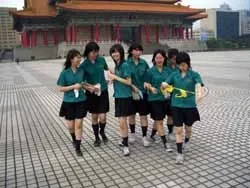
One may have any attitude toward the late generalissimo, but when visiting the memorial complex dedicated to him, one is overcome by painfully familiar feelings. There is the statue of the founding father, there is the honor guard, and there is the artistic legacy of the local personality cult: young Chiang Kai-shek with his teacher, with his mother, with his fellow soldiers. Also on display is the leader's personal limousine - a ZIS, a gift from Stalin, with whom the leader of pre-communist China alternately befriended and quarreled.
Taiwanese like to recall that their second president, Chiang Ching-kuo, the son of Chiang Kai-shek, was Kolya Yelizarov; under that name he lived and studied in Russia and married a Russian woman. And, as a rule, they add: 'We have our own Komsomol.' By 'Komsomol,' locals refer to the structures of the Ministry of Youth Affairs, which devotes considerable attention to the 'military-patriotic education' of young people. As Minister Cheng Li-chun said, military service (and the island has universal conscription) is very honorable, but 'we simply don't need so many soldiers. Now we try to send conscripts to related branches – for example, the police.'
After leaving the friendly youth office, on the nearest street I unexpectedly met a 'fellow countryman,' as the young Taiwanese man called himself. He immediately determined that I was from somewhere in the CIS. It turned out that the young man had studied and then completed graduate school in Alma-Ata. At the Taipei Institute of Industrial Technology Research, there is a whole Center for the Study of Central Asia, which sends students to the vast expanses of the CIS. We started talking. 'So, how do you like Taipei after Alma-Ata?' The answer was disconcerting: 'The girls there are better, more sociable. But here, no one wants to get married!' Really? As it soon turned out, the problem does exist, and not only in my interlocutor's mind heated by 'gender injustice.'
The very fact that today, out of the country's 23 million population, about 400,000 are 'imported' brides says a lot. Taiwanese women, especially urban ones, really are not eager to get married; first and foremost, they want to get an education and start their own business. It is no coincidence that a discussion has arisen about the need to rename one of the capital's streets – Wu Fei (translated from Chinese as 'Five Concubines'). Legend has it that in the second half of the 17th century, five noble concubines of Prince Ning Ching followed him to Taiwan from mainland China. The prince got entangled in the intrigues of the struggle for power, trying to save his once glorious dynasty, which ultimately led to his death. And then all five of his lovers simultaneously committed suicide.
Today's Taiwanese feminists are not at all pleased by such stories, which is why the idea arose to get rid of such historical memory. And, of course, in elections, most Taiwanese businesswomen vote for all kinds of changes, for getting rid of the 'legacy of authoritarianism' in everything – from politics to family.