
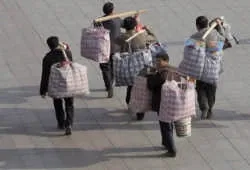
Some migrant workers prefer to wait out the crisis in their homeland
According to the FMS, in 2008 Russia employed 14.2 million foreign workers. The recorded number of entries and exits was even larger – 23.4 million. According to FMS Director Konstantin Romodanovsky, the vast majority of labor migrants come from CIS countries, with which Russia has a visa-free regime.
Zhanna Zayonchkovskaya, head of the Population Migration Laboratory at the Russian Academy of Sciences' Institute of Forecasting, asserts that migration is "not a cause but a consequence of shadow employment." At the same time, according to Zayonchkovskaya, "the Russian economy cannot exist without migrants." The Moscow city authorities agree with this. In the opinion of Oleg Neterebsky, head of the Moscow Department of Labor and Employment, the labor market needs to be improved.
Meanwhile, the State Duma is preparing to equate migrants from the CIS with migrant workers from countries with which Russia has a visa regime. This was recently stated by Ildar Gabdrakhmanov, first deputy chairman of the Duma Committee on Labor and Social Policy. He believes that quotas need to be tightened. "The increase in illegal labor is due to the strengthening of state control over small businesses," Zhanna Zayonchkovskaya objects.
The FMS believes that migrants hinder the employment of Russians. Despite the fact that by March the number of migrant workers had decreased by 13% compared to last autumn's figures, their total number still exceeds 10 million. The situation is different in the Russian capital. According to Oleg Neterebsky, the unemployment rate in Moscow is 0.6%. There are 40,000 Muscovites registered at employment centers, while there are 223,000 vacant positions. "Muscovites do not want to work where they offer tiny salaries and overly high hiring requirements that do not correspond to their specialty," says Oleg Neterebsky.
The migrants themselves are being robbed by law enforcement agencies. Officially, over the past year, 27 million fines were collected from them. At the same time, the main violation is the forgery of migration cards, and the reason for detention is crossing the roadway in an unauthorized place, says Anatoly Kucherena, chairman of the Public Chamber (OP) Commission for Control over Law Enforcement Agencies.
Nikolai Svanidze, chairman of the OP Commission on Interethnic Relations and Freedom of Conscience, lists among other problems "migrantophobia," which is widespread among police officers as well as ordinary citizens, government officials, and journalists. "The criminogenic situation develops regardless of ethnicity if a 'male barracks' is created, that is, a large concentration of men detached from home and women. This is exactly what is happening now with labor migrants in Russia," explains Nikolai Svanidze.
Darya VENISLAVICHEVA.
"Novye Izvestia"