
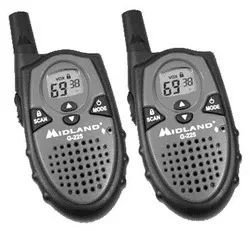
Midland G-225 Walkie-talkie
The main application of walkie-talkies is the ability to transmit information over various, including long, distances – widely used in military, space and professional fields. But the so-called amateur or civilian radio communication has gained particularly wide popularity among the population worldwide. Largely due to the constant experiments of radio amateurs, the possibilities of using walkie-talkies have expanded enormously.
The development and modernization of amateur radio stations is ongoing. Among the new, modern achievements are walkie-talkies like the Yaesu VX-8R, designed specifically for amateur hikes along mountain-forest trails or used by fishermen. The metal case of such a walkie-talkie can withstand the harshest operating conditions.
Or the portable walkie-talkie Midland G-225 with a frequency range of 433-434 MHz, with a communication range of up to 8 km in open terrain and about 5 km in rugged terrain, combining a large number of different functions in a small compact case – the best LPD station in its class.
There is a huge variety of amateur radio stations available on the market today. The airwaves of radio amateurs are never empty. However, on different frequency ranges allowed for amateur walkie-talkies, radio waves have different propagation characteristics, which should be known and taken into account.
Thus, the propagation of waves on shortwave depends on the reflectivity of radio waves from the ionosphere. In this case, low-frequency waves are reflected more strongly, while high-frequency waves are reflected more weakly. Thus, even the reflection of waves of different frequencies at the same time differs from each other. Therefore, in winter at night, waves of low-frequency ranges can propagate quite far, while high-frequency waves can pass through the ionosphere. And in spring during the daytime, the best conditions for the propagation of high-frequency waves. And all these nuances should be taken into account.
In principle, in the shortwave range, radio amateurs can use nine bands: 10, 12, 15, 16, 20, 30, 40, 80 and 160 meter bands with a range from 1.81 to 29.7 MHz. However, the 1.8 MHz band is the hardest to use for long-distance communications. In Russia, it is allowed and used by beginners. However, communication over distances greater than 1500 km with such a waveband is practically impossible. Therefore, many countries set operating limits. For example, communication with Japan is possible at 1908-1912 kHz at night. Frequencies 1840-1845 kHz allow working with fairly distant stations – the so-called DX window.
Radio amateurs working on short waves distinguish three types of operation: telegraph, teletype, and single-sideband phone. Such division has made it possible to reduce the amount of radio interference. And only telegraph can be used on all frequencies, because it practically does not create interference.
The 3.5 MHz band is used only at night. In this band, in central Russia, they hear Ukraine, Eastern and Western Europe. In winter, one can even listen to Canada and Asia, less often – Africa.
The 7 MHz band is received throughout the day. In the summer months, one can listen to stations operating at distances up to 1500 km. And after sunset, even DX signals. This band is especially often used by radio amateurs in Japan and Brazil. In Europe – radio amateurs in Yugoslavia, Romania, Finland. Americans are allowed to work in the 7.1-7.3 MHz band.
Practically all radio amateurs operate in the 14 MHz band. This band works excellently in spring over fairly long distances, allowing signals from distant stations in America and Australia.
Stations operating in the 21 MHz band best pick up and pass short signals during the day. On this wave and in this band, there are especially many amateurs from Japan, and in the evening hours one can also hear African stations.
Another band – 28 MHz – is borderline with medium waves. Its behavior is very variable – from ideal to complete loss of signal. At night, signal transmission is practically reduced to zero. During daylight hours, one can hear Africa, Asia, very rarely Oceania. Signals from Eastern Europe almost never pass. The 28 MHz band is practically free of interference and, when propagation is present, allows picking up stations up to 12,000 kilometers away. However, in the absence of propagation, its capabilities are minimized even with a powerful transmitter.
There are intermediate shortwave bands that are also used by radio amateurs. These are 10.1 MHz, 18.1 MHz, and 24.9 MHz - the so-called WARC bands. Their characteristics correspond to their intermediate position. With the exception of the 10.1 MHz band, on which only telegraph and teletype operate. Signal propagation in this band is possible up to 3,000 km during the day and over longer distances at night.