
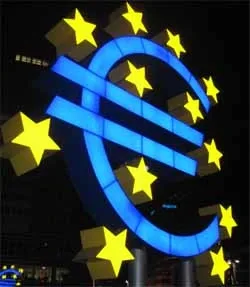
According to the authors, the eurozone is not operating at full capacity, and the currency itself remains fragile. It is necessary to strengthen coordination of fiscal policy across the dozen countries that currently use the single currency in their transactions, the report's authors believe.
"We must act," urges EU Commissioner for Economic and Monetary Affairs Joaquín Almunia. A little earlier, he openly stated the potential possibility of the EU's collapse.
The main threat to the monetary unity of the European Union is not the differences in the economic structure of different EU member states, but the different speed of their development.
Euro Veil
Initially, when the union of European states was just being formed, it was assumed that increased integration would lead to a reduction in differences and convergence of all key macroeconomic indicators. The introduction of a single currency, according to experts, was supposed to lead to the adoption of a single interest rate set by an independent European Central Bank. All this was supposed to be a condition for this general economic integration. But as the recently deceased economist Milton Friedman liked to say, "money is a veil." The introduction of the euro turned out to be such a veil.
Almost eight years have passed, and the expected integration has not happened. The authors of the current review frankly admit that differences in interest rates have much less explanatory power (than expected) for differences in growth and inflation rates across countries. Instead, specific country factors have come to the fore. That is why, despite monetary integration, real integration is not occurring. Moreover, as the report's authors write, differences between countries are only increasing.
The new European countries from Eastern Europe are certainly developing faster. But in this case, the effect of economic catch-up is at play, and such growth is not seriously perceived as an achievement of the EU's common economic policy. Small European states are developing faster. They have benefited the most from European integration. The development of large European countries is proceeding at a slower pace. But it is these slow-developing states (primarily Germany) that form the foundation of the entire European economy and its financial system.
Thus, the rapid development of small parts of Europe can only exacerbate the situation. The situation is beginning to resemble the late USSR, where the development of large republics was slow, which predetermined the voluntary collapse of the Union. Against this backdrop, the prospects for the single European currency are beginning to seem particularly unclear.
Forever Second
The single European currency had not yet been born, but many economists already predicted an unhappy future for it - a permanently secondary currency. Eight years later, the situation has not changed much. The share of settlements in euros is gradually growing. And over time, the share of global currency reserves denominated in euros will increase. But for now, the dollar's position remains unshakable. Moreover, as specialists from the Bank for International Settlements write in their recent research, the recent strengthening of the euro in settlements may be explained more by the weakening of the dollar than by the strengthening of the euro itself. But despite the already long existence of the European currency, experts are still inclined to cite the transition period. Agvan Mikaelyan, Deputy General Director of FinExpertiza, is confident: "Everything indicates that Europe is learning to manage its single currency very effectively, and therefore no serious uncontrolled shocks threaten the euro."
But recent events clearly show that the persistent and growing economic differences are leading to increased political differences. And they provoke serious conflicts among members of the union.