
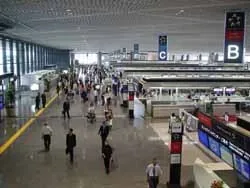
Getting to know a country begins at the airport
Kansai Airport (Osaka)
When building the airport on the artificial island of Kansai in Osaka Bay, the ingenious Japanese outdid themselves. The result was the largest man-made island on the planet, covering 510 hectares, the construction of which cost the Japanese $17 billion. More than 6,000 steel piles were driven into the foundation of the future airport. Five years were spent filling 178 million cubic meters of soil, for which two mountains had to be leveled.
The airport terminal, 1,800 m long and covering 300,000 sq m, is a joint project of Renzo Piano's workshop and the firm Ove Arup. Along its wings, spread out on either side of the central hall, aircraft are parked – it is easy to navigate. It is immediately clear on which side is the 3.5 km runway, and on which is the world's largest four-kilometer two-tier bridge connecting the airport to the opposite shore.
According to a columnist for the magazine "Voyage and Leisure", Kansai is currently the second largest and most important airport in Japan. Its capacity is 25 million passengers per year. Buses of various routes connect the airport to many areas of the Osaka metropolis. The number of passengers carried per year is 17 million.
Heathrow Airport (London)
London's Heathrow Airport is the third busiest in the world for passenger traffic and second for cargo. It is a whole city consisting of four terminals located quite far from each other. Terminal 1 handles domestic and European flights of British airlines. Terminal 2 is for European flights of foreign airlines. Terminal 3 is for long-haul flights and Scandinavian routes. Terminal 4 is fully used by British Airways.
Heathrow serves more than 68 million air passengers annually, and when the fifth terminal opens here in 2008, that number will reach 100 million.
Other, not so pleasant records of the airport include high prices for food and drinks: almost one and a half times higher than even in the far from cheap London. Currently, due to recent terrorist threats, flight delays at Heathrow have become more frequent. The only consolation in such a situation is lunch at Zen Oriental, a new Sichuan cuisine restaurant at the Hilton hotel adjacent to Terminal 4. All four terminals are connected by lifts and escalators to the metro station. The journey from Heathrow to the city center by metro takes about 40 minutes.
Hartsfield-Jackson Airport (Atlanta)
Located 11 km south of downtown Atlanta, Hartsfield-Jackson Airport serves as the main hub and primary transfer point for the largest US airline, Delta Air Lines. Perhaps for this reason, the airport's Central Terminal in terror-fearing America is designated for thorough screening of passengers before they are allowed into the check-in area.
Flanking the central terminal on both sides are the South and North terminals, designed for check-in and passenger reception, mostly for those in transit. The sectors located there – A, B, C, D, E (the international sector, opened for the 1996 Summer Olympics) and T – are connected by an underground mini-metro line. The number of shops, restaurants and McDonald's in each of them easily saves millions of passengers from tedious standing in queues.
The most convenient way to get from the airport to any part of Atlanta is by metro. Trains run from 5 am to 1 am with intervals of 5 to 20 minutes, depending on the time of day.
Hartsfield-Jackson has recently become the busiest airport in the world. In 2006, a record number of passengers passed through its terminals – 85 million people, and the total number of takeoffs and landings from its five runways came close to 1 million.
Changi Airport (Singapore)
In terms of the number of awards, titles and various international diplomas, Singapore's Changi Airport has no equal. Based on a survey of more than 7 million passengers conducted by the British company Skytrax, the airport has been recognized as the best on the planet, and according to a reader vote by Germany's Business Traveller magazine, it received the title "Best Airport in the World" for the 14th time and "Best Airport in the Asia-Pacific Region" for the 15th time. And it must be said, it is well deserved. Everyone who has ever used Singapore's air gateway will agree.
Soft carpets, polite staff, modern design… It could easily be mistaken for a luxury hotel, which has everything you need for rest and relaxation: rest rooms, a swimming pool, showers, sauna, a fitness center and a SPA center where you can treat yourself to pearl baths or order Thai massage. But, in fairness, it should be noted that most passengers prefer Changi's shops, covering an area of 33,000 sq m. The most popular items: perfume, watches, alcohol, all kinds of electronic equipment. Almost 60% of the airport's income comes from trade, more than 70% of passengers buy something in its shops. Singapore Airport is the largest transit hub in Southeast Asia. The number of passengers carried per year is 35 million.
Bus No. 36, running every 10 minutes, connects Changi with the center of Singapore. Travel time is 20 minutes.
Frankfurt am Main International Airport
Frankfurt Airport is the largest transit hub in Europe (53 million passengers per year). Most airlines flying to Germany use it. There are two terminals connected by the Sky Line elevated railway. Terminal 1 has arrival and departure sectors A, B, and C. Terminal 2 has sectors E and D. Each sector has its own cafes and shops, and on the second level of sector E there is a real supermarket. The airport is huge but organized with typical German pedanticism, and once you understand its logic, it's quite easy to navigate.
A separate topic is the airport restaurants. Chinese gastronomic literacy can be explored at China Restaurant. The bastion of respectability is the "Europa" club between sectors B and C, where besides a TV, phone, fax, and personal computer, you can find fresh newspapers in 12 languages. The atmosphere is much more democratic at the 24-hour restaurant "Watzhaus" in sector C. In addition to German cuisine and excellent beer, there is a bowling alley with four lanes. Thrill-seekers can take the captain's seat in a Boeing 737 flight simulator installed in Terminal 1. The briefing and the "flight" itself will not take much time, but guarantee a wealth of impressions and a souvenir photo.
From Frankfurt Airport you can easily go to almost any city in Germany. Regional trains and commuter trains depart from the station located under Terminal 1 in sector B. To the center of Frankfurt - no more than 25 minutes. Trains running between Stuttgart and Hamburg pass through the airport, there are trains going via Cologne and Dortmund to Berlin and even to Swiss Basel.