
Much is known about Patrick, and practically nothing. The future saint was born in Bannavem Taberniae, in Roman Britain. However, to this day the location of this town has not been precisely established, and several British provinces claim the right to be called Patrick's birthplace. It is known that at the age of sixteen the young man was abducted and for six years herded Irish sheep as a slave. Incidentally, it was in the shackles of slavery that he became truly believing, and upon becoming free, he took monastic tonsure. Patrick went to Gaul, but a voice in a dream begged him to carry the Word of God to Ireland. His return to his homeland took place in 432. Interestingly, a year earlier the Pope had sent another saint to the Emerald Isle - Bishop Palladius. But the Irish chronicles of the 7th century are silent about him, while Patrick is the one called the baptizer of Ireland. There you can also find another inconsistency: the chronicles say that Patrick died in 461, and elsewhere his death is dated to 491. Maybe there were two Patricks? Or could Bishop Palladius have adopted that name?
The mystery of Ireland is not even in the presence of two Patricks, but in the fact that the new religion spread here rapidly and, more importantly, bloodlessly. The druids, who had held sway over the minds and souls of the Irish for centuries, disappeared as if by the wave of a magic wand, leaving behind only a host of beautiful legends. Saint Patrick, however, also became part of the myth. For if his biography is to be believed, he drove all the snakes from the island. This fact could be considered a mythologeme, were it not for a certain coincidence: Cernunnos, the Celtic deity, was depicted with a snake in his hands. Patrick explained the symbol of the Holy Trinity to the Irish using the example of a clover leaf (a popular emblem of Ireland). Perhaps the belief in the lucky four-leaf flower is also a return to Celtic traditions? And the Irish cross - with the 'circle of the Sun' sacred to the Celts - is it not a reminder of the vitality of paganism? By the way, in Ireland the 'special cross' was accompanied by a 'special' church charter that allowed monks to live in monasteries with their families and abbots to pass monasteries on by inheritance.
But let us return to Patrick. Once on the island for the second time, he settled in what is now County Down, and not by chance - the sacred center of the druids was nearby. In short, pagan cults became Christian. Possibly not without Patrick's help. Who knows, perhaps we owe it to him that the Celtic festival of Samhain turned into All Saints' Day, also known as Halloween? Although Ireland is no exception: our country was also not alien to paganism. Otherwise, how could one explain, say, the preserved riotous Maslenitsa week or the mysterious night of Ivan Kupala?
And did Saint Patrick even exist at all? Some scholars claim that his hagiography is a generalized narrative about the first Christian missionaries on the island. The 'Confession' left by Patrick, which, by the way, contains not a single line about his life or the people around him, is an almost exact copy of the 'Book of Armagh' (both are kept in Trinity College in Dublin).
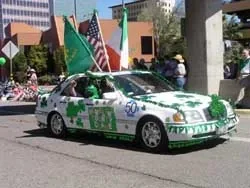
However, what does it matter now? What matters is that there is a holiday where the main colors are green and orange, where it is customary to walk around with painted faces, having drawn that same clover on one's cheek, to a cheerful Celtic tune, and to finish the celebration in some pub-bar with a mug of good beer. And it is good that we know whom to thank for this feeling of sparkling life. Saint Patrick from the Emerald Isle.