
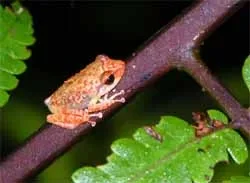
The main enemy of the Hawaiian Islands is not volcanoes or hordes of tourists, but ordinary frogs with the strange name coqui. To combat these amphibians, the state authorities recently decided to allocate a substantial amount from their budget. In the near future alone, Hawaii is ready to spend almost $5 million. Now coqui frogs have simply flooded the main islands of the archipelago and have become almost the main species of local fauna.
These frogs are not native inhabitants of the Hawaiian Islands. They appeared here only at the end of the last century. Most likely, they were accidentally brought by ship along with some agricultural cargo. In their natural environment, coqui are found in Caribbean countries, for example, there are plenty of them in Florida and Puerto Rico. But once in Hawaii, the foreign frogs discovered that after escaping their historical homeland, they found themselves in an earthly paradise: warm all year round, humid enough, large open spaces, and most importantly, no predators. After that, an explosive growth in the coqui population began on the Big Island and Maui.
The main evil caused by 'illegal immigrants' is sound. Coqui are extremely loud-voiced frogs, and the chorus of several hundred of these amphibians can almost drown out the noise of a taking-off jet plane. Naturally, Hawaiians do not really like living in such cacophony, and they demand that local authorities somehow reduce the number of coqui in the surroundings.
In addition, the frog population is seriously worrying ecologists, who believe that the established visitors of the archipelago could displace the birds living here. The fact is that coqui feed on insects and in this they actively compete with birds. In March of this year, one of the reserves on the Big Island even had to be closed to visitors for several days: the frogs that got in populated its territory so densely that they threatened the survival of protected bird species. While the authorities carried out chemical treatment of the part of the reserve that had suffered especially badly from the coqui invasion, people were asked to stay away from these places.
But the Hawaiians, it seems, have no meaningful way to combat the visiting amphibians. So, most of the five-million fund allocated to solve the frog issue will go to maintain additional inspectors tasked with monitoring the reproduction of coqui. They plan to spend only $2 million on destroying the immigrants. The main weapon of the authorities should be citric acid and lime: these chemicals, as biologists hope, will help destroy about 80% of the coqui population. However, one should not hope that this will radically solve the problem: the surviving 20% are quite capable of multiplying back to the previous level in the shortest possible time. Then, apparently, the authorities will have to carry out another chemical attack on the fertile amphibians, which have easily won the struggle for a place in the sun against all local fauna taken together.
The king of nature – its enemy
However, despite all the harmfulness of American frogs, the greatest harm to endemic species is, of course, caused by man himself. Wherever people settle, they reshape local nature for their own convenience and benefit. Hunters and farmers always, first of all, destroyed dangerous predators. The expansion of arable land reduces the areas where wild animals can settle. Biologists, for example, have for many years lamented that the plowing of plains in Central and Eastern Europe and southern Siberia has led to a sharp decline in the number of steppe animals and plants. In Africa and South America, equatorial forests are regularly cut down, which causes local fauna to suffer. Such examples can be given by the dozen.
In addition, it is man who is the main reason why wild or domestic animals move from continent to continent. Most often, such migrations harm the isolated ecosystems of islands, which have difficulty adapting to the appearance of new species – predators or competitors. One of the most famous cases of extermination of endemic species by humans and other illegal immigrants is the fate of the dodos – flightless birds that lived on the island of Mauritius in the Indian Ocean. Through the combined efforts of people and the cats and dogs they brought, dodos were completely exterminated in less than a hundred years. Sometimes the help of our smaller brothers was not needed: for example, Australian farmers, fearing for the fate of their sheep, exterminated the Tasmanian marsupial wolf completely on their own.
Such a sad fate befell many species of birds and animals that could not withstand competition with humans and the animals they domesticated. Moreover, we do not know about all biological tragedies. Sometimes settlers did not bother to describe the local fauna, and when scientists arrived on the islands, only the most resilient and competitive of the local species remained alive. No one can now say with certainty how many endemic species were destroyed by cats, dogs, pigs, goats, rats and other immigrants on the islands of Oceania and the Indian Ocean.
However, sometimes, coming to their senses in time, people manage to save some endangered animals. For example, the kakapo (owl parrot) barely managed to survive after meeting humans. This almost flightless bird lived in the forests of New Zealand. First, its population was reduced by the indigenous Maori people, who cleared forests, then Europeans arrived on the archipelago, who not only continued deforestation but also brought rats, cats, and stoats here. As a result, the flightless kakapo, unable to protect its nests from invasive predators, has by now almost become extinct. Currently, attempts are being made to revive its population on several small islands where the owl parrot has no natural enemies.
Immigrants against natives
Another sad story of illegal immigration happened on the Pacific island of Guam, which belongs to the United States. Sometime in the middle of the last century, the brown tree snake, a tree snake that lives in Indonesia, New Guinea and Australia, was accidentally brought there. This alien reptile not only easily settled on the island, but also began to displace the local fauna, which cannot fight poisonous snakes. Over the past half century, the uninvited guest, feeding on small creatures, has already destroyed two species of geckos and skinks and sharply reduced the population of island birds. It got to the point that local residents began to complain about the brown snakes that had flooded Guam, suffering from its bites (fortunately, the venom of these snakes is not too strong and does not pose a danger to human life). Effective methods of destroying the aliens have not yet been found.
The struggle between immigrants and natives happens not only on exotic islands, but also in the Old World familiar to us. In the UK, for years they have been unable to find a solution to the problem of American gray squirrels, brought here at the turn of the 19th and 20th centuries. Local red squirrels have completely lost to their larger gray relatives in competition. Now immigrants have almost displaced the natives in England and Wales; reds retain their positions only in Scotland, but even there the "Americans" are gradually expanding their habitat. The question of how to deal with overseas guests was even considered at meetings of the British Parliament. It was proposed, for example, to catch and sterilize the alien squirrels, or simply poison them.
It is worth noting that exterminating adapted immigrants and reviving the population of native species is an extremely difficult task. Successful examples of this kind are practically unknown. The most radical measures were tried in Australia in the middle of the last century, when the authorities attempted to fight wild rabbits. These animals, brought to the Green Continent in the 19th century, took root perfectly and are now the most numerous species of mammals in Australia. To prevent rabbits from interfering with the local fauna and farm sheep, biological weapons were used against them: they began to infect them with myxomatosis. For a while this helped: within a few years most of the immigrant population died out, but the surviving animals acquired immunity to the disease and multiplied again.
A similar war has been waged for many years on all continents against the gray rat, which came to Europe from Asia only a few hundred years ago, in the 15th-16th centuries. This pest, ideally adapted to live next to humans, is practically indestructible. Rat extermination is a top priority for many city services around the world. Despite the fact that special services have been set up in large cities to fight these rats, it has not been possible to destroy gray rats with traps, poisons, or cats. To date, rats have spread almost everywhere and live wherever there are cities or villages. Unfortunately, man, having learned to change the nature around him, has not yet managed to master technologies for returning ecosystems to their original state.