
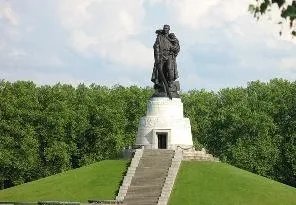
Soldier-Liberator in Berlin's Treptow Park
This is necessary so as not to feel alone in the vast world. We can fight each other... but inevitably a moment comes when the guns fall silent, and sobering and awareness set in.
Cultural monuments that reflect real, and moreover positive, events of common history are a wonderful way to find support and confidence. One of these amazing "sculpture-events" is the Soviet soldier-liberator in Berlin's Treptow Park. It is known that there was a real prototype for the monument – Sergeant Nikolai Masalov, who saved a German girl on April 30, 1945 during the storming of Berlin. The great sculptor Yevgeny Vuchetich, who talentedly reflected this event, made the first sketches for the monument just a few days later. The war with Nazi Germany was not yet over...
The work on creating the sculpture lasted about a year. By that time, hostilities had ended and peaceful life began. The Group of Soviet Forces in Germany was formed. The model for the monument was a fellow warrior-liberator – paratrooper Ivan Odarchenko, who fought in Belarus, Poland, Austria and Czechoslovakia. And the role of the German toddler was played by the daughter of Russian General Kotikov, commandant of Berlin – three-year-old Sveta. The statue weighing 72 tons and 13 meters high was cast in Leningrad, transported in parts to Germany and installed at the burial site of over 5,000 Soviet soldiers who fell during the storming of Berlin. On May 8, 1950, the park was officially opened.
Treptow Park, laid out in 1876-1888, is in itself a historical heritage of the German people: a place of recreation, folk festivals, exhibitions and gatherings. Since the creation of the GSFG, almost every Soviet soldier who served in the garrisons of the GDR has visited the park and the foot of the warrior-liberator monument at least once.
After the fall of the Berlin Wall and the reunification of East and West Germany, there were proposals to demolish the monument or move it to a new location, even to return it to the USSR. However, common sense and the desire for good relations prevailed. Our countries fought, a huge number of wonderful people died. But the blame for the victims lies not with the soldiers, but with their leaders. Moreover, the symbolism of the monument in Treptow is directed not against Germany, but against the Nazi military dictatorship.
There is a beautiful military tradition: after any battle, to pay tribute to the fallen and a tribute of mutual respect to worthy opponents. This and much more is embodied in the unique sculpture in Treptow Park – not a "warrior-conqueror", but a liberator, defender and peacemaker.