
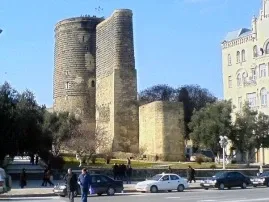
The Maiden Tower is a symbol of Baku city
Azerbaijan is called the Land of Black and Blue Gold. It is an oriental fairy tale come true, where more than 6,000 monuments and architectural masterpieces of antiquity are concentrated – impressive fortresses and khan palaces, mysterious towers and fire temples, caravanserais, mosques decorated with openwork Arabic script, unique mausoleums. Many of them are associated with beautiful legends.
Thus, the famous Baku Maiden Tower of the 12th century, which offers a view of the beautiful Seaside Boulevard, according to legend, became the last refuge for the proud shah's daughter. She had a beloved, but her stern father-ruler fell in love with his own daughter and desired to marry her. The girl tried to dissuade her father from such a step and, hoping that he would change his mind, asked to build a tower and wait. But the shah was adamant, and then the unfortunate beauty climbed the tower and threw herself into the sea. The stone against which she crashed was called the "Maiden's Stone," and all brides before the wedding began to bring flowers to it. There is another version of the legend – a happy one. The girl was saved by mermaids, and her beloved, learning of the father's treachery, killed him, and the young people got married.
Old Baku: Eastern Caravanserais and European Baroque
…Old City of Baku, medieval Icheri Sheher – a tiny fairy-tale island in the center of a noisy metropolis. That people settled in these places from very ancient times is evidenced by fortresses and cities on the bottom of the Caspian Sea (at the end of the 13th century, the sea level rose by more than 10 meters), found ancient manuscripts and recipes of healers. Arab and Persian historians of the 9th, 10th, and 11th centuries described Baku as a city of oil and gas fountains, hot mineral springs, and mud volcanoes. It attracted merchants from India, Arabia, Byzantium, China; here they bought and sold rare silk, valuable carpets, and exotic goods.
Those times are long gone, but in memory of them, two caravanserais have remained – Bukhara and Multan (Indian), Eastern baths, mosques, and the Palace of the Shirvanshahs (medieval rulers of Baku). Eastern flavor is added by stray cats, bagel sellers, and local traders who beckon to buy a national headdress "papakhi" made of white sheepskin, copper utensils, or a hand-woven carpet. It is not worth buying carpets from them, as you are unlikely to be able to take them out of the country. Carpet weaving is a cult craft in Azerbaijan; carpets are declared a national treasure, and therefore each exported copy is considered as having cultural or historical value.
A foreigner can leave here with a carpet only with the appropriate certificate and permission from the Ministry of Culture of the republic. Obtaining it is a troublesome and virtually impossible matter. Therefore, if you absolutely do not want to leave without a carpet, buy it at a special carpet factory that sells its products with export permits. There you can choose a woolen or silk hand-woven carpet of any size, color, and pattern.
Beyond the fortress walls of the 12th century lies the "City of Boom," which emerged during the rapid development of the oil industry in the early 1900s. At that time, Azerbaijan provided half of the world's oil demand, and wealthy oil magnates invited the best architects from Europe, who erected many architectural masterpieces in the styles of Art Nouveau, Renaissance, and Baroque here. With the oil boom, cultural life also flourished: theaters were opened, singers and musicians from Europe were invited.
It is said that the opera house was built by a rich man on a bet. A prima donna came to Baku from Italy and was very surprised that there was no theater in the city. She performed, but said that she would hardly come again – there was no theater, nowhere to sing. In response, a worthy man said that in a year Baku would have its own opera house. He kept his word, the theater was built…
In the vicinity of the capital, there is also much of interest: the 22-meter fortress-castle Dörd Gjuz Galа (four-cornered tower) built in the 13th century, the impregnable watchtowers-gasyrs of the 12th century, the Ramana castle in the village of Ramana of the 14th century. A separate story deserves the fire-worshippers' temple Ateshgah, in the village of Surakhany, 30 km from Baku. Oil lay shallow here, and the gas coming to the surface often caught fire. The ancestors of modern Azerbaijanis were Zoroastrians who worshiped fire and considered these places sacred. Following merchants from India and Persia, pilgrims flocked here, building a monastery and a temple. Recently, concerts of classical music have been held in the Ateshgah temple.
Along the Silk Road – to Visit the Shamakhi Queen
In his "Tale of the Golden Cockerel," Pushkin wrote about the mysterious Shamakhi Queen. She was, apparently, from Azerbaijan, from the city of Shamakhi, the capital of Gulistan, where in the 9th–16th centuries the possessions of the Shirvanshah rulers were located. Gulistan means "flower garden" in translation – this is how the Shirvan region is called, one of the brightest and most beautiful regions of the country, a land of gardens and vineyards. The area attracts tourists with picturesque mountain peaks, valleys, and numerous ruins of ancient temples, cave labyrinths, unique tent-shaped mausoleums.
In Shamakhi, Alexander Dumas stayed during his journey through the South Caucasus. And from here he brought many Eastern recipes for his "Cookbook." Shamakhi cuisine is indeed rich: 46 types of pilaf, 14 types of dolma, 16 varieties of shashlik, and many other delicacies. All this should be washed down with red or white wine made in the neighboring region – Ismayilli, known from the work of another Russian poet, Mikhail Lermontov, who mentions it in his lyrical poem "Ashik-Kerib."
Ismayilli is the largest winemaking region, located at an altitude of 1,400 meters above sea level. The mild local climate allows the cultivation of varieties that produce good fruity-aromatic dry and dessert wines. High in the mountains are the village of Ivanovka, where descendants of Russian Molokan settlers live, preserving our national traditions and pure Russian language, and the reserve settlement of Lahij, famous for its skilled artisans. Hundreds of tourists come here for holidays and craft festivals to buy unique products that were valued by merchants of the Great Silk Road and are known far beyond the Caucasus.
The main shopping street of the settlement is lined with shops and workshops of coppersmiths, leatherworkers, embossers, potters, tailors, inlayers, wood and stone carvers, and gunsmiths. In this mountainous region, you can buy a cute souvenir and a real work of art at a very reasonable price. And for silk, you need to go to the ancient city of Sheki – the heart of the Sheki-Zagatala region, 300 kilometers northwest of Baku.
The region, spread on the southern slopes of the Greater Caucasus Range, enchants with its mountain peaks densely overgrown with oaks, chestnuts, hazelnuts, and elms. Sheki is located on the pass of the Great Silk Road, where trade caravans came for many centuries. From here, merchants and travelers carried amazingly beautiful silk fabrics and gold-embroidered scarves. Sheki silk is light, transparent as a veil, durable, and was valued no less than Chinese silk.
In Sheki itself and its surroundings, there are many unique architectural monuments: one of the oldest Albanian churches in the world in the high-mountain village of Kish, founded in the 1st century AD by Saint Eliseus; the ruins of the impregnable fortress Gelersen, the setting of Leo Tolstoy's story "Hadji Murat"; but the main one is the 18th-century Palace of the Sheki Khans. It amazes with its elegant wall and ceiling paintings (frescoes with plant ornamentation are perfectly preserved) and windows made of decorative colored glass "shebeke".
Be sure to visit the confectioners' quarter. Only here can you taste and buy famous Sheki sweets – honey baklava, delicate halva, and melt-in-the-mouth flour straws. Oriental sweets are baked according to traditional recipes passed down from generation to generation; walnuts, hazelnuts, almonds, and mountain herb honey give them a unique taste. The stern confectioners (here it is exclusively a male profession) let you taste fresh sweets from the blade of a large knife. If they offer you a juicy piece of halva or baklava to try, you cannot refuse – you must eat it all, otherwise you will greatly offend the host.
Note for gourmets
Azerbaijan is a paradise for gourmets and all lovers of Caucasian and Oriental cuisine. Shashlik, lyulya-kebab, kutabs, sweets and pickles – a hungry tourist can eat all this in any corner of the country. But in each region you will also be treated to something unique and distinctive.
In Sheki, it will be "dushbara" soup with tiny lamb dumplings and scrambled eggs with honey; in Zagatala – chicken plov; in Ganja – sherbet and creamy kaymak. Azerbaijan has many delicious dishes that have never become an export option, and you can only taste them at home. Potatoes and apples stuffed with lamb, sturgeon with tomatoes and olives under "Absheron" sauce, potato dolma with meat, lamb khash – traditional Azerbaijani dishes that you are unlikely to try anywhere else.
But keep in mind that, despite all its charms and spices, local cuisine is quite heavy for our people, whose stomachs are not accustomed to such a huge amount of lamb. When accepting another invitation to lunch or dinner, measure the size of the treat against your strength.
Vegetarians will also find something to enjoy. In this fruit paradise, fruits and berries of the East and South ripen: scarlet pomegranates and currants, amber persimmons, cream cherries and peaches, pearly plums, turquoise figs, tender lemons, feijoa and walnuts, sun-kissed olives, sweet oranges, honey melons and sugar watermelons, juicy apples and grapes of all varieties.
Facts and figures
Azerbaijan has 65 monuments of world significance, (the Old City of Baku is included in the UNESCO World Heritage List), 15 natural and historical reserves, 20 wildlife sanctuaries and hunting grounds;
Of the total area of the country (86.6 thousand sq km), more than half – 47 thousand sq km – are oil and gas fields. Experts say that Azerbaijan's underground oil reserves amount to almost 3 billion tons;
Baku has always been famous for its talents. Among the world-famous Baku residents are Soviet physicist and Nobel laureate Lev Landau and brilliant cellist Mstislav Rostropovich, intelligence officer Richard Sorge, singer Muslim Magomayev, chess player Garry Kasparov. Yuliy Gusman, Larisa Dolina, Rustam Ibragimbekov – they too are all from the Caspian shores;
The capital of Azerbaijan has many unusual, unique museums, including:
– Museum of Carpet and Applied Arts with the largest collection of carpets in the world;
– State Museum of Musical Culture, which houses more than 35 thousand exhibits, including the oldest instrument in the world – the stone-tambourine "gavaldash";
– Museum of Miniature Books – the only one in the world, with a collection of more than five thousand tiny books in all languages, some of which can only be read under a microscope;
– Baku Museum of Oil, popular among specialists of international oil companies.
Natalya TIMASHOVA.
Novye Izvestiya